CHANNEL ARCHIVE // [870] ARTICLES // PAGE 49 OF 58
Astrophysics
Research into stars, galaxies, cosmology, planets, and the physics of the universe.
CHANNEL // 04 [870]
Astrophysics
Research into stars, galaxies, cosmology, planets, and the physics of the universe.

WISPIT 2’s gas shows clues near known planets
Source published
- WISPIT 2
- protoplanetary disks
- ALMA

Why the strongest black-hole jets may be hard to make
Source published
- active galactic nuclei
- black hole spin
- relativistic jets
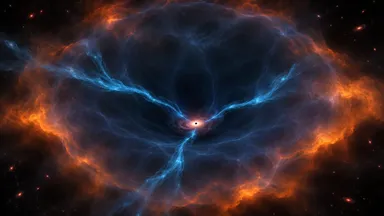
Why early black holes may need a fast cosmic gas supply
Source published
- early supermassive black holes
- Little Red Dots
- cold-mode accretion

H-alpha light puts galaxy feedback simulations to the test
Source published
- galaxy formation
- baryonic feedback
- H-alpha

Could Little Red Dots Help Explain IceCube’s Neutrinos?
Source published
- Little Red Dots
- high-energy neutrinos
- IceCube
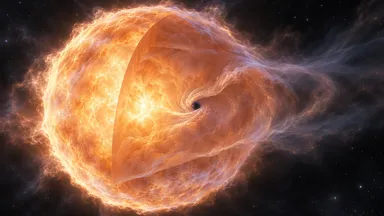
When a black hole becomes the heart of a star
Source published
- black hole stars
- stellar-mass black holes
- stellar collisions

How a black hole inside a star could make an eccentric pair
Source published
- black hole binaries
- orbital eccentricity
- gravitational waves

A lingering ultraviolet glow at the Milky Way’s poles
Source published
- cosmic ultraviolet background
- GALEX
- interstellar dust

A Search for Supernovae That Fade to a Rhythm
Source published
- stripped-envelope supernovae
- periodic variability
- binary stars

Quasar jets leave a mark on ultraviolet emission lines
Source published
- blazars
- quasars
- ultraviolet astronomy
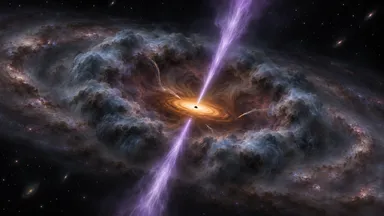
How a Black Hole’s Jets Could Disrupt Its Own Fuel Supply
Source published
- supermassive black holes
- active galactic nuclei
- radio galaxies

How Convecting Magma Could Help Sub-Neptunes Absorb Hydrogen
Source published
- sub-Neptunes
- magma oceans
- hydrogen ingassing

A smarter way to track oscillating scalar dark matter
Source published
- scalar-field dark matter
- cosmology
- CLASS
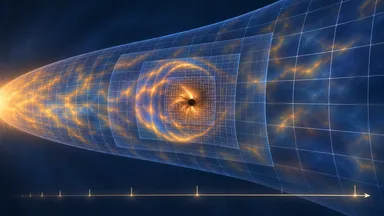
A faster way to follow primordial black holes from birth
Source published
- primordial black holes
- numerical relativity
- early Universe

New method sorts newborn neutron stars’ vibrations by their physics
Source published
- proto-neutron stars
- gravitational waves
- asteroseismology