TRANSMISSION // 2611.34942v1
Can a Wireless AI Adapt Without Retraining from Scratch?
Source published
A study tests whether a learned wireless transmitter and receiver can adapt to fading channels by updating only selected network layers.
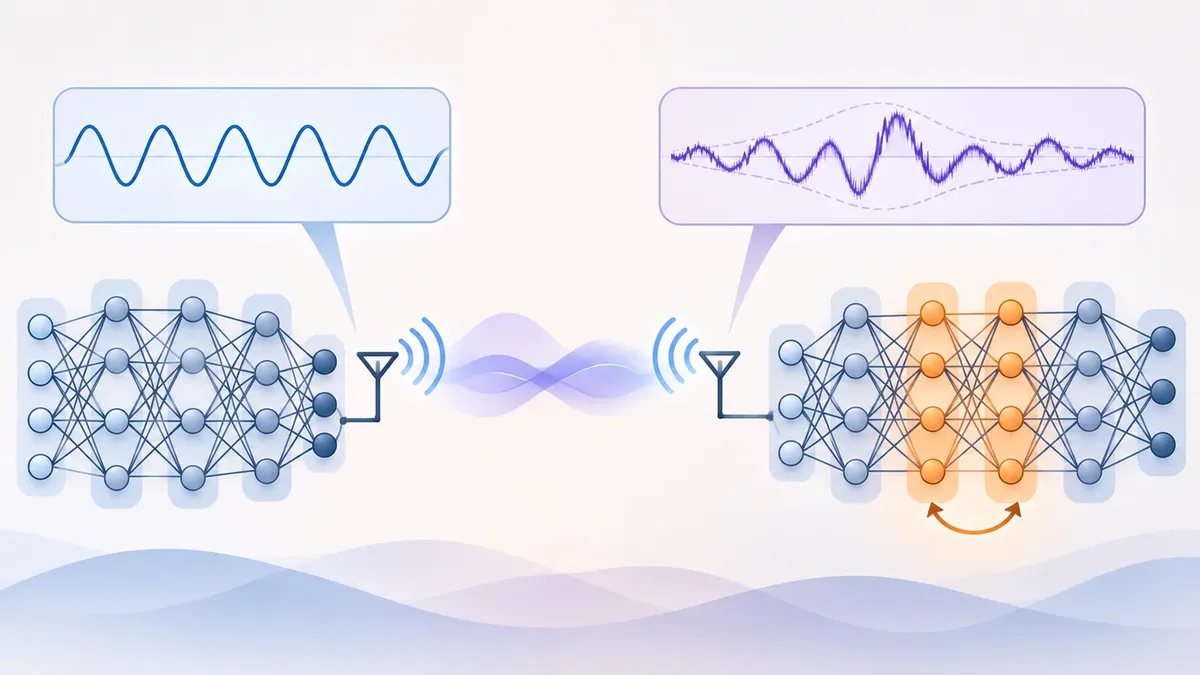
A neural communication system can work well in the conditions it learned—but what if the wireless channel changes? Researchers tested a way to adapt an autoencoder-based transmitter and receiver to simulated fading and hardware distortions while leaving much of the model untouched.
When a learned radio meets a different channel
In conventional wireless systems, modulation, coding and detection are designed as separate steps. An AI-native approach can instead train a neural transmitter and receiver together as an autoencoder: the transmitter turns bits into a signal, and the receiver tries to recover them after transmission.
The challenge is that the pair learns in a particular channel environment. A model trained on additive white Gaussian noise (AWGN)—a standard model of random signal noise—may struggle when signals also undergo fading, which changes their strength and phase. This study asks whether such a model can be adapted more cheaply than training a new system from scratch.
What the researchers tested
Yalin E. Sagduyu and Tugba Erpek first trained neural transmitter–receiver pairs on AWGN, on Rayleigh fading with simulated front-end impairments, or on a mixture of those conditions. They then compared bit error rate (BER)—the fraction of transmitted bits recovered incorrectly—across training and test environments.
Their system used short blocks, mapping eight information bits to 16 complex channel uses. The main adaptation experiments examined a simulated 4-by-4 multiple-input, multiple-output (MIMO) Rayleigh channel. The impairment model included effects such as carrier-frequency offset, phase noise, I/Q imbalance and finite-resolution quantization. The receiver did not use explicit channel-state information or a separate channel-estimation step; it learned to decode from the received signal.
For transfer learning, the researchers initialized the system with its AWGN-trained weights, then fine-tuned selected parts using data from the fading-and-impairment setting. In one strategy, they updated only the first blocks of the transmitter and receiver and froze the rest. In another, they used a short probe phase to score parameter groups by their gradients, then selected groups within a parameter budget.
What changed with adaptation
The mismatch tests showed a clear weakness: AWGN-only training transferred poorly to the simulated fading channel with impairments, where BER remained high. Training on Rayleigh fading transferred more successfully to AWGN, while mixed training performed across both tested channel types. In the authors’ experiments, adding antennas helped more when training and test conditions matched than when they did not.
Fine-tuning the AWGN model for the fading target reduced BER compared with leaving it unchanged. Updating more blocks generally brought performance closer to full adaptation, but the authors report that moderate partial updates could approach the fully adapted model while requiring fewer training steps and fewer updated parameters. The budget-based selection method also reported lower BER than updating a simple prefix of layers at comparable parameter budgets.
The proposed interpretation is that some learned structure can be retained while other parts adjust to the new channel. In the authors’ account, selected layers near the transmitter input and receiver signal input can adapt to fading and distortions, while frozen layers preserve much of the learned signaling and bit-decision structure. This is a result for the tested model and setup, not a general rule for every learned radio.
What remains uncertain
These are simulation results, not a demonstration on a live wireless link or deployed hardware. The central adaptation test uses a specific block-Rayleigh model, a 4-by-4 configuration and a specified impairment chain. Real channels and device imperfections can differ, and the study does not establish how well the method would handle other fading patterns, changing conditions during use, or different model designs.
The paper reports reductions in training time, multiply-accumulate operations and GPU-measured energy, but those costs depend on the experimental setup; they do not by themselves establish end-to-end latency or energy savings in a radio device. Nor does a lower simulated BER guarantee reliable performance in practical deployment.
The source is an arXiv preprint, so its claims should be treated as preliminary unless and until independently reviewed and reproduced. The available paper text describes the authors’ experiments and conclusions; it is not independent validation. The results suggest a possible way to make learned communication systems cheaper to adapt, while leaving open how robust the approach will be beyond the simulated conditions.
- wireless communications
- transfer learning
- autoencoders
- MIMO
- Rayleigh fading
- bit error rate
Reviewed cross-references
These connections were reviewed by a model, not independently fact-checked by a human. Similarity does not imply agreement; consult the original papers and the evidence below.
Can Wi-Fi predict when its channel needs measuring again?
Shared method: Both papers use transfer learning to adapt a pretrained wireless model: the origin paper partially fine-tunes transmitter and receiver layers for impaired Rayleigh MIMO, while Zhang et al. fine-tune a CSI predictor on cosine-trajectory data. The tasks, models, and evaluation settings differ, so their results do not establish comparative adaptation performance.
Model review: · openai-codex/gpt-6-luna
Evidence and provenance
Selected excerpts, not complete papers. PDF extraction can omit figures or damage equations, tables and reading order; sources may be preprints.
2611.34942v1 — Original paper
Excerpt reference:
static/papers/2611.34942v1.md:71-155
Basis: Paper text
Source SHA-256:83072c17a5e0abfaaf1ad4069b957bc19500217f53aa7a89ee3b9c5261e02f8d2611.05970v1 — Original paper
Excerpt reference:
static/papers/2611.05970v1.md:2548-2672
Basis: Paper text
Source SHA-256:ca6171a74d95a779bba60312a63d0cfe034b7414b57fcd260b8f0758c44cce2b
Related reading
Automatically matched by shared topic keywords. These links do not imply that the sources agree or establish a consensus.
Training Wireless AI to Handle Signals It Has Never Seen
Source published
Shared keywords: wireless communications
GBPNet learns to improve error correction while keeping a classic decoder’s structure
Source published
Shared keywords: bit error rate
Can a smaller EfficientNet learn from a larger one?
Source published
Shared keywords: transfer learning
Larger EfficientNet models did not consistently improve retinal scan classification
Source published
Shared keywords: transfer learning
Reconstructing turbine wakes from two observation planes
Source published
Shared keywords: transfer learning