TRANSMISSION // 2611.34928v1
DART helps AI revisit failed math solutions
Source published
Instead of starting over after a wrong answer, DART changes selected steps in an AI’s failed solution. The authors report broader problem coverage, with important limits to the evidence.
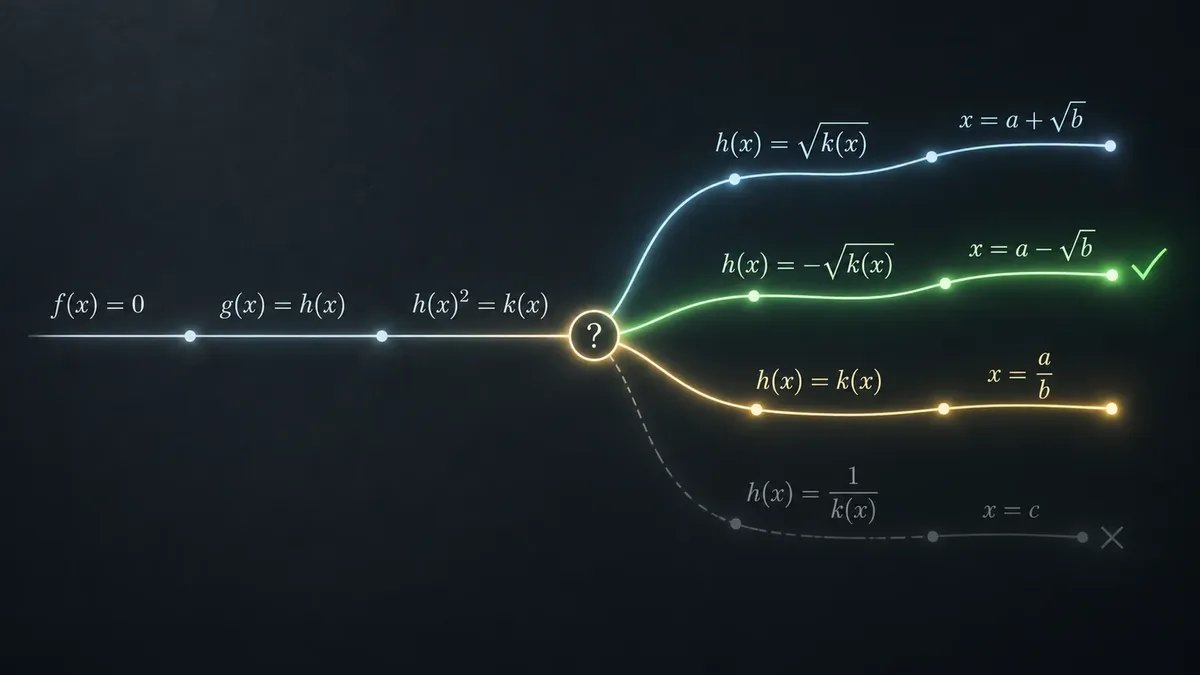
When a language model cannot solve a difficult math problem, repeated attempts may keep missing it. A new method called DART tries a different tactic: take a failed solution, identify uncertain steps, and explore alternatives. In tests, this recovered more problems than ordinary sampling at a matched number of completed traces—but the results concern one main model and do not establish that every reasoning step is sound.
A language model can produce many plausible-looking solutions to a hard math problem without producing one whose final answer is correct. A common way to collect training examples is to generate solutions repeatedly and keep only those that pass an answer checker. But if a model rarely finds the right answer for a particular problem, this approach may yield no training example for it at all.
A paper by Lukas Aichberger and colleagues proposes a way to make those failed attempts more useful. Their method, Diverse Alternative Reasoning Traces (DART), does not simply start over. It examines a rejected solution, chooses a reasoning step to revisit, proposes an alternative, and generates a new continuation. The goal is to uncover correct solutions for problems that ordinary sampling misses—and to collect more accepted examples for training.
How DART changes a failed attempt
The researchers first generate a solution using greedy decoding, a method that selects the model’s most likely next token at each step. A verifier checks the final answer against the reference answer. If the solution is rejected, the model divides it into reasoning steps and scores those steps for uncertainty, with extra weight given to earlier steps. Earlier choices can shape more of what follows, so changing one may redirect the rest of the solution.
DART then prompts the model to suggest a deliberately different candidate for a selected step. In its main version, the prompt includes the reference answer as guidance and asks the model to form a brief “meta-thought” about an alternative strategy. The model uses the proposed step to generate a new continuation; the original solution’s later steps are discarded. The completed trace is kept only if its final answer passes the verifier.
This is a data-mining method, not evidence that the model has identified the precise error in its original work. The authors note that the verifier checks the final answer, not every intermediate step. A trace with the right answer could still contain faulty reasoning.
More problems recovered in the tests
In a component study on MATH-500, DART recovered more problems than a step-level sampling baseline when both methods generated the same number of completed traces. The authors also report that versions without reference-answer guidance still beat that matched baseline, although guidance helped further.
The larger coverage and cost analysis used Llama-3.1-8B-Instruct on 6,200 greedy-unsolved problems from DeepMath-103K. With roughly eight completed traces per problem, DART recovered 2,971 problems, or 48%, compared with 2,168, or 35%, for full-trace Monte Carlo sampling. The paper describes this as 37% more recovered problems. Its estimated generation cost per recovered problem was nearly unchanged, while estimated cost per accepted trace was 30% lower. These are estimates of generation FLOPs, not measurements of elapsed time, energy use, or end-to-end cost; the accounting excludes some work, including step decomposition.
The researchers also fine-tuned Llama-3.1-8B-Instruct on traces collected by different methods. DART had a higher reported point estimate than ordinary Monte Carlo sampling in all six combinations of training dataset and evaluation set, and the highest point estimate in five. These evaluations used MATH-500 and AIME math benchmarks. They do not show that DART is best in general: the training sets differed in size and composition, and the authors selected the best-performing checkpoint for each evaluation. The reported uncertainty ranges do not account for variation across training seeds or checkpoint selection.
What remains uncertain
The study’s strongest claims are about collecting data for mathematical reasoning, not improving AI performance across domains. Most experiments used one model, and the authors identify broader testing across models and domains as future work. MATH-500 informed the development of some method choices; AIME extends evaluation beyond that benchmark, but AIME results also informed checkpoint selection. The authors further note that exact-string deduplication cannot rule out near-duplicate overlap with evaluation problems.
DART also uses reference answers during trace construction, which makes its main form suitable for building training data rather than a method for solving new problems without known answers. The paper reports ablation results without this guidance, but that does not remove the broader limitation. And because acceptance is based on final answers, more accepted traces do not necessarily mean more trustworthy explanations.
The source is an arXiv preprint whose text describes the work as a NeurIPS 2026 workshop paper. The results should therefore be read as evidence from the authors’ reported experiments, not as a settled demonstration of performance in other settings. Overall, DART offers a targeted alternative to repeatedly generating whole solutions from scratch: it can broaden which problems contribute accepted training traces, while leaving questions about generality, reasoning quality, and real-world compute costs open.
- DART
- AI math reasoning
- language models
- training data
- Monte Carlo sampling
- arXiv preprint
Reviewed cross-references
These connections were reviewed by a model, not independently fact-checked by a human. Similarity does not imply agreement; consult the original papers and the evidence below.
Teaching smaller AI models with corrections they can follow
Supporting evidence: Both studies report improved downstream mathematical-reasoning results after constructing training data with targeted methods: DART reports higher point estimates than Monte Carlo mining across its six evaluations, while FPRT reports the highest average accuracy across five benchmarks for both student backbones. This supports the bounded claim that targeted data construction can be useful in the evaluated settings; the methods, models, baselines and benchmarks differ, so the results are not a direct comparison.
Model review: · openai-codex/gpt-6-luna
Evidence and provenance
Selected excerpts, not complete papers. PDF extraction can omit figures or damage equations, tables and reading order; sources may be preprints.
2611.34928v1 — Original paper
Excerpt reference:
static/papers/2611.34928v1.md:893-944
Basis: Paper text
Source SHA-256:525fab1188771c66404e403ee5023666e917743df0ee3fcff74bfe53b6e02a172611.09042v1 — Original paper
Excerpt reference:
static/papers/2611.09042v1.md:1010-1084
Basis: Paper text
Source SHA-256:9feb302fad1e0889fed1b3bfc0edbc35a13cba35352f243bd529843df4dae3fc
Related reading
Automatically matched by shared topic keywords. These links do not imply that the sources agree or establish a consensus.
Making diffusion-teacher gradients cheaper to estimate
Source published
Shared keywords: monte carlo sampling
A cheaper way to look for training-data overlap in language models
Source published
Shared keywords: language models
Why rare training facts may help AI make discoveries
Source published
Shared keywords: training data
How Training Data Shapes AI’s Reusable Rules
Source published
Shared keywords: training data
Teaching smaller AI models with corrections they can follow
Source published
Shared keywords: language models