TRANSMISSION // 2611.34909v1
What does it cost for an event to become a fact?
Source published
A theoretical preprint calculates the work and upkeep of redundant records in a restricted model, and distinguishes reducing copies from erasing information in an accessible sector.
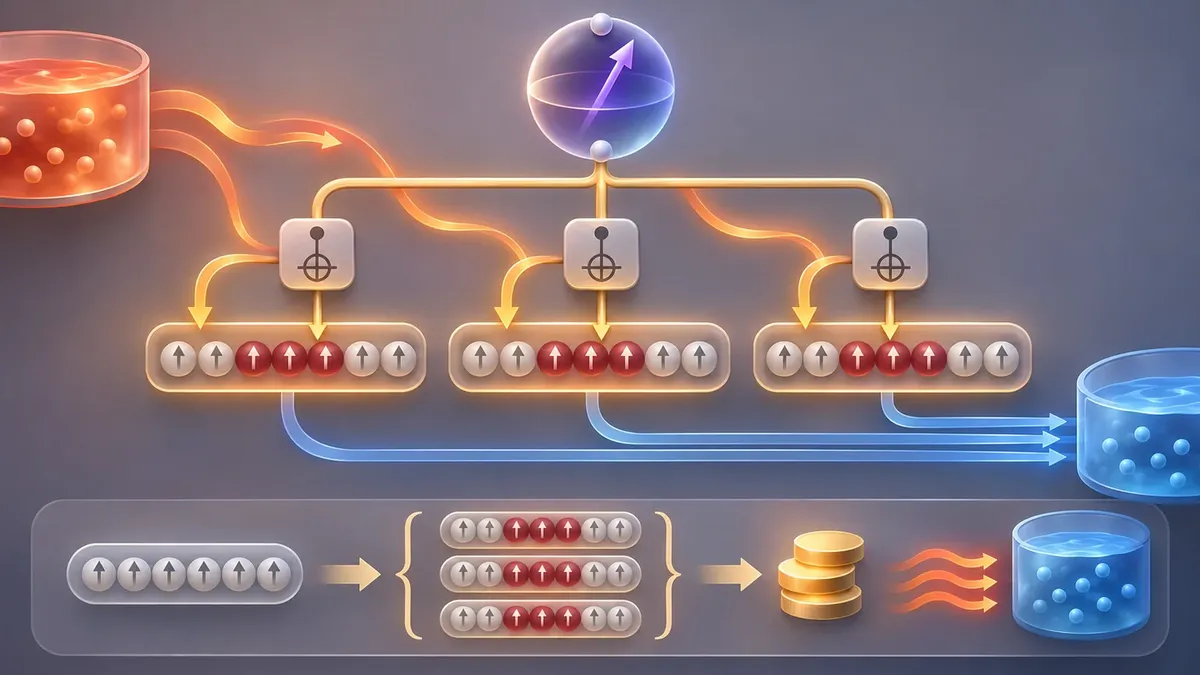
When can an event count as an objective fact—something different observers can learn from separate records? Wonyong Chung’s preprint asks what thermodynamic resources that requires. Its exact results apply only to a deliberately restricted model and set of operations, not to every measurement or detector.
Information needs somewhere to be stored
A measurement may seem like a simple transfer of information: something happens, and observers find out. But information must be stored in physical systems. Records can fade as their surroundings change, and someone with access may alter or erase them. In The thermodynamic budget of objectivity, physicist Wonyong Chung asks what resources are needed to create, maintain, and change multiple records of an event.
The paper builds on quantum Darwinism, an account of how interactions with an environment can leave repeated records of selected properties. Here, “objectivity” has a specific definition: at least R separate fragments must each retain information about an event to a chosen quality. The paper describes quality using an information deficit, δ; a smaller deficit means a more informative record.
Exact results within a restricted model
The model has a central qubit carrying the event and N initially thermal register qubits that may record it. Work sources and thermal baths are included. The allowed operations are restricted: they are controlled operations diagonal in the system’s z basis, with ideal thermal contacts between strokes. The paper’s results are exact within this operation class, not a general account of all possible recording devices.
For a uniform event, at the zero-gap benchmark, and when the system’s own record is preserved, the paper gives a lower bound on the work to create objectivity at level (R, δ): R kBT ln 2 (1 − δ) H(ε), where H(ε) is the event’s entropy in bits. The bound grows linearly with the number of records. The paper reports that it can be approached in the model in the quasistatic limit, with total entropy production tending to zero. At finite speed, there is excess work. With access to the work source, the work invested can be recovered by reversing the process; this does not mean every finite-speed recording operation is reversible.
These qualifications matter. The quoted bound and its attainability use stated assumptions, including a uniform event. For biased events, the lower bound still applies in the model, but it is not generally saturated; the paper notes that a perfect record has a different work cost. Thus, the formula should not be read as a universal price tag for high-quality information.
The model also restricts which event basis can be recorded. For a uniform event misaligned with the machinery’s z basis, the paper derives a quality-dependent critical angle: beyond it, the requested level of objectivity cannot be reached at any work within the allowed operations. Below that angle, it calculates an optimal work cost. This is a result about the model’s recording machinery and operation class, not a universal limit on all measurements.
Maintaining and changing records
Creation and upkeep are separate costs. In the model, registers that re-thermalize lose information. Maintaining records indefinitely requires power, with a minimum that depends on record quality and relaxation rate and grows with redundancy. The claimed minimum and its optimality are model-specific; perfect records require an unbounded maintenance rate in this setting.
The paper distinguishes reducing the number of accessible records from erasing a fact from a controlled sector. Reducing redundancy below a threshold requires access to enough of the qualifying fragments; insufficient access makes it impossible within the model, regardless of work. If an adversary has access, records can be consolidated reversibly: fewer copies remain, but the information survives in them. By contrast, erasing the event’s correlation from the sector the adversary controls and retains requires dissipation at least as large as the correlation erased. The result concerns what happens to information in that sector, not its disappearance from the global state.
A separate speed-limit result concerns independent records made in zero-gap thermal registers under the specified operation class. It relates entropy production and bath activity: rapid recording requires a combination of the two. It does not establish the same quantitative bound for collective operations that act between fragments; feedback extensions are also left open.
Instruments and limitations
The paper discusses a calorimeter and an adiabatic magnetic drift filter as possible illustrations of its framework. For the filter, it describes radiation that may carry records of an electron’s passage, but says the photons’ information quality and redundancy are not calculated there. The extension to records propagating inside a real detector enclosure is proposed, not completed. The author presents a thermodynamic budget of objectivity as a potential instrument-design quantity, not an established detector standard.
These claims are reported from the supplied paper text; they are not independent experimental verification. The source is an arXiv preprint, not evidence of peer review or consensus, and the paper itself says its broader laws are developed rather than established beyond the model’s operation class. Its contribution is a structured way to ask what creating, maintaining, and altering redundant records might cost under explicit assumptions—not a complete thermodynamic account of how every everyday fact becomes known.
- quantum thermodynamics
- quantum Darwinism
- objectivity
- information theory
- measurement
- physical records
- preprint
Reviewed cross-references
These connections were reviewed by a model, not independently fact-checked by a human. Similarity does not imply agreement; consult the original papers and the evidence below.
How one local change can leave many readable records in a quantum chain
Supporting evidence: Both papers describe one event or bit becoming readable in multiple records: Chung derives redundancy and work costs in a thermal-register broadcast model, while Zhang and Chen establish extensive partial records from local readouts in finite many-body models. These are compatible demonstrations in different settings; the latter does not test the former’s thermodynamic cost bounds.
Model review: · openai-codex/gpt-6-luna
Evidence and provenance
Selected excerpts, not complete papers. PDF extraction can omit figures or damage equations, tables and reading order; sources may be preprints.
2611.34909v1 — Original paper
Excerpt reference:
static/papers/2611.34909v1.md:12-69
Basis: Paper text
Source SHA-256:f9cff8375e99c6e1c2745e83d01b1b8bd54e799d3a06d9b1a3b626bd8410c1f92611.11446v1 — Original paper
Excerpt reference:
static/papers/2611.11446v1.md:878-944
Basis: Paper text
Source SHA-256:1bb301313630e50aefb7d027d6a29e5ff9b8c746bf9fd16b5d918b2c062b044f
Related reading
Automatically matched by shared topic keywords. These links do not imply that the sources agree or establish a consensus.
When measurements may help a quantum engine
Source published
Shared keywords: quantum thermodynamics
A quantum work-extraction proposal puts complementary measurements to work
Source published
Shared keywords: quantum thermodynamics
A geometric measure of extractable energy
Source published
Shared keywords: quantum thermodynamics
A quantum clock offers a new route to black-hole entropy’s second law
Source published
Shared keywords: quantum thermodynamics
When Quantum Populations Have an Order
Source published
Shared keywords: quantum thermodynamics