TRANSMISSION // 2611.34890v1
A hidden stellar population in the Milky Way’s bar
Source published
A study of stars in the Milky Way’s central bar region finds a population whose chemistry and orbits resemble the “Splash” stars near the Sun, offering clues to the Galaxy’s early history.
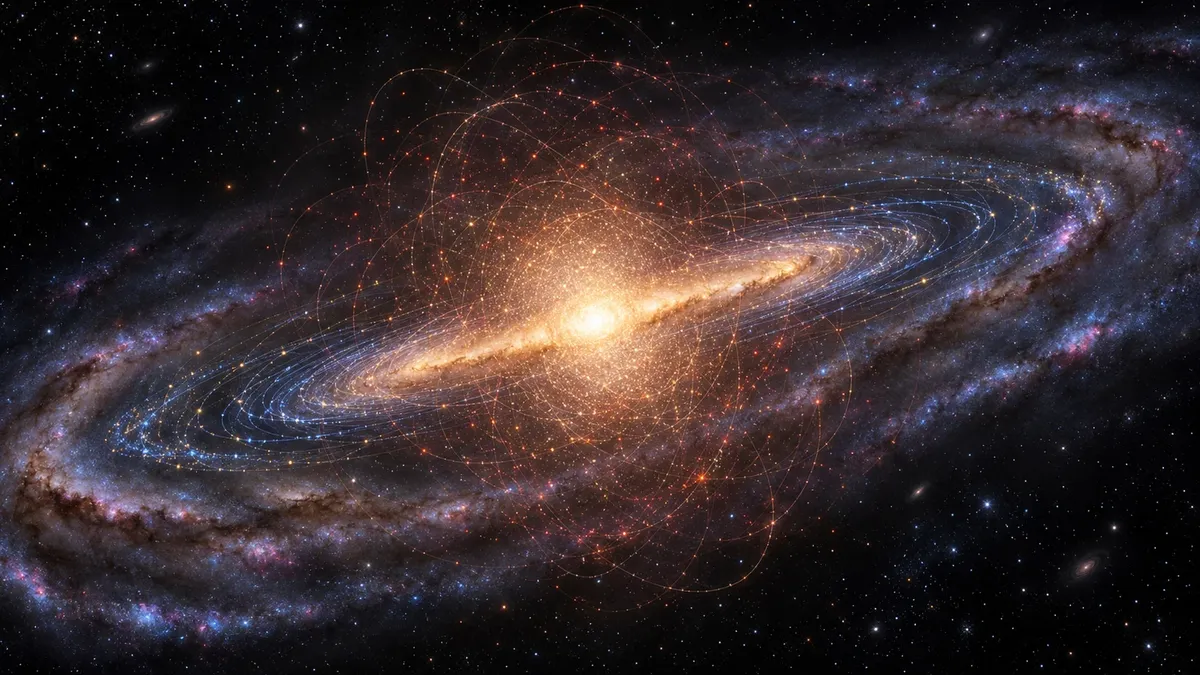
The Milky Way’s bar is crowded with stars moving on a wide range of paths. Can astronomers pick out, among them, the inner-Galaxy counterpart of the Splash: stars thought to have been scattered from the early disc into more halo-like orbits? A new preprint identifies a candidate population and argues that its properties fit that picture.
The Milky Way’s central bar is not just a collection of stars moving together. Its rotating, non-round gravitational field can twist and mix stellar orbits, making it difficult to distinguish stars that follow the bar from stars on more loosely organized paths. That matters for a question about the Galaxy’s past: does the “Splash” population seen near the Sun have an inner counterpart in the bar region?
The Splash is a group of stars with disc-like chemical signatures but unusually hot, often low-rotation orbits. One explanation is that an early merger heated stars that had formed in the Milky Way’s disc. Aakash Pandey and Ortwin Gerhard examine whether similar stars can be recognized inside the central five kiloparsecs, where the bar strongly influences motion.
Reading stellar chemistry and motion together
The researchers combined chemical measurements from APOGEE Data Release 17 with Gaia astrometry and distance estimates from the AstroNN catalogue. Their initial sample contained 64,686 red giants selected for reliable measurements. They then focused on stars whose calculated orbital paths remained within five kiloparsecs of the Galactic centre.
To follow those paths, the team integrated stellar orbits in a model of the Milky Way’s bar and bulge. A star’s rotation at one moment can be misleading: even a bar-related orbit can temporarily have negative angular momentum in the bar’s rotating frame. So the researchers used a normalized, time-averaged measure of bar-frame rotation, called Vφ in the paper. In plain language, it summarizes how an orbit behaves over time rather than judging it from a single snapshot. They also compared their results with those from a second bar-potential model.
The team mapped this orbital measure against metallicity, an indicator of a star’s iron content relative to the Sun, and examined orbital eccentricity, vertical reach and the abundances of magnesium and aluminium.
A bar-region population with Splash-like traits
Between [Fe/H] = −1 and −0.3, the maps show an extension of stars with negative Vφ: stars that do not follow the bar’s average rotation. These stars tend to have more eccentric orbits and larger vertical excursions than the bar-following population. Their reconstructed orbital distribution is broadly spheroidal rather than strongly bar-shaped.
The chemistry adds a second line of evidence. Across this metallicity range, the negative-Vφ stars have magnesium-to-iron and aluminium-to-iron abundance distributions similar to stars on the bar’s main supporting orbits. Their metallicity and abundance patterns also resemble those of Splash stars near the Sun. The authors therefore call them the “central Splash.” They estimate that this population makes up about 30% of high-magnesium stars in the relevant metallicity range in their bar sample; the paper’s abstract describes it as roughly 30% of all stars at those metallicities.
The authors interpret the shared chemical patterns as evidence that the central Splash and bar-following stars formed from related early-disc material, while their different orbits reflect later dynamical disturbance. They argue that the Gaia-Sausage-Enceladus merger is a plausible source of that disturbance. The analysis does not directly observe a merger scattering these particular stars, however; it connects present-day patterns to a proposed history.
The study also finds a weaker negative-Vφ feature among very metal-rich stars, which are concentrated toward the bulge. For stars below [Fe/H] = 0.3, the authors report no additional classical-bulge population in their maps beyond the central Splash and very metal-poor proto-Galactic stars. They suggest that the high-magnesium bulge could instead have developed from the early high-magnesium disc.
What remains uncertain
Negative bar-frame rotation alone is not proof that a star belongs to the Splash. The bar can produce complex motion, and the paper notes that its selection may include heated disc stars as well as stars affected by a merger. The authors estimate that processes associated with the bar could contribute some contamination, reducing their inferred fraction; they describe the fraction and any radial trend as uncertain. Orbit classifications also depend on the adopted gravitational model, although the authors report that their main distributions agree between the two models they tested.
This is a preprint: it is presented as a paper prepared for Monthly Notices of the Royal Astronomical Society, but its text still contains a placeholder for the acceptance date. Its claims should therefore be read as the authors’ reported analysis, not as a settled result. The work offers a way to investigate the bar’s stellar history, while leaving room for further tests using independent data, improved models and more direct age measurements.
- Milky Way
- Galactic bar
- stellar populations
- Splash stars
- Gaia-Sausage-Enceladus
- galactic archaeology
Reviewed cross-references
These connections were reviewed by a model, not independently fact-checked by a human. Similarity does not imply agreement; consult the original papers and the evidence below.
Milky Way Star Patterns May Share a Dynamical Story
Shared method: Both studies combine stellar abundances with astrometric and kinematic data to analyze Milky Way stars. Pandey and Gerhard use APOGEE abundances, Gaia astrometry, and AstroNN distances for their bar-region sample; Yang et al. use GALAH DR4 abundances and Gaia astrometry to construct a disk sample and calculate orbital quantities. This is a methodological overlap, not evidence about the same stellar population or corroboration of the central Splash result; the excerpts are selective and both papers are preprints.
Model review: · openai-codex/gpt-6-luna
Evidence and provenance
Selected excerpts, not complete papers. PDF extraction can omit figures or damage equations, tables and reading order; sources may be preprints.
2611.34890v1 — Original paper
Excerpt reference:
static/papers/2611.34890v1.md:199-254
Basis: Paper text
Source SHA-256:4d45edf8583fece93d38afec045d70107e103ed317cc539fbc206389d8b8f60c2611.25804v2 — Original paper
Excerpt reference:
static/papers/2611.25804v2.md:245-322
Basis: Paper text
Source SHA-256:a7a8fd1e9fd3c8e24fa779b6ef51e1e532fbb2635efe251fb54869c81eb0599f
Related reading
Automatically matched by shared topic keywords. These links do not imply that the sources agree or establish a consensus.
A Proposed Infrared Instrument Could Trace the Milky Way’s History
Source published
Shared keywords: galactic archaeology, milky way
Can Europium Reveal How Other Galaxies Built Their Star Clusters?
Source published
Shared keywords: galactic archaeology
Milky Way Star Patterns May Share a Dynamical Story
Source published
Shared keywords: galactic archaeology, milky way
A Sagittarius flyby may have left a lasting mark on the Milky Way’s disc
Source published
Shared keywords: galactic archaeology, milky way
Red giants’ individual vibrations sharpen estimates of their ages
Source published
Shared keywords: galactic archaeology