TRANSMISSION // 2611.34871v1
A shared flow for finding multiple excited states
Source published
A theoretical framework aims to compute several excited states at once using a common double-bracket flow, convergence conditions and two scheduling strategies.
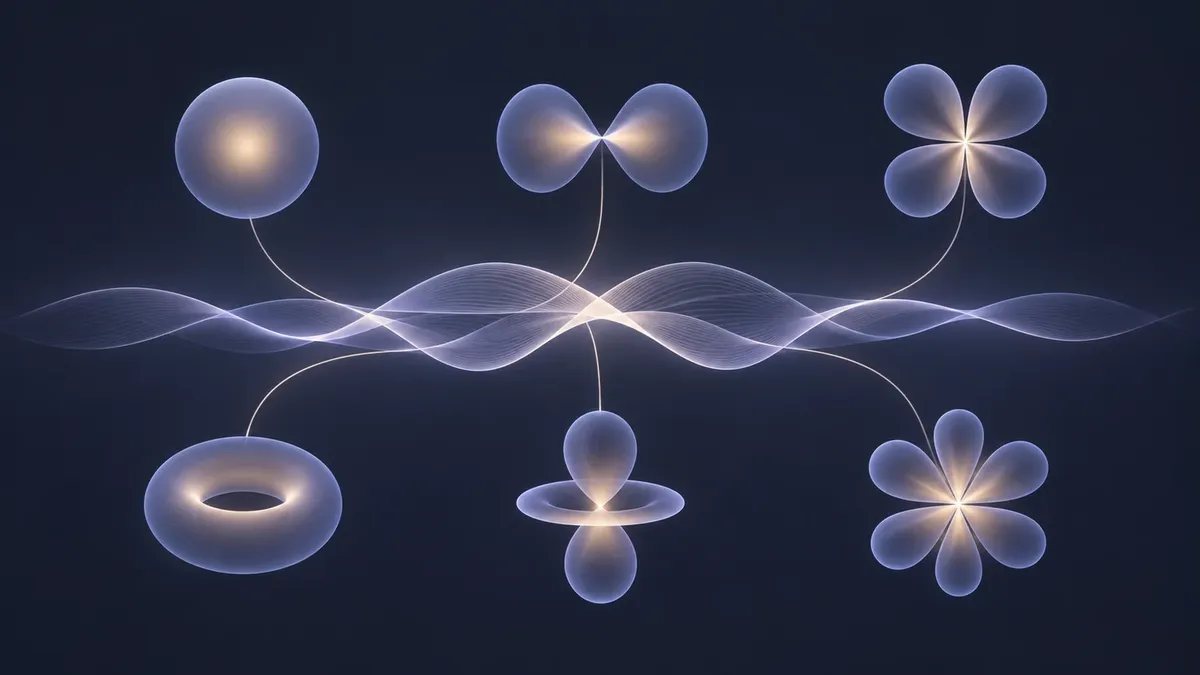
Excited states help describe molecular electronic structure and strongly correlated many-body systems. A new theoretical framework proposes using one shared double-bracket flow to guide different initial states toward different excited states, without specifying the targets in advance.
Why look for several excited states at once?
A quantum system’s ground state is its lowest-energy state; excited states lie above it. These higher-energy states matter in studies of strongly correlated many-body systems and molecular electronic structure. Computing several of them is an important challenge in these fields.
In an arXiv preprint, Reyhaneh Aghaei Saem, Mehrad Sahebi, Zoë Holmes and Yudai Suzuki propose a framework for computing multiple excited states simultaneously. Its central idea is a common double-bracket flow that is intended to drive different pure initial states toward different target excited states, without prior knowledge of those targets. The abstract does not give the flow’s mathematical form, so its operation should not be inferred from the name alone.
What did the researchers report?
The authors analyze conditions for convergence: whether the evolving states reach their intended targets. They establish a necessary condition for convergence and a sufficient condition for exponential convergence. A necessary condition must hold for convergence; a sufficient condition, when met, ensures the stated outcome. The abstract does not specify these conditions, so their assumptions and scope cannot be assessed here.
The paper also presents two scheduling strategies. Chebyshev scheduling is reported to achieve optimal convergence near a fixed point, but it requires prior spectral information. Adaptive scheduling does not require spectral information and achieves comparable performance in numerical simulations, according to the abstract.
These claims have limits. The stated optimality for Chebyshev scheduling applies near a fixed point, not necessarily across an entire computation or in every setting. The abstract does not specify what spectral information is required, what systems were simulated, how performance was measured, or how closely the strategies performed.
What could the approach offer?
The authors say the framework could enable new classical and quantum algorithms for computing excited states without prior preparation of lower-energy eigenstates. This is a proposed algorithmic direction, not evidence of a general speedup or demonstrated practical advantage. The abstract reports convergence analysis and numerical simulations of the scheduling strategies; it does not describe an experimental implementation or provide comparisons with existing methods.
What remains uncertain?
This account is based on the abstract, not the full paper. It therefore cannot establish the precise mathematical assumptions, details of the convergence guarantees, or computational costs of implementing the method. Those details matter for judging which problems the framework can address and whether it offers practical benefits. The abstract’s summary of numerical performance also leaves the tested cases and measurements unspecified.
The source is an arXiv preprint; availability there does not by itself establish peer review. The findings should be understood as claims in a proposed theoretical contribution. Assessing them fully requires the paper’s technical details and any subsequent review or replication. From the abstract alone, the central idea is that one shared flow may direct different initial states toward different excited states under stated conditions. Whether this translates into useful computational gains remains uncertain.
- excited states
- double-bracket flows
- quantum algorithms
- many-body physics
- molecular electronic structure
Reviewed cross-references
These connections were reviewed by a model, not independently fact-checked by a human. Similarity does not imply agreement; consult the original papers and the evidence below.
Can quantum machine learning train without measurements?
Shared method: Both papers use Riemannian-gradient dynamics implemented through double-bracket-related flows: the origin paper applies a common double-bracket flow to compute multiple energy eigenstates, while Srimahajariyapong et al. develop Riemannian-gradient dynamics for autonomous quantum-machine-learning training. This is a methodological connection, not evidence that the approaches have comparable performance; the tasks and stated conditions differ.
Model review: · openai-codex/gpt-6-luna
Evidence and provenance
Selected excerpts, not complete papers. PDF extraction can omit figures or damage equations, tables and reading order; sources may be preprints.
2611.34871v1 — Original paper
Excerpt reference:
static/papers/2611.34871v1.md:59-185
Basis: Paper text
Source SHA-256:4bdd1d40094d1cc094cbb0ea8f1f0211ae2a6552e2bb9a47d09524266153c4922611.27815v1 — Original paper
Excerpt reference:
static/papers/2611.27815v1.md:58-113
Basis: Paper text
Source SHA-256:5e233bba7e08ae7652f1f80e3e3fe1f33acc0827d6cb76ee408f3e271e967c8b2611.27815v1 — Original paper
Excerpt reference:
static/papers/2611.27815v1.md:114-178
Basis: Paper text
Source SHA-256:5e233bba7e08ae7652f1f80e3e3fe1f33acc0827d6cb76ee408f3e271e967c8b
Related reading
Automatically matched by shared topic keywords. These links do not imply that the sources agree or establish a consensus.
When adaptive quantum circuits miss the ground state
Source published
Shared keywords: quantum algorithms
A quantum instrument for steering rare trajectories
Source published
Shared keywords: many body physics
A locality bound for quantum fermions moving in continuous space
Source published
Shared keywords: many body physics
A quantum search for the lowest point in an energy landscape
Source published
Shared keywords: many body physics
A geometric signal for quantum ergodicity
Source published
Shared keywords: many body physics