TRANSMISSION // 2611.34865v1
A complete test for converting quantum-state texture
Source published
A mathematical criterion determines when one quantum state can be converted into another under quantum-state texture rules, including mixed states in dimensions above two.
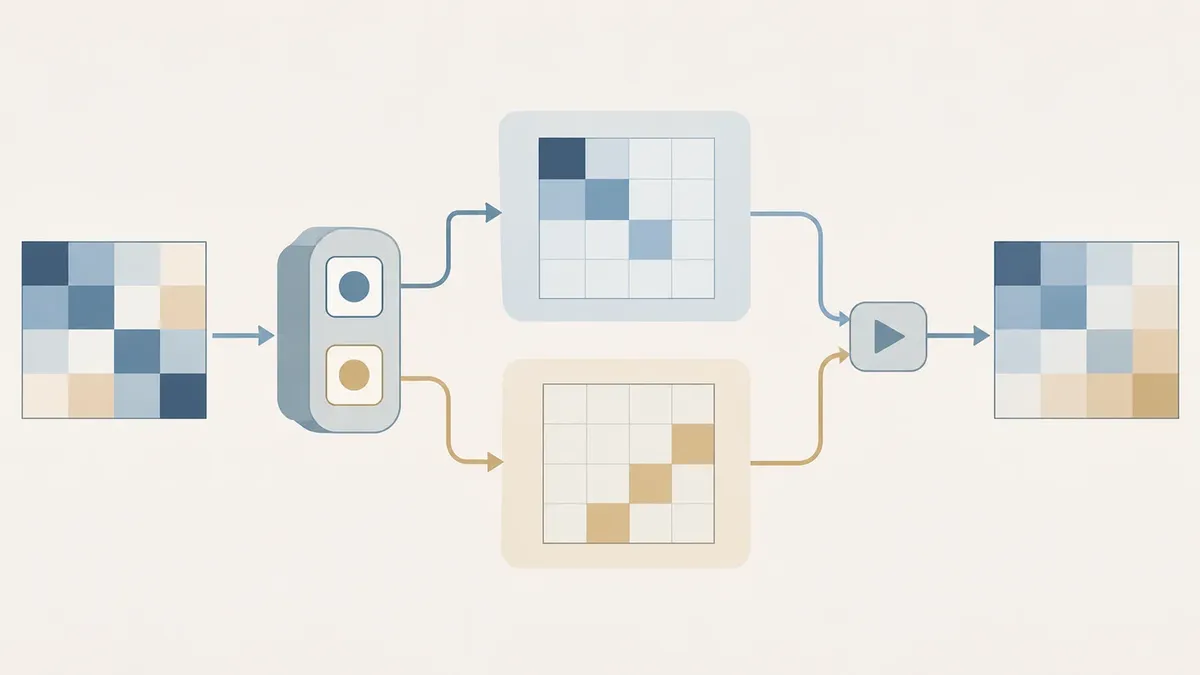
Quantum resource theories restrict which transformations are allowed. In quantum-state texture, allowed channels must leave the theory’s unique textureless state unchanged. Jose Alfredo de Leon’s preprint derives an exact conversion test for this framework, including mixed states with more than two levels.
The conversion problem
Quantum-state texture (QST) treats departure from a particular flat, textureless state as a resource. The theory has one free state, a specific pure state denoted f₁. Its free operations are quantum channels that leave f₁ unchanged.
The question is whether one of these operations can transform a source state into a chosen target with certainty. Resource measures can impose necessary conditions, but they do not always settle whether a transformation is possible. Earlier deterministic criteria covered qubits and pure sources in arbitrary finite dimensions. A general criterion for converting mixed states in higher dimensions was missing.
De Leon addresses this case by deriving a general form for QST-free operations and using it to give an exact conversion criterion. The work is theoretical: it establishes results within the defined QST framework rather than reporting a laboratory demonstration.
A filter and a prepared remainder
The paper shows that every QST-free operation can be written as a quantum filter plus a residual completely positive map. In the paper’s adapted basis, the filter acts as AρA†: it leaves the textureless component fixed, transforms the component in the orthogonal subspace, and also transforms coherences between those subspaces. The residual map, by contrast, acts only on the input state’s block within the orthogonal, maximally textured subspace.
For a particular conversion, the residual contribution can be replaced by preparing a fixed state after a second outcome of a measurement. One outcome retains the filtered state. The other discards the system and prepares a state chosen for that source-to-target conversion. Averaging the conditional outputs defines a deterministic channel; the branches are alternatives, not states that physically merge.
Conversion is possible exactly when a valid filter can be found such that the target minus the filter’s unnormalized output is positive semidefinite. This difference is the remainder supplied by the preparation branch. It may be unnormalized or zero; it need not itself be a normalized quantum state. When nonzero, its trace sets the probability of the preparation outcome, and normalizing the remainder gives the prepared state.
Finding such a filter can be expressed as a semidefinite-programming feasibility problem, with constraints on matrix positivity. If feasible, a solution provides a filter and the remainder needed to construct the conversion; if infeasible, no filter satisfies the criterion. The formulation does not require inverting the source or target, so it also applies when either has zero eigenvalues.
What scalar tests can miss
The paper studies two quantities that impose necessary conditions on conversion. The grand sum Σ(ρ) is D times the probability of finding the system in the textureless state; that probability is Σ(ρ)/D, where D is the system’s dimension. The maximal free-state fraction is the largest weight that the textureless state can have in a convex decomposition of whichever state is being considered, whether source or target. Neither quantity may decrease under an allowed conversion. Together, these conditions completely characterize conversion for qubits.
For mixed states in dimensions above two, satisfying both conditions is not enough. The paper gives qutrit examples in which the scalar tests permit a conversion but the full matrix constraints rule it out. In those examples, the filter would have to amplify a component, which a valid quantum filter cannot do. These measures can still rule out some transformations; they simply do not decide every higher-dimensional case.
The paper also identifies situations with simpler criteria. A source supported entirely in the subspace orthogonal to the textureless state can be converted into any target. For a pure source and an arbitrary target, conversion is possible exactly when the target’s grand sum is at least as large as the source’s. These special cases do not replace the general test for mixed states.
Scope and limitations
The results are mathematical characterizations, illustrated with examples including qutrit conversions. They do not demonstrate experimental implementation or establish practical performance. The author notes that the construction may extend to other resource theories whose free operations fix a unique pure state. This is a proposed scope for the method, not a claim that every such theory has been analyzed.
This article is based on an arXiv preprint, which may not have undergone peer review. The conclusions apply to the stated QST model and its specified free operations. The source describes the derivation and examples; this account does not independently verify the mathematical results. Further work would be needed to assess the criterion’s usefulness in particular applications or other resource theories.
- quantum-state texture
- quantum resource theory
- quantum state conversion
- semidefinite programming
- quantum filters
- mixed quantum states
Reviewed cross-references
These connections were reviewed by a model, not independently fact-checked by a human. Similarity does not imply agreement; consult the original papers and the evidence below.
A convergent hierarchy probes classical explanations of quantum states
Shared method: Both papers use semidefinite programming: the texture study formulates a test for state conversion, while the classical-simulability study builds a hierarchy of approximations and witnesses. This is a methodological connection, not evidence that their criteria or results transfer between the different problems.
Model review: · openai-codex/gpt-6-luna
Evidence and provenance
Selected excerpts, not complete papers. PDF extraction can omit figures or damage equations, tables and reading order; sources may be preprints.
2611.34865v1 — Original paper
Excerpt reference:
static/papers/2611.34865v1.md:187-282
Basis: Paper text
Source SHA-256:6b543c50659f4636468911d5745bad4de3a89e639efc3ced12824ad3cf1260772606.06204v2 — Original paper
Excerpt reference:
static/papers/2606.06204v2.md:65-135
Basis: Paper text
Source SHA-256:358c2fc3f8f61b3a81f43a3ab47ce08281dc89da97e2da133298e633ab03947b
Related reading
Automatically matched by shared topic keywords. These links do not imply that the sources agree or establish a consensus.
A visual map for mixed quantum states
Source published
Shared keywords: mixed quantum states
When Quantum Populations Have an Order
Source published
Shared keywords: quantum resource theory
A convergent hierarchy probes classical explanations of quantum states
Source published
Shared keywords: semidefinite programming
Can an RC Circuit Trace a Quantum Phase?
Source published
Shared keywords: mixed quantum states
A fixed-size calculation for the exact PPT entanglement cost of two qutrits
Source published
Shared keywords: semidefinite programming