TRANSMISSION // 2611.34864v1
How RePace teaches robot policies to move faster
Source published
RePace uses a language model to choose how much to speed up each part of robot demonstrations before training. Tests show faster successful trials, with trade-offs in task success.
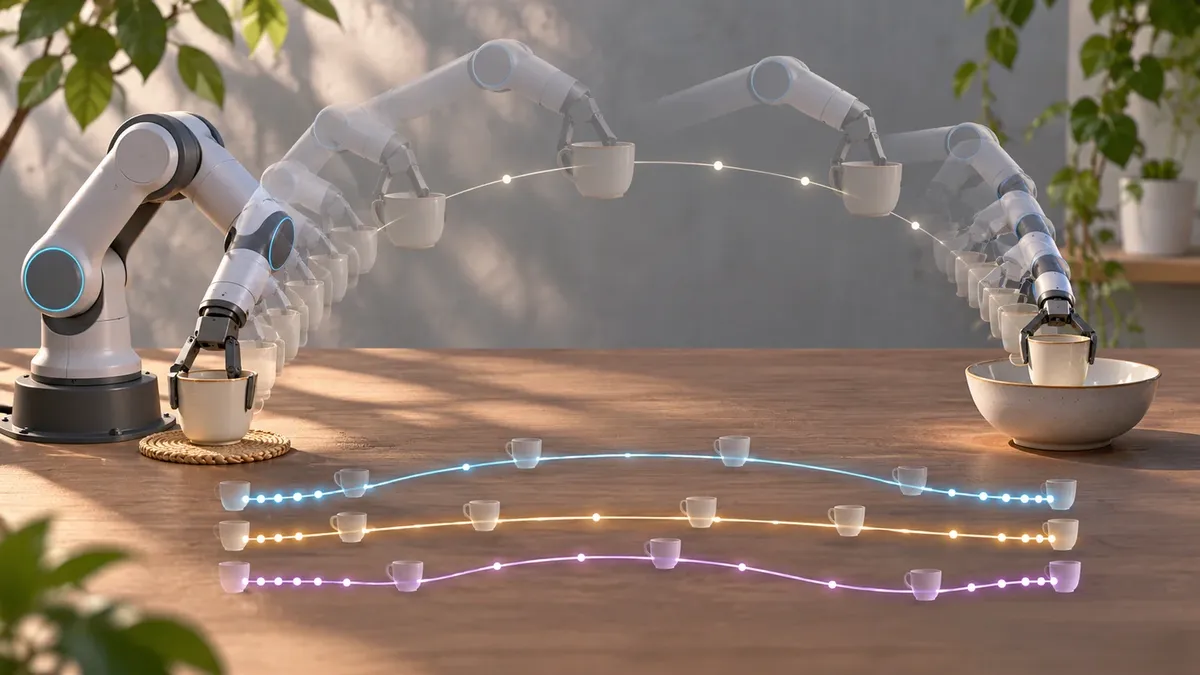
Robot demonstrations can be deliberately cautious, and a policy trained on them may inherit that slow pace. RePace tries to speed up training demonstrations without erasing details that matter for precise movements such as grasping or placement.
A robot policy can learn not only what to do from a demonstration, but also how quickly to do it. That can be a problem when a person moves cautiously while teleoperating a robot: the resulting vision-language-action (VLA) policy may also move slowly, even when a faster movement would be suitable.
RePace, a new method described in an arXiv preprint, asks a practical question: how much can each part of a recorded demonstration be sped up without removing useful information? Rather than adjust a robot’s speed during deployment, RePace changes demonstrations before a VLA policy is fine-tuned. The intended benefit is a faster learned policy without adding a separate speed-selection component to the deployed system.
Comparing possible retimings
Earlier offline approaches have selected parts of demonstrations to accelerate, then applied predefined speedup rates. But a single stretch of movement can contain both easy travel and careful positioning. A rate that works for moving through open space might skip an important observation during alignment.
RePace divides each demonstration into fixed, ordered windows and considers three candidate rates: 1.0, 1.5 and 2.0. A rate of 1.0 keeps the original timing. For each window and candidate, the method calculates how many training steps would remain and how the retiming would change the observation-and-action pairs. It also measures features such as movement between retained observations, command peaks and gripper-command transitions.
A vision-language model describes visible scene details, including nearby obstacles and whether the route looks open or tight. The system also summarizes the recorded robot motion. A pretrained language model then considers the task instruction and the ordered windows together to select a speedup profile for the whole demonstration. In effect, it weighs the time saved against the movement details that may be lost. The chosen profile is applied using the same retiming rules used to calculate its effects.
The researchers tested policies trained on these altered demonstrations in two simulation benchmarks, LIBERO and RoboCasa-Kitchen, and on three tasks with a physical Franka Research 3 arm. The simulation experiments used thousands of demonstrations and evaluation trials; the real-robot tests used 40 demonstrations per task and 32 evaluation trials per method. Comparisons included training on original demonstrations and several acceleration baselines.
Faster trials, but success still matters
In LIBERO, RePace’s policy achieved a reported overall effective speedup of 1.257, a measure that accounts for failed as well as successful trials. Successful trials took fewer control steps on average than with the policy trained on original demonstrations. But the success rate also fell, from 97.45% to 92.45%. The authors report that RePace had the highest overall effective speedup among the tested LIBERO methods and the highest success rate among the accelerated policies.
Results differed across RoboCasa-Kitchen task groups. Across the benchmark overall, RePace was the only tested acceleration method with an effective speedup above 1. On pick-and-place tasks, successful trials were shorter, but success fell from 48.0% with the original policy to 41.2% with RePace; the effective speedup for that group was below 1. This illustrates why faster successful attempts alone do not establish better overall performance.
On all three physical-robot tasks, RePace matched or exceeded the acceleration baselines’ success rates and completed successful trials faster, according to the paper. The study also removed individual information sources in a LIBERO analysis. Without measurements of candidate retiming effects, the resulting policy had lower overall effective speedup than the full method. Removing visual context produced a similar overall effective-speedup value, while success rates and completion times varied by task group.
What remains uncertain
These results suggest that comparing the actual data changes caused by different speedup choices may help balance speed and task performance. They do not show that every demonstration can safely be accelerated this way, or that the method will work equally well on other robots, tasks or policy models. The real-world evaluation covers only three tasks, with 32 trials per method, and the simulations use particular benchmarks and training setups. The authors also note that fixed window boundaries can combine transport and alignment into one segment; choosing boundaries adaptively is left for future work.
The evidence comes from a single arXiv preprint, which may not have undergone peer review. Search results are not independent confirmation, and the paper’s reported comparisons should be read within its tested settings. RePace is best understood as a promising training-data strategy—not a guarantee that faster robot motion will preserve success in broader deployment.
- robotics
- vision-language-action
- robot learning
- demonstrations
- robot speed
- RePace
Reviewed cross-references
These connections were reviewed by a model, not independently fact-checked by a human. Similarity does not imply agreement; consult the original papers and the evidence below.
Teaching robots without demanding an exact copy
Supporting evidence: Both papers report benefits from addressing timing in robot demonstrations, but by different means: RePace retimes demonstrations before fine-tuning and reports faster successful trials, while SURE uses Soft-DTW supervision and reports strong success with reduced data or training. This supports only the bounded point that timing-aware approaches can help in their evaluated settings; it is not a direct performance comparison or evidence of a shared mechanism.
Model review: · openai-codex/gpt-6-luna
Evidence and provenance
Selected excerpts, not complete papers. PDF extraction can omit figures or damage equations, tables and reading order; sources may be preprints.
2611.34864v1 — Original paper
Excerpt reference:
static/papers/2611.34864v1.md:13-37
Basis: Paper text
Source SHA-256:3f458191e22782f6c3340b55e0130be698372b8653f3c9736f4ce36addc1c6392611.34864v1 — Original paper
Excerpt reference:
static/papers/2611.34864v1.md:959-977
Basis: Paper text
Source SHA-256:3f458191e22782f6c3340b55e0130be698372b8653f3c9736f4ce36addc1c6392611.09684v1 — Original paper
Excerpt reference:
static/papers/2611.09684v1.md:15-65
Basis: Paper text
Source SHA-256:aba71950639558ae55458bc53e0d94edfa2681a2bebdbb5d761a9c4d612c92eb
Related reading
Automatically matched by shared topic keywords. These links do not imply that the sources agree or establish a consensus.
Teaching robot policies to handle stale observations
Source published
Shared keywords: robot learning
Can a general AI model control a robot arm?
Source published
Shared keywords: robot learning
A robot plan that knows what remains—and when to consult a demonstration
Source published
Shared keywords: robot learning
One learned policy, plus an agent on selected robot tasks
Source published
Shared keywords: robot learning
How RoboEvo² trains robots from verified repairs
Source published
Shared keywords: robot learning