TRANSMISSION // 2611.34838v1
When New Forces Hide Behind Their Own Higgs Field
Source published
A theoretical study finds that a Higgs field can screen hypothetical long-range forces, changing how strongly existing experiments constrain them.
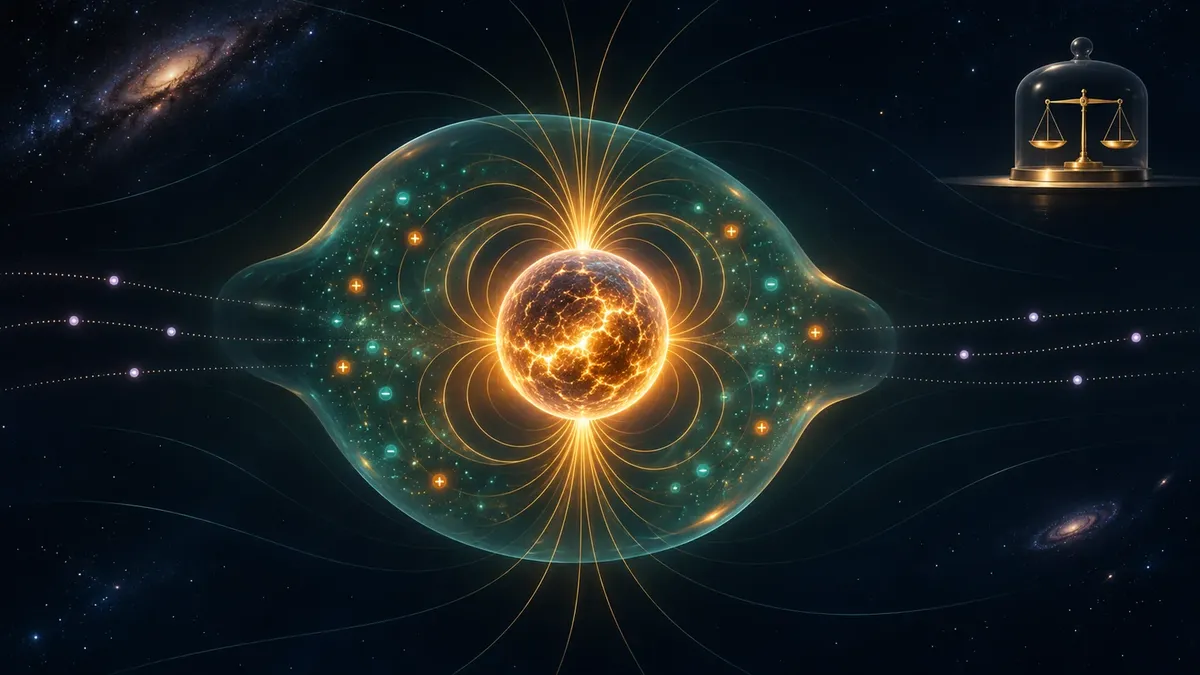
What if a new force became harder to detect because the mechanism that gives it mass also changes the charge of its source? Marco Costa, Andrey Shkerin and Ananda Thomlinson explore that possibility for hypothetical forces linked to familiar particle-physics symmetries. Their calculations suggest that experimental limits can depend on the details of the force’s Higgs field—not just on the force’s strength and range.
Searches for new forces test a simple possibility: perhaps matter feels an interaction beyond gravity and the known forces. One way to look is for a “fifth force” that would make different materials fall differently. Other clues might appear in neutrino oscillations or in the motion of neutron-star binaries.
A new theoretical paper by Marco Costa, Andrey Shkerin and Ananda Thomlinson asks whether those searches interpret the force correctly if its mediator gets mass through a Higgs mechanism. The mediator is the particle that carries the force. In the simplest treatment, it is assigned a mass and produces a field around a charged object. The authors instead model the extra force together with a charged Higgs field, whose changing configuration can alter the field around a source.
How a Higgs field can screen charge
The study considers four possible extra U(1) forces, associated with the Standard Model charge combinations B−L and Lₐ−Lᵦ, where the lepton flavours are electrons, muons and taus. The Higgs mechanism gives the new gauge boson a mass, while the Higgs field itself has a mass set by its self-interaction. That second mass matters: it affects how readily the Higgs field responds to a source.
The researchers model charged astronomical bodies as sources of the new field. They derive equations for the gauge field and the magnitude of the Higgs field, then solve them analytically in limiting regimes and numerically for the scenarios of interest. Their calculations translate existing experimental constraints into this more detailed model. The paper considers equivalence-principle tests, neutrino-oscillation measurements and observations of neutron-star binaries.
In the model, a sufficiently strong source can displace the Higgs field from its vacuum value. The resulting field configuration can produce a cloud of oppositely charged particles that screens some of the source’s charge. Put simply, the source’s effective charge—and therefore the force measured outside it—need not match the unscreened value assumed in the simplest treatment.
The authors describe two regimes, named thin-shell and gradient screening, depending on which effects control how the Higgs field varies. Across these regimes, screening can reduce the force’s strength or shorten its effective range. The amount depends on the model parameters, including the Higgs mass relative to the gauge-boson mass.
Different searches respond differently
The paper’s results are not a blanket weakening of existing limits. For the B−L force, the authors find that the upper bound on the coupling from the MICROSCOPE equivalence-principle experiment remains robust in their analysis. But screening can shorten the force’s range enough to make MICROSCOPE insensitive in some parameter regions; the paper says Eöt-Wash measurements cover part, but not all, of the resulting open region.
For the electron–muon and electron–tau forces, the authors examine how screening changes the extra potential that affects neutrino oscillations. In their calculations, screening of the Sun can weaken the solar-neutrino constraint, leaving terrestrial neutrino data as the leading limit in the relevant cases. Screening of Earth can then further alter that constraint.
The most striking change concerns the muon–tau force. Neutron stars can carry muon charge, and a new force between stars could affect their orbital motion or cause energy loss through radiation. The paper finds that Higgs screening can remove the bounds from both dipole radiation and orbital precession over substantial parameter ranges. It also notes a qualification: screening can itself modify the force law and strengthen the precession constraint in some circumstances.
What the result does—and does not—show
These are calculations within a specified theoretical setup, not evidence that any of the proposed forces exists. The authors make simplifying assumptions, including idealized source models; for neutron stars they assume a uniform muon distribution and use selected equations of state. They also identify open work, such as a fuller treatment of local sources in some laboratory settings, possible Higgs interactions with neutrinos, and effects on neutron-star inspirals and gravitational-wave signals.
The paper is an arXiv preprint, so its claims should be read as research in progress rather than as settled scientific consensus. Its central message is conditional but important: experimental bounds on a hypothetical long-range force may change when the mechanism giving that force mass is included. Testing such forces therefore requires attention not only to the mediator, but also to the fields that shape its surroundings.
- long-range forces
- Higgs mechanism
- charge screening
- neutrino oscillations
- neutron stars
Related reading
Automatically matched by shared topic keywords. These links do not imply that the sources agree or establish a consensus.
When can gauge-symmetric quantum circuits scramble quickly?
Source published
Shared keywords: charge screening
How precisely can neutrino oscillations be measured?
Source published
Shared keywords: neutrino oscillations
Nuclear pasta may reshape a young neutron star’s crust
Source published
Shared keywords: neutron stars
Simple patterns emerge in models of magnetic neutron stars
Source published
Shared keywords: neutron stars
How viscous neutron-star tides vary with temperature
Source published
Shared keywords: neutron stars