TRANSMISSION // 2611.34830v1
How LeWM and DreamerV3 handle uncertainty differently
Source published
A controlled study of LeWM and DreamerV3 in simulated environments finds that architecture and training objective can affect what post-hoc uncertainty estimates detect.
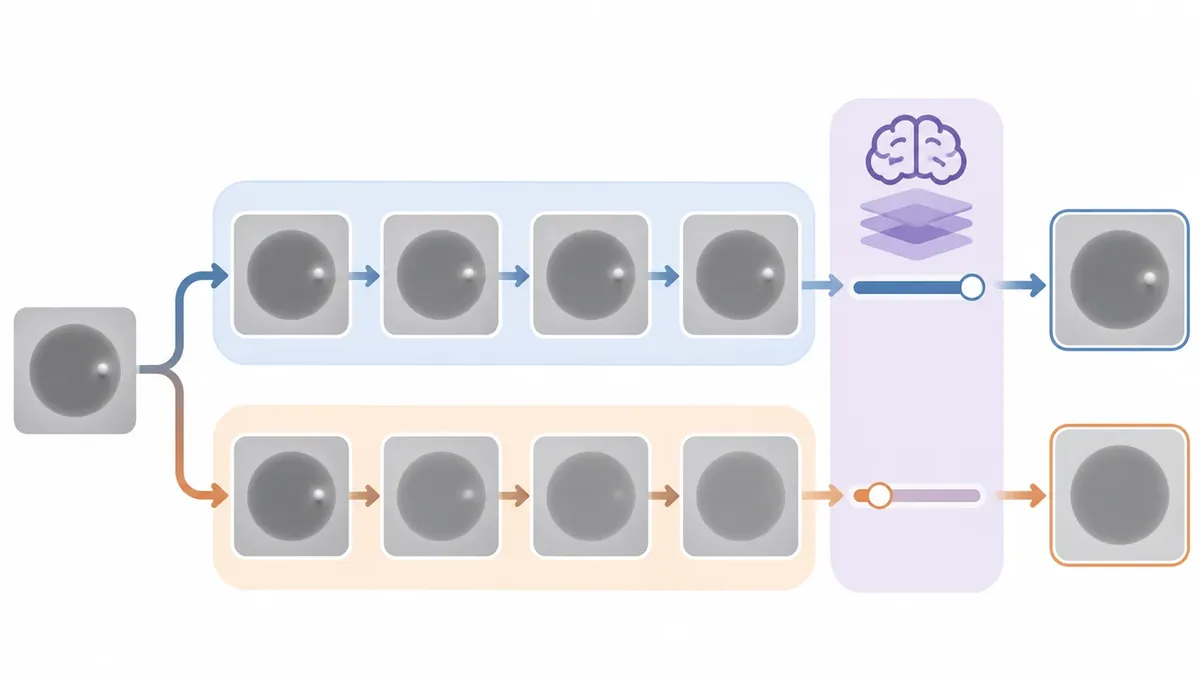
World models let AI agents evaluate possible actions using predictions about what may happen next. But a model’s uncertainty score is useful only if the model’s internal features preserve the changes that score is meant to flag. Researchers tested how this works in two specific systems, LeWorldModel and DreamerV3, across simulated control tasks.
An agent that plans with a world model acts on imagined outcomes rather than directly observed ones. If those predictions are unreliable in a situation the model has not encountered, a system may benefit from an uncertainty estimate that signals a lack of experience. But such a signal is not guaranteed to work: if a relevant change is weakened inside the model before the estimate is calculated, the estimate may not register it.
The researchers compared two particular world models: LeWorldModel (LeWM), a joint-embedding predictive architecture (JEPA), and DreamerV3, which uses a recurrent state-space model (RSSM). LeWM predicts future representations without reconstructing images. DreamerV3 combines recurrent memory with a stochastic latent state and reconstructs observations from its latent state. The study fitted uncertainty estimates after training, using a last-layer Laplace approximation, and also checked an ensemble-based estimate.
In ten simulated visual-control environments, the authors changed coordinates of the simulator’s underlying state and followed the effects through each model, from rendered observations to the features used by its uncertainty estimate. These were controlled diagnostic manipulations, including discontinuities that could violate ordinary environment dynamics—not simply examples of routine changes an agent might encounter. The team also evaluated five uncertainty-related tasks, including identifying unfamiliar states, ranking prediction errors, detecting physical violations and distribution shifts, and uncertainty-penalized planning.
The authors report that in DreamerV3, a state change could reach the model’s posterior representation yet have a much weaker effect on the later feature used by the uncertainty estimate. They identify two mechanisms. First, the recurrent update integrates information over time: a change in one frame may enter the recurrent state only partly, while a persistent change can accumulate. Second, the reconstruction objective gives more weight to entities that occupy more pixels. Consequently, changes to small objects may have less influence on the learned representation, even if those objects matter to a task.
The tested LeWM lacked the recurrent update and reconstruction-term mechanisms examined in DreamerV3. In the study’s perturbation tests, changes generally passed through LeWM’s stages to its uncertainty estimate. This does not mean that every change was detected in every setting, or that the estimate measures everything the model does not know.
Across downstream tasks, the Laplace estimate for LeWM more often detected unfamiliar states and single-frame physical violations, though there were exceptions. Results for shifts to the environment’s underlying physics were mixed: both systems struggled in some cases, and neither was consistently ahead. Adding an uncertainty penalty to planning improved success in selected conditions for LeWM, but not universally; some environments showed no gain for either model, and the experiments do not establish a general improvement in real-world planning.
A supplementary check offers a clue about DreamerV3’s recurrent step. The researchers fitted an estimate using Dreamer’s posterior features, before the later recurrent update attenuated the signal. Detection improved for many tested violations, but the outcome varied across violations and environments. The altered readout did not bring every unfamiliar-state or prediction-error result up to LeWM’s level. This is evidence consistent with the proposed mechanism, not a universal remedy.
The scope matters. The comparison involved LeWM and DreamerV3—not every JEPA or RSSM—and one trained model instance per paradigm in each environment, not repeated model instances establishing how results vary across training runs. The simulator enabled the controlled state tracing, so the study does not cover pretrained world models. The authors call for causal tests of the proposed mechanisms and further analysis of large pretrained JEPAs, including V-JEPA 2. The experiments also do not show that these uncertainty estimates guarantee safe action in physical robots.
The takeaway is that an uncertainty estimator cannot recover information the features it reads have already lost. For these two models and the tested simulated tasks, the training objective and architecture shaped how the post-hoc estimates responded. The work is an arXiv preprint; the supplied source does not establish its review or publication status, so its findings should be treated as reported research rather than settled evidence.
- world models
- epistemic uncertainty
- LeWorldModel
- JEPA
- DreamerV3
- RSSM
- simulated control
Reviewed cross-references
These connections were reviewed by a model, not independently fact-checked by a human. Similarity does not imply agreement; consult the original papers and the evidence below.
What should an AI explore before it has a task?
Shared method: Both papers use DreamerV3’s RSSM: the origin compares its post-hoc uncertainty behavior with LeWM, while Keller et al. use DreamerV3 as a backbone for studying intrinsic objectives and representation strategies. This is a shared architecture, not evidence that the studies test or confirm the same uncertainty claim.
Model review: · openai-codex/gpt-6-luna
Evidence and provenance
Selected excerpts, not complete papers. PDF extraction can omit figures or damage equations, tables and reading order; sources may be preprints.
2611.34830v1 — Original paper
Excerpt reference:
static/papers/2611.34830v1.md:13-76
Basis: Paper text
Source SHA-256:ec8f3a555ce568efe534e279f024f551fb01ef24deda658b07764fbdcf6e24e72611.13113v1 — Original paper
Excerpt reference:
static/papers/2611.13113v1.md:226-349
Basis: Paper text
Source SHA-256:c6df1a69be7962d4fc644fede472eed330e8abf2c0d4ef4369787ba4b4ddaff1
Related reading
Automatically matched by shared topic keywords. These links do not imply that the sources agree or establish a consensus.
A graph-based approach to robot world-model drift
Source published
Shared keywords: world models
A smoother way for robot AI to imagine what actions do
Source published
Shared keywords: world models
What should an AI explore before it has a task?
Source published
Shared keywords: world models
A world model adds memory and a physics-inspired bias
Source published
Shared keywords: world models
Why one action may not teach an AI how actions work
Source published
Shared keywords: world models