TRANSMISSION // 2611.34817v1
How a Lightweight Balloon Payload Keeps a Calibration Source Pointed
Source published
Two flights tested ALTAIR’s momentum-wheel pointing system. A pivot-motor upgrade may extend pointing, but its benefits have so far been shown only in simulations.
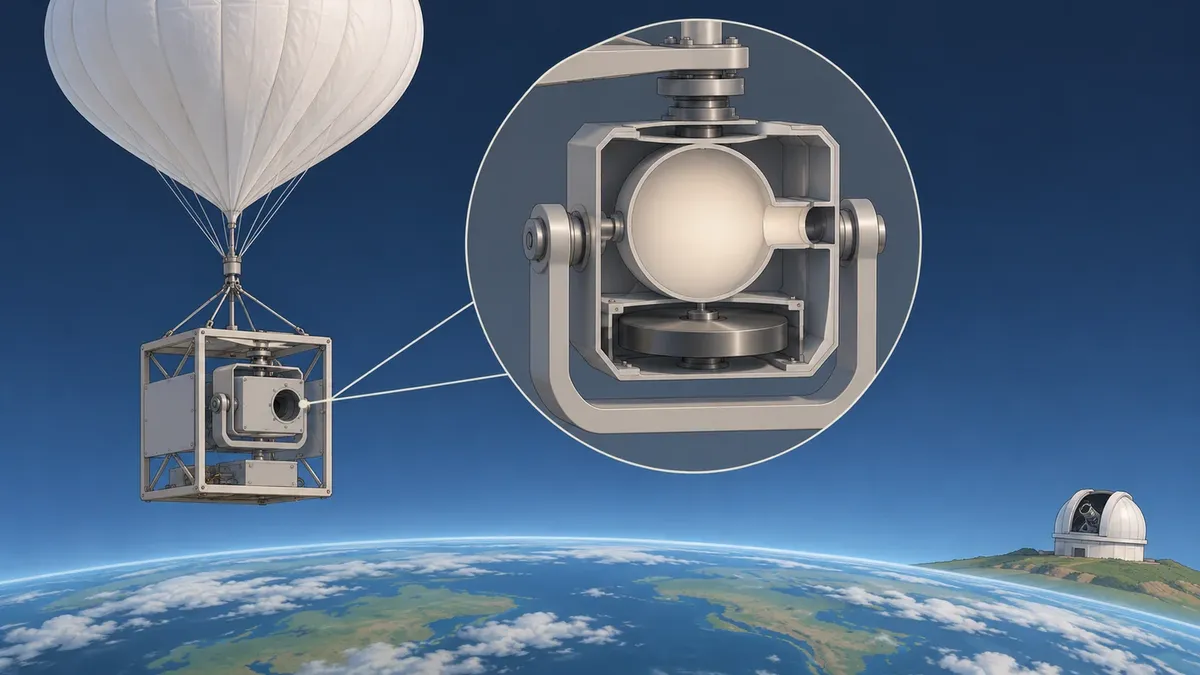
A balloon can carry an optically measured, SI-traceable light source high above the ground, but the source is useful only if it stays aimed toward a telescope. Researchers report two flights of ALTAIR, including a test of its momentum-wheel pointing system, and simulations of a momentum-management upgrade that has not yet flown.
Why pointing matters
ALTAIR is designed to help ground-based telescopes calibrate brightness measurements. It carries an integrating sphere whose light output is optically measured and calibrated, providing an artificial star-like source. Light from the sphere’s exit port is approximately Lambertian: its intensity decreases as the viewing direction moves away from the port’s normal, or straight-ahead direction.
The payload must point within 8 degrees of the telescope’s line of sight. The paper says that this limits the intensity difference from perfect alignment to below 1%. The payload must hold that pointing for at least 30 seconds so the telescope can take exposures.
The challenge is to do this with a lightweight payload exposed to wind and balloon motion. The team combined passive stabilization, onboard sensors for estimating orientation, and a motor-driven flywheel called a momentum wheel. They also designed a second motor to manage momentum that builds up in the wheel. That pivot motor’s performance, however, has not been demonstrated in flight.
Stabilize, sense and steer
Carbon-fiber rods, which the authors call inertial booms, increase the payload’s inertia and couple it to the balloon neck. Their purpose is to reduce tilt and pendulating motion. The control model treats azimuth—the direction the payload faces around the horizon—separately from tilting and swinging. The authors say the booms make this simplification workable, while noting that fuller modeling of motion and its coupling to azimuth remains future work.
The onboard attitude system uses gyroscopes, accelerometers and magnetometers. Motor interference remained a problem for the external magnetometer, so the team also pursued a heading solution using two GNSS antennas. Differences in the carrier phase of signals received by the antennas can be used to estimate heading. The paper describes this as an additional approach; it does not establish that GNSS heading measurements were fused with magnetometer readings in the reported estimate.
The momentum wheel turns to apply torque to the payload. But it has speed limits: near those limits, it loses control authority in one direction. The proposed pivot motor sits between the payload and the balloon’s flight train. By torquing the payload against that connection, it is intended to desaturate the wheel—manage its accumulated momentum and restore pointing authority.
The researchers built a Python simulation that included payload and motor dynamics, sensor noise, actuator limits and wind disturbances modeled from flight measurements. They used it to size actuators and tune control settings. For the wheel-only system, comparisons with flight data reproduced reported saturation and recovery patterns and altitude-related disturbance trends. This does not demonstrate the pivot motor in flight.
What the flights showed
The first flight, on May 7, 2026, did not include the pivot motor. Its stated objectives included measuring wind disturbances and payload tilt. The authors report a tilt root-mean-square (RMS) of 12.3 degrees. The paper does not identify this flight as a test of wheel-based pointing, so it is not possible to conclude from the report whether or how the momentum wheel was used for that purpose.
The second flight, on May 27, tested azimuth pointing with the momentum wheel alone and reached a maximum altitude of about 23.5 km. During its ascent, the researchers identified 53 windows of 30 seconds in which pointing stayed within the required 8-degree limit. Across those windows, the reported root-mean-square pointing error was 3.7 degrees. The longest uninterrupted pointing window lasted 7 minutes 55 seconds, with a 5-degree RMS error.
The wheel-only system therefore met the stated pointing requirement in repeated 30-second windows during that flight, not continuously throughout it. The authors report drift and interruptions, with wheel saturation limiting how long pointing could be maintained before recovery was needed.
The pivot motor’s reported performance comes from simulations, not a flight. In one simulated ascent, the authors report a 45-minute pointing window with the pivot motor, compared with 15 minutes for the wheel alone. In a separate set of 50 simulated cases, 46 runs with the pivot motor stayed within the pointing bounds for more than 97.5% of simulated time; none of the wheel-only runs did. These results depend on the simulation’s assumptions. The authors say a future flight is planned to test the pivot motor in the air.
What remains uncertain
The simulation simplifies the payload’s motion by treating azimuth as a single-axis problem and approximating the balloon as a momentum sink. The authors identify fuller modeling of pendulating motion and its coupling to azimuth, improved wind-disturbance models and more precise measurements of system parameters as future work. The momentum wheel was tested for pointing in one of the two flights, and the pivot motor has not flown.
This article is based on an arXiv manuscript. Although the manuscript includes an IEEE copyright notice, the available source information does not establish its peer-review or publication status. The findings should be understood as the authors’ reported results, not independently verified conclusions. In particular, the pivot motor’s simulated advantages await a flight test.
- high-altitude balloon
- telescope calibration
- azimuth pointing
- momentum wheel
- ALTAIR
- balloon payload
Related reading
Automatically matched by shared topic keywords. These links do not imply that the sources agree or establish a consensus.