TRANSMISSION // 2611.34816v1
Can One Network Borrow Another’s Learning Bias?
Source published
A study tests whether aligning a model to a randomly initialized guide can reshape its starting representations and improve later training.
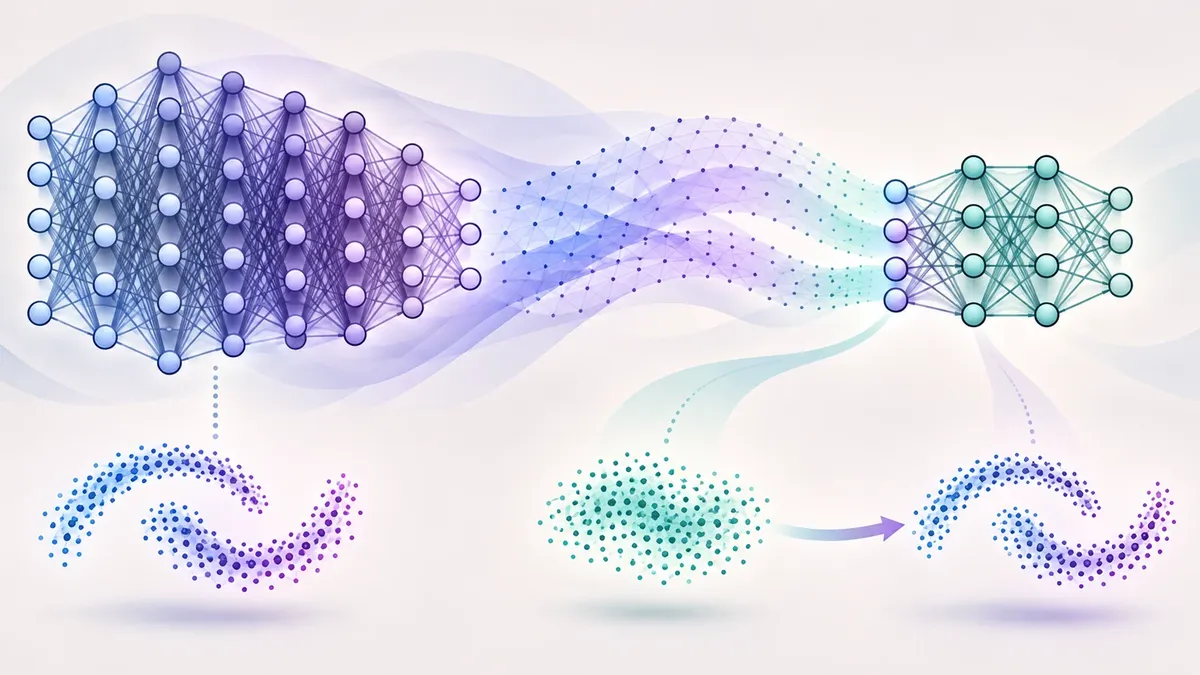
A model’s starting point may shape more than how smoothly training begins: it can influence which examples seem similar and what the model learns first. This study tests whether that starting geometry can be reshaped using a different network—one that has never learned the task.
A different kind of model initialization
Neural networks are usually initialized with rules designed to keep their signals and gradients at workable scales. But initialization can also influence how a model represents its inputs: which examples appear close to one another, for instance, and which patterns are easiest to adjust during early training.
In Transferring Architecture as an Optimization Prior, Vighnesh Subramaniam, Boris Katz and Brian Cheung ask whether one network can give another a useful starting geometry—and whether that changes how the second network learns. Their approach uses a randomly initialized network as a guide. The guide is frozen, never trained on the task and discarded before the target network’s ordinary supervised training begins.
That distinction matters. The guide does not pass along learned features, predictions or labels. Instead, the researchers adjust the target’s initial parameters so that its representations resemble the guide’s on an unlabeled set of inputs. In effect, the target borrows a pattern of relationships among examples, not a solution to the task.
How they tested the idea
The study explores two kinds of transfer. For depth transfer, shallower targets are aligned with deeper guides. For granularity transfer, a vision transformer that divides images into larger patches is aligned with one that uses smaller patches, then trained in its original, coarser form.
The researchers compare two ways to measure representational similarity. Linear CKA compares broad, overall relationships among representations; DiffKNN focuses on local neighborhoods—roughly, which examples are near each other. They align the target using unlabeled inputs, then train it on the usual supervised task. Standard-initialization baselines receive 101 supervised-training epochs, while aligned targets receive 100 supervised epochs after alignment. Alignment takes one epoch per stage, with three to six stages, so it adds training work; the paper describes its comparison as using the same overall training budget, but this does not establish equal total compute or elapsed time.
The experiments cover ResNets, vision transformers and ConvNeXtV2 models on ImageNet-1K, and GPT-2 variants on WikiText-103. They also test alignment using synthetic Gaussian inputs rather than real images or text. Results are averaged across five random seeds, according to the paper.
What the study reports
Across the tested model families, aligning a shallower target to a deeper random guide generally improved downstream results. The largest reported gains were around three to four ImageNet top-1 accuracy points for vision models, or a similar number of perplexity points for language models. For perplexity, lower is better. Shallower guides usually did not help deeper targets, and alignment between models of the same architecture generally had little effect.
The granularity results were more dependent on the similarity measure. Aligning a coarse-patch ViT-B/32 target to a fine-patch ViT-B/16 guide improved ImageNet accuracy most clearly with DiffKNN; CKA produced a weaker signal. The authors suggest that local-neighborhood matching can be useful when broad representational similarity is already high.
They also report gains when alignment uses Gaussian-generated inputs. This suggests that, in these experiments, natural image or text statistics were not necessary for the observed improvements. It does not show that data is irrelevant to model training overall: the target still undergoes supervised training on the task data afterward.
What remains uncertain
These are results from a particular alignment procedure, set of architectures and benchmarks—not evidence that any larger model can reliably improve any smaller one. The authors say their study does not cover the full range of architectures, datasets or alignment objectives. They also describe the gains as modest and note that transfer can depend on how similar the guide and target already are. In some settings, alignment can make performance slightly worse.
The paper’s explanation is that alignment changes the target’s initial feature geometry, which affects early gradient-based updates. The authors provide a mathematical analysis connecting similarity in feature kernels to similar first training steps under stated conditions. That helps explain the proposed mechanism, but does not mean the guide controls the target’s entire learning trajectory: the guide is removed, and the target retains its own architecture and parameters.
The paper text identifies the work with NeurIPS 2026, but the cited source is an arXiv version. The evidence available here does not independently establish peer-review status or provide external replication. The reported findings concern initialization alignment in the specific tasks and settings the authors tested; broader applicability remains uncertain.
- neural network initialization
- optimization
- representation alignment
- deep learning
- computer vision
- language models
Reviewed cross-references
These connections were reviewed by a model, not independently fact-checked by a human. Similarity does not imply agreement; consult the original papers and the evidence below.
Can a neural network change shape after training?
Shared method: Both papers use representational-similarity alignment across architectures: the origin paper aligns a target’s initialization to a frozen random guide, while NoT progressively aligns replacement modules to a guide network. The procedures differ in timing and purpose—initialization shaping versus staged architecture conversion—so this is a shared alignment method, not evidence that their results are interchangeable.
Model review: · openai-codex/gpt-6-luna
Evidence and provenance
Selected excerpts, not complete papers. PDF extraction can omit figures or damage equations, tables and reading order; sources may be preprints.
2611.34816v1 — Original paper
Excerpt reference:
static/papers/2611.34816v1.md:66-121
Basis: Paper text
Source SHA-256:3b9103564f8a9f214bf1fe8c4f8bd95174cc7dcc1785d7ba9122ed2cac32104d2512.04198v2 — Original paper
Excerpt reference:
static/papers/2512.04198v2.md:65-108
Basis: Paper text
Source SHA-256:6e89bee6fffaa87a6dfa4e2c7fc7636656023dcf80578d1cf7339c8c1abececf
Related reading
Automatically matched by shared topic keywords. These links do not imply that the sources agree or establish a consensus.
A Retinex-inspired network aims to restore many kinds of damaged images
Source published
Shared keywords: computer vision, deep learning
Better Tokenization Aligns Languages—but Doesn’t Guarantee Transfer
Source published
Shared keywords: representation alignment
A registration model that knows when its matches are shaky
Source published
Shared keywords: computer vision, deep learning
Can a smaller EfficientNet learn from a larger one?
Source published
Shared keywords: computer vision
How ‘causal pieces’ could help explain spiking neural networks
Source published
Shared keywords: neural network initialization