TRANSMISSION // 2611.34811v1
Teaching Robot Vision to Notice Edges
Source published
HOG-WAM adds a training-only edge-structure prediction task to a robot policy’s learning process. Tests show improved results in several noisy-vision settings, but gains vary across benchmarks and tasks.
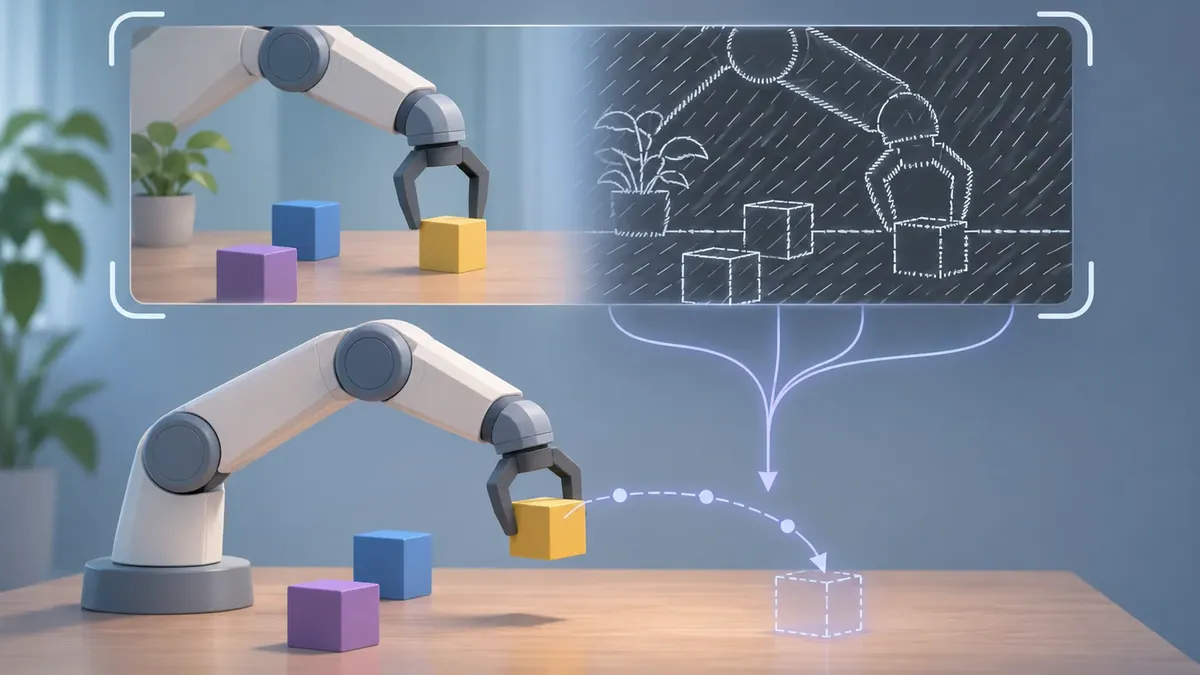
Robots often have to act from camera images that differ from the conditions they encountered during training. HOG-WAM explores whether predicting the structure of future images—especially their edges—can help a robot policy cope with some visual changes without changing what it sees at deployment.
A robot asked to stack blocks or place an object must interpret camera images well enough to choose its next movement. But lighting, camera angle or sensor noise can alter an image even when the task itself has not changed. Could a robot model learn visual features that are less tied to appearance and more attentive to the arrangement of objects and their boundaries?
A new preprint introduces HOG-WAM, a training approach that adds predictions of future image structure to a model already trained to predict robot actions and future observations. The authors report better task success than the FastWAM baseline in several tests involving corrupted images, while keeping the policy’s RGB-based action architecture at deployment. The results are promising, but they do not show that the method is reliably better in every setting.
Teaching with edges as well as images
The method uses Histograms of Oriented Gradients, or HOG. In everyday terms, HOG summarizes how brightness changes across small image regions, including the directions of prominent edges. It represents some information about shapes and spatial boundaries while discarding color. The researchers compute these targets directly from demonstration images, rather than relying on object labels or a separate learned system to generate them.
During training, an additional neural-network module learns to predict HOG representations of future frames. It reads features from the RGB visual model, and its prediction error helps update the visual representation used for control. The original RGB prediction objective remains in place too. At inference—the point when the robot is actually choosing actions—the HOG module is removed. The policy uses RGB observations, language instructions and robot-state information to generate actions, as in FastWAM.
This distinction matters: HOG is an extra learning signal, not a replacement camera input. The researchers also tested a version that replaced RGB with HOG, to examine whether edge summaries alone were sufficient.
Tests in simulation and on a robot
The evaluation covered three settings: RoboTwin with four added image-corruption conditions, the LIBERO Plus benchmark, and four tasks performed with a physical Franka robot. The RoboTwin-Plus tests applied controlled changes to camera images, including mixed pixel noise, a warm color filter, underexposure and reduced contrast. These changed the visual input while leaving the task and nonvisual inputs unchanged.
On RoboTwin, HOG-WAM recorded 82.86% success under mixed noise, compared with 78.86% for FastWAM. It also had the highest success among the compared policies in each of the four corruption conditions. On clean RoboTwin scenes, however, the two models were close: 91.88% for HOG-WAM and 92.08% for FastWAM. Thus the reported advantage is not a general increase across every condition.
On LIBERO Plus, overall success was 75.26% for HOG-WAM and 74.49% for FastWAM. The largest category difference was under sensor noise: 78.89% versus 74.14%. But the overall difference was small, and the paper’s task-cluster bootstrap interval for that overall difference included zero. The sensor-noise interval did not; the authors caution that these intervals reflect task-sampling uncertainty for the evaluated models, not variation across repeated training runs.
In physical tests, each model attempted four tasks under clean and noisy observations, with 25 trials per task and condition. Average success was 59% for HOG-WAM and 40% for FastWAM in the clean condition, and 24% versus 17% with mixed noise. The authors report higher HOG-WAM success on three of the four tasks under noise; neither model completed cylinder insertion in that condition. These are small trial groups, so individual outcomes can substantially affect the percentages. The results do not establish performance across robots or real-world lighting and sensor changes more broadly.
The representation comparison supports the authors’ design choice: on LIBERO Plus, using HOG as auxiliary supervision while retaining RGB achieved 75.26% overall success, compared with 66.80% when HOG replaced RGB. That comparison tests particular model configurations and does not prove why the difference occurred. The authors suggest RGB preserves useful appearance cues, while HOG encourages attention to local structure.
What the evidence can—and cannot—say
Overall, HOG-WAM offers evidence that predicting future edge structure can complement RGB-based learning, particularly for some camera-viewpoint and sensor-noise tests. The gains are not uniform: some LIBERO Plus categories favored FastWAM, and the aggregate LIBERO difference was uncertain under the paper’s task-based analysis. The experiments use specific benchmarks, corruption settings and trained checkpoints; the physical study covers four tasks and a limited number of trials.
The work is identified in the supplied source as an arXiv preprint. The supplied evidence does not establish whether it has undergone peer review or been published elsewhere, so its findings should be treated as preliminary pending independent assessment and replication. The code is linked by the authors, which may help others examine the method and test it under additional conditions.
- robotics
- robot learning
- visual robustness
- world-action models
- computer vision
- HOG
Reviewed cross-references
These connections were reviewed by a model, not independently fact-checked by a human. Similarity does not imply agreement; consult the original papers and the evidence below.
DexWAC: Teaching robots to act, predict and evaluate
Shared method: Both methods train robot control alongside prediction of future visual information: HOG-WAM adds an auxiliary future-HOG prediction objective that shapes RGB features, while DexWAC jointly trains an action-conditioned world model and actor. The prediction targets and architectures differ, so this connection does not establish comparable performance or a shared robustness result.
Model review: · openai-codex/gpt-6-luna
Evidence and provenance
Selected excerpts, not complete papers. PDF extraction can omit figures or damage equations, tables and reading order; sources may be preprints.
2611.34811v1 — Original paper
Excerpt reference:
static/papers/2611.34811v1.md:276-380
Basis: Paper text
Source SHA-256:0d275ddbd5c580e4f1f26eec3e2bf4ce004e28814e87eeb50c23700ae029a1cf2611.32654v1 — Original paper
Excerpt reference:
static/papers/2611.32654v1.md:77-130
Basis: Paper text
Source SHA-256:06878acf341b3dcdadf440664105160c084d4c342fa798e3435427bccaa64811
Related reading
Automatically matched by shared topic keywords. These links do not imply that the sources agree or establish a consensus.
Can a Robot Learn a New Task by Watching One Video?
Source published
Shared keywords: robot learning, world action models
Teaching a robot model to predict what its actions will change
Source published
Shared keywords: robot learning, world action models
DexWAC: Teaching robots to act, predict and evaluate
Source published
Shared keywords: robot learning, world action models
A robot model that predicts the moving target—not the whole world
Source published
Shared keywords: robot learning, world action models
RoboAda Lets Robots Adjust to Hidden Changes in Their Bodies
Source published
Shared keywords: robot learning