TRANSMISSION // 2611.34802v1
When Galaxy Dust Models Predict Too Much Infrared Light
Source published
JWST measurements from Blue Jay galaxies test how well one energy-balance model predicts mid-infrared emission from shorter-wavelength data.
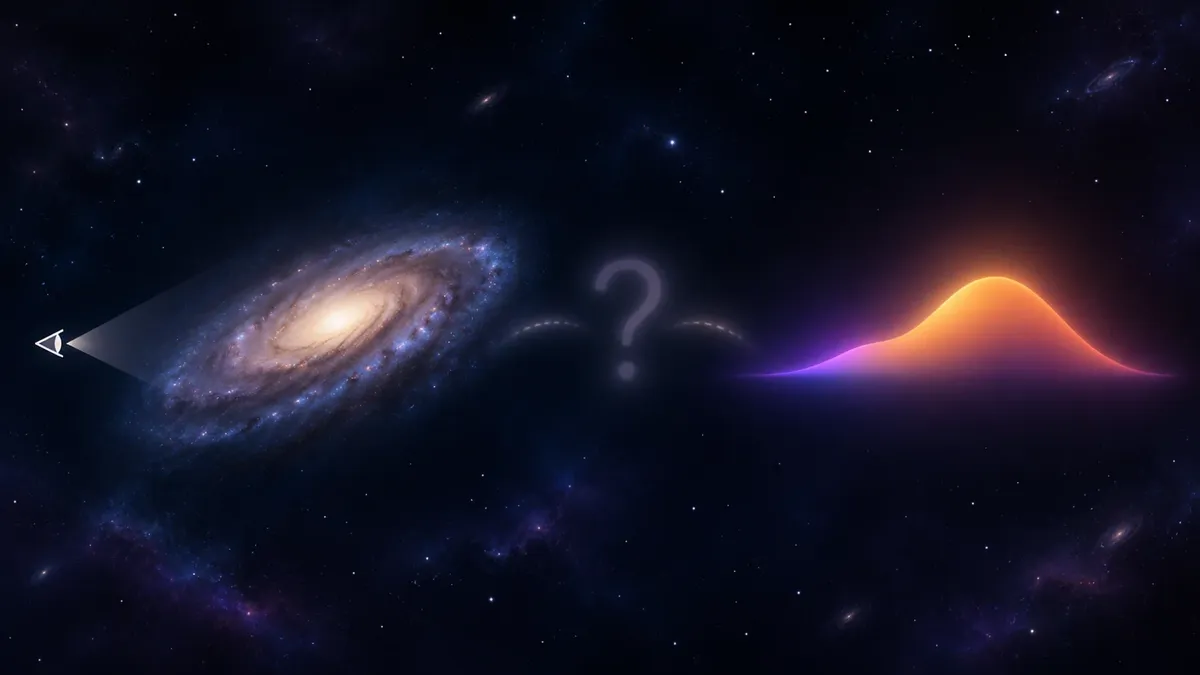
Dust dims and scatters some starlight, then emits energy in the infrared. A common modelling approach estimates that infrared output from the light absorbed along our line of sight. Comparing one such model setup with JWST observations, researchers found that its mid-infrared predictions tended to run high, especially for more attenuated galaxies.
Testing an assumption about dust
Dust changes the light we receive from a galaxy. It absorbs and scatters some ultraviolet and optical starlight, then re-emits energy in the infrared. In a method called dust energy balance, a galaxy model estimates infrared emission from the amount of starlight inferred to have been absorbed. This can help researchers estimate galaxy properties when direct infrared measurements are unavailable.
The method connects two different perspectives: attenuation is inferred from light reaching us along a particular line of sight, while infrared emission represents energy released by dust across the galaxy. If that sightline is not representative of the whole system, the estimate may be off. Benjamin P. Collins and colleagues tested this issue by comparing predictions from one energy-balance setup with JWST mid-infrared observations of galaxies at cosmic noon, an era of substantial galaxy growth.
Comparing predictions with MIRI data
The team measured photometry from JWST’s Mid-Infrared Instrument (MIRI) for 111 galaxies in the Blue Jay survey, at redshifts between 1.7 and 3.5. Their main analysis used a subsample of 89 star-forming galaxies. The observations came from public JWST programmes in the COSMOS field.
For the main test, the researchers fitted Hubble Space Telescope and JWST/NIRCam photometry with the Prospector modelling code. These data span the galaxies’ rest-frame ultraviolet to near-infrared light. The fits did not include MIRI measurements: the team used them to predict mid-infrared fluxes, then compared those predictions with the observed MIRI photometry. They also tested fits that included NIRSpec spectroscopy or MIRI measurements.
The MIRI flux measurements have an important calibration step. Comparing their F770W measurements with a separate COSMOS2025 catalogue, the researchers found that catalogue’s fluxes were higher by a median factor of 1.182. They scaled their measurements by that factor and added an 11% relative uncertainty. This comparison and adjustment are relevant context when interpreting the results, especially because measuring faint mid-infrared sources also involves background structure and detector artefacts.
Overprediction grows at longer wavelengths
With HST and NIRCam data alone, the model’s predicted mid-infrared fluxes were generally higher than the measured values. The reported median offset increased from about 10% in the F770W band to a factor of roughly three in F2100W. Predictions also showed greater scatter at longer wavelengths, where the model’s dust-emission parameters were weakly constrained.
The discrepancy increased with inferred dust attenuation. In the F2100W trend, the paper reports no significant systematic offset for galaxies with relatively low attenuation, around Aᵥ below 1. That does not mean all short-wavelength-only predictions agree with the observations: across the MIRI bands, the overall median offsets were positive. The trend with attenuation was clearer than any trend with recent star-formation activity.
Adding NIRSpec spectroscopy, but not MIRI data, reduced the median overprediction in the reddest band from about a factor of three to about 1.5. The authors argue that spectroscopy helps distinguish dust attenuation from effects of stellar age and metallicity, improving estimates of the absorbed starlight used by the energy-balance calculation.
When the researchers included MIRI photometry in the fits, the resulting models matched the measured MIRI fluxes to about 10% on average, with a median reduced chi-squared of 1.31. But matching fluxes does not show that every dust property has been accurately recovered. The paper says parameters describing dust emission remain poorly constrained, in part because the available broadband observations do not sample the full emission spectrum. For galaxies with inferred Aᵥ above about 1, the running median infrared luminosity from fits including MIRI was about 0.6 dex lower than from fits without it. This is a sample-level trend, not a stated reduction for every individual galaxy.
Possible explanations and limits
The authors consider whether the discrepancy reflects an overestimate of total absorbed starlight, a shift of dust emission toward longer wavelengths, or both. They favor the first possibility, suggesting that complex arrangements of stars and dust could make a particular sightline unrepresentative of galaxy-wide attenuation. They also discuss steeper, SMC-like attenuation curves as consistent with the results. These are interpretations, not geometries directly established for the observed galaxies. The comparison does not uniquely identify the cause for any one system.
The findings apply to a selected Blue Jay sample and a particular Prospector modelling setup; they do not show that energy-balance methods fail for every galaxy or code. The paper’s mock-data tests also found that several dust-emission parameters were hard to recover. Those tests used simulated galaxies at two redshifts, and even an idealized setup with all nine MIRI imaging bands left some parameters poorly constrained. The real observations cover only four MIRI bands and do not reach the far-infrared dust peak.
The manuscript was submitted to Astronomy & Astrophysics and is identified as a submission in the source, not as a peer-reviewed publication. Its results therefore warrant further scrutiny. The study’s practical point is that, for dusty galaxies, direct mid-infrared measurements or additional spectroscopy can change estimates based on shorter-wavelength photometry—and that agreement in measured flux does not by itself settle the underlying dust physics.
- JWST
- Blue Jay survey
- galaxy dust
- infrared emission
- Prospector
- spectral energy distributions
Related reading
Automatically matched by shared topic keywords. These links do not imply that the sources agree or establish a consensus.