TRANSMISSION // 2611.34797v1
How Neutrino Flavors Could Help Trace the Milky Way’s Cosmic Signals
Source published
A forecast suggests that IceCube, KM3NeT and future neutrino telescopes could use flavor measurements to test how the Milky Way’s high-energy neutrinos are made.
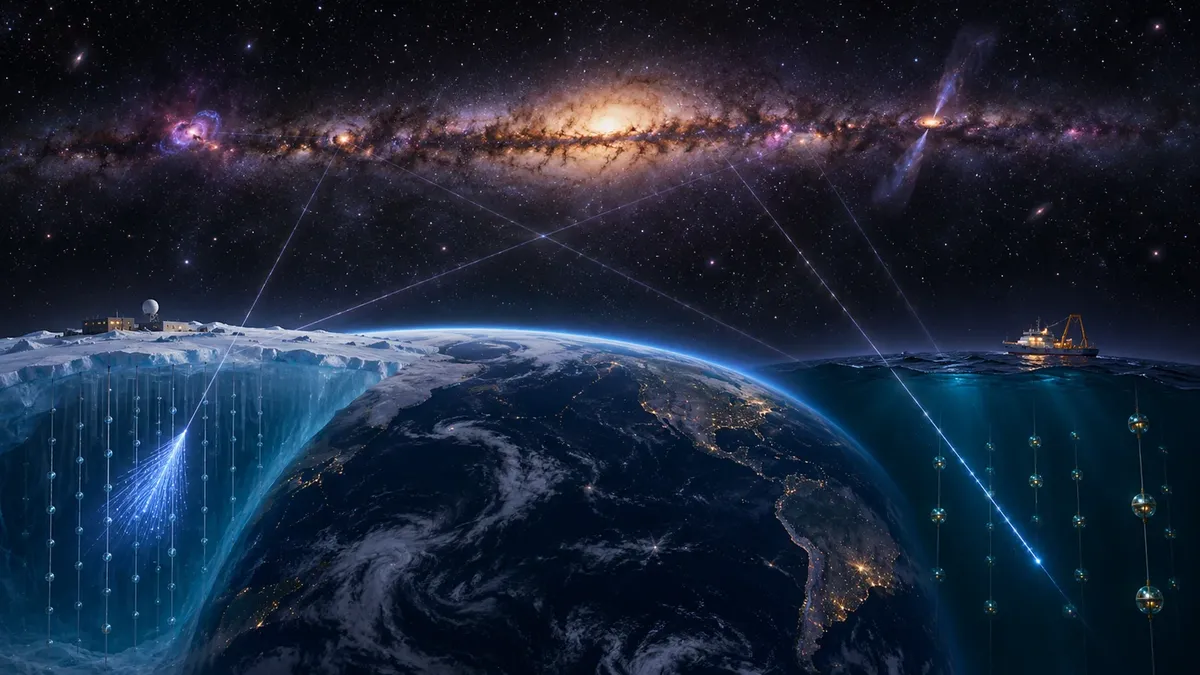
The Milky Way’s high-energy neutrinos have been detected, but their origin remains unsettled. A new study forecasts how well a global network of neutrino telescopes might distinguish possible production mechanisms by measuring the neutrinos’ flavors.
High-energy neutrinos are elusive particles that can cross the Galaxy with little interference. Their arrival is now established, but scientists are still debating what makes them: cosmic rays colliding with interstellar gas, unresolved astrophysical sources, or some combination. A new study by Mauricio Bustamante asks whether the neutrinos’ flavor composition could help distinguish these possibilities.
Neutrinos come in three flavors: electron, muon and tau. Their mix carries clues about how they were produced. In a common process, charged particles called pions decay through muons, making electron and muon neutrinos in a source ratio of roughly 1 to 2, with almost no tau neutrinos. Strong magnetic fields can cool muons before they decay, shifting the mix toward muon neutrinos. Neutron decay, another proposed mechanism, would instead produce electron antineutrinos. As neutrinos travel to Earth, oscillations change the mix; the study accounts for this when translating a measurement at Earth back to the sources.
The flavors are not equally easy to identify in a telescope. A muon neutrino can create a long track of light, while electron and tau neutrinos usually produce more compact showers that are harder to tell apart. IceCube, at the South Pole, sees much of the inner Galaxy mainly in showers. KM3NeT, in the Northern Hemisphere, can observe the region in tracks. The study’s central idea is that these views complement one another: tracks help measure the muon-neutrino share, while showers contribute information about the other flavors.
A forecast, not a measurement
The paper does not report a new flavor measurement. Instead, it forecasts what a set of detectors might be able to measure. The author modeled expected events in three sections of the Galactic plane and in the sky away from it, where extragalactic neutrinos dominate. The analysis combines tracks, showers and, where available, distinctive double-cascade events associated with tau neutrinos. It includes atmospheric neutrinos and muons as backgrounds, along with uncertainties in detector efficiency, energy measurement, pointing and event identification.
The forecasts use simulated expected counts, called Asimov data, for assumed source fluxes and flavor mixes. The modeled Galactic fluxes and spectra are based on IceCube measurements; the main forecast assumes pion decay at the sources. The paper considers IceCube, KM3NeT, Baikal-GVD and P-ONE, plus four planned telescopes. Its headline future scenario gives IceCube 15 years of data and the other detectors 10 years at full size. Those timelines and detector capabilities are assumptions, not guaranteed outcomes.
Under that scenario, all eight telescopes could estimate the source electron-neutrino fraction in the brightest, inner section of the Galactic plane to within 27% of its assumed value, at 68% confidence. The study says that precision could distinguish the pion-decay benchmark from both neutron decay and muon-damped sources. With the currently operating or being built telescopes considered together, the forecast is less precise: it could disfavor neutron decay but would not separate pion decay from muon damping in that section. IceCube and KM3NeT provide much of the complementarity because one mainly sees the inner Galaxy in showers and the other can add tracks.
The paper also explores comparing Galactic and extragalactic neutrinos. If their flavor mixes differ, possible explanations include muon cooling in the distant sources or neutrino decay during cosmological travel. In the model, the full detector network could detect signs of muon cooling for some assumed source conditions and could probe certain neutrino-decay scenarios. These are conditional projections, not evidence that either effect occurs.
What the numbers depend on
The results are sensitive to how well the detectors perform and to the assumptions used to model them. For some instruments, the author builds or adapts detector responses from publicly available information, because complete response data are not available. The paper reports checks against published performance, but those checks cannot eliminate uncertainty in future instruments or in the approximations. The forecast also assumes simplified source compositions, including no tau-neutrino production at the source for its main inference of the electron fraction. Real sources may be more varied, and the paper notes that energy-dependent flavor changes are difficult to detect.
Most importantly, the study estimates potential sensitivity under specified future exposures; it cannot guarantee that the measured fluxes, operating schedules or source conditions will match those assumptions. The work is a preprint, so its claims should be treated as research in progress rather than as a settled result. If the projected measurements become possible, flavor could add a new way to compare the Milky Way’s neutrinos with those arriving from beyond it—and test ideas about their sources and journey.
- high-energy neutrinos
- neutrino flavor
- Milky Way
- IceCube
- KM3NeT
- neutrino astronomy
Related reading
Automatically matched by shared topic keywords. These links do not imply that the sources agree or establish a consensus.
IceCube measures how the Milky Way’s neutrino emission varies across the sky
Source published
Shared keywords: high energy neutrinos
What Sets IceCube’s Neutrino Break?
Source published
Shared keywords: neutrino flavor
An AI Agent for Searching Neutrino Data
Source published
Shared keywords: high energy neutrinos
Neutrino flavor changes could reshape tests of dark matter interactions
Source published
Shared keywords: neutrino flavor
Could Little Red Dots Help Explain IceCube’s Neutrinos?
Source published
Shared keywords: high energy neutrinos