TRANSMISSION // 2611.34792v1
A Compact Encoding for Rydberg Optimization
Source published
A proposed crossing lattice reduces graph-site counts in benchmarks and proves exact decoding under an ideal blockade model, with important limits for real atoms.
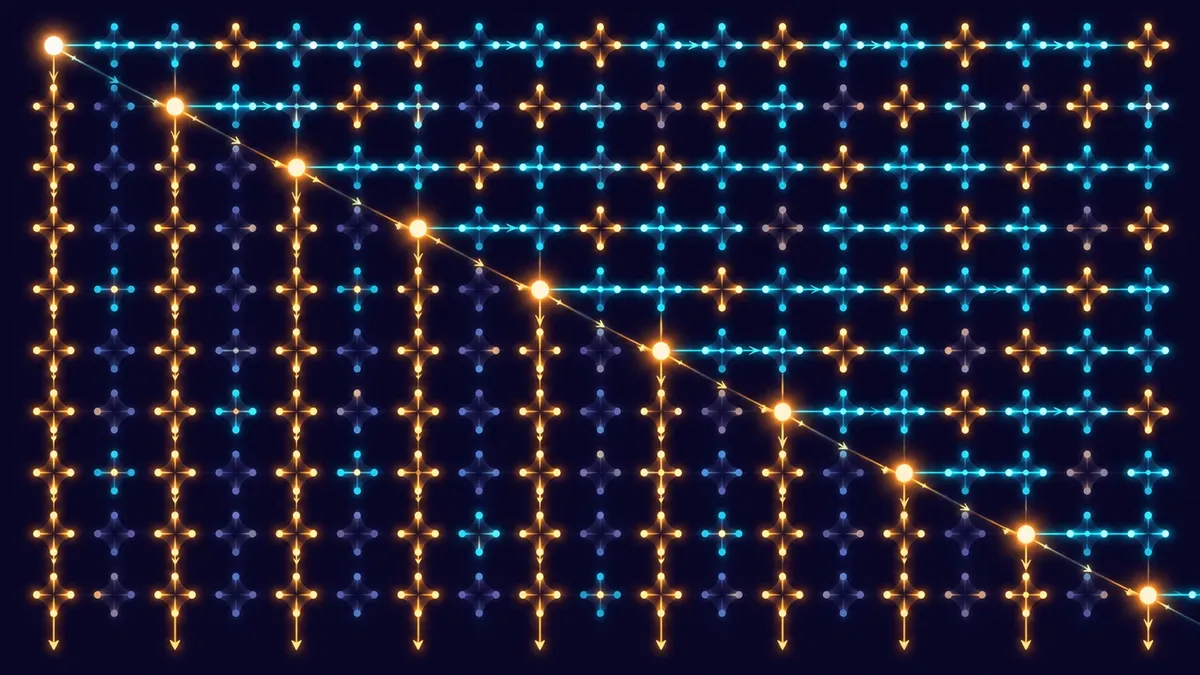
Rydberg-atom arrays can encode graph optimization problems, but representing connections that do not fit the array’s native geometry can require auxiliary atoms. Liyin Hu and colleagues propose a four-state crossing lattice to reduce that overhead. Their proofs apply to an idealized model, while their resource comparisons count graph sites—not demonstrated hardware savings.
Rydberg atoms can represent a graph: atoms are vertices, and pairs close enough to block one another’s excitation are connected by edges. In an idealized blockade model, allowed excitation patterns correspond to independent sets: groups of vertices with no connected pair. Assigning different rewards to atoms turns the ground-state search into a maximum-weight independent set problem. But a problem’s logical connections may not match the local connections available in a two-dimensional array. Encoding those connections can require auxiliary atoms, using up potential sites.
Liyin Hu and colleagues propose a different crossing layout. Each crossing is a four-state cell representing assignments to two binary variables. Cells connect directly to their neighbors, with row and column copy paths extending from diagonal sites. Along an occupied path moving away from the diagonal, the copied bit may stay the same or change from zero to one, but not from one to zero. The authors call this one-sided rule monotone propagation.
The central question is whether this compact arrangement can still encode optimization exactly: does an optimal configuration of the constructed graph reveal an optimal solution to the original problem?
For maximum-weight independent set, the authors put each original variable’s reward on its diagonal site and give crossing-cell states a uniform reward. They prove that every maximum-weight independent set of the constructed graph is filled—selecting one state in every retained cell—and that reading its diagonal sites gives an optimal solution to the source problem. The copies need not all agree. The one-way propagation rule, combined with deleting the forbidden 11 state at crossings for graph edges, is sufficient for correct diagonal readout. In the ideal blockade model, these graph optima correspond to zero-drive ground states.
The authors also prove an encoding for binary quadratic objectives with pairwise Boolean constraints. Here, weights at the ends of propagation paths penalize inconsistent copies. When the source constraints are feasible, every optimal target configuration has consistent active copies, and its weight is a constant offset minus the original objective. For infeasible instances, the construction provides a target-weight threshold certificate instead; the exact decoding guarantee does not apply as if a feasible source optimum existed.
A rectangular variant encodes minimum set cover. The stated construction applies to preprocessed instances with at least two candidate sets and at least one element. These are mathematical results about constructed unit-disk graphs, not demonstrations that an experimental device has solved the problems.
The resource comparison counts graph sites, or potential atom locations. Before constraint-based site deletions, the complete triangular layout uses 2n² − n sites, compared with 4n² − 2n − 4 for a fixed complete-grid reference. The leading quadratic term is therefore halved in that specific comparison. The authors also prune inactive parts of the layout; the resulting count depends on how far copies must propagate and on variable ordering.
In paired tests on 18 instances, each method could choose an ordering from the same candidate pool. The proposed layout used 12.1% to 54.0% fewer sites than the selected reference. The paper also reports larger savings under a shared-order procedure. These are finite benchmark comparisons, not a guarantee for every problem. Results depend on ordering and simplification choices, and site counts do not establish equivalent savings in working hardware.
There is also a physical caveat. The decoding proofs use an ideal blockade model: nearby excitations are strictly forbidden, while interactions beyond the cutoff are neglected. Real Rydberg interactions are finite and extend beyond that cutoff. In a ten-site example, the authors find that finite interactions can change the ground-state ordering at the specified coordinates and relative detunings. They say extending the guarantee requires analyzing detuning choices and the full interaction energies; the graph-level proof alone does not establish the same result for a real array.
This work is an arXiv preprint; the supplied evidence does not establish peer review. Its results combine proofs under ideal assumptions with finite site-count benchmarks, rather than experimental demonstrations. The proposed lattice may reduce encoding overhead in the graph model, but translating that advantage into reliable performance on physical arrays remains unresolved.
- Rydberg atoms
- quantum optimization
- maximum independent set
- binary optimization
- unit-disk graphs
- quantum computing
Reviewed cross-references
These connections were reviewed by a model, not independently fact-checked by a human. Similarity does not imply agreement; consult the original papers and the evidence below.
Turning L-system inference into a graph problem
Shared method: Both papers use graph reductions to formulate an optimization problem as maximum independent set: the origin constructs a unit-disk-graph MWIS encoding for binary optimization, while Lotfi, McQuillan and Rayan reduce deterministic L-system inference to MIS on a characteristic graph. This is a shared reduction approach, not evidence that the characteristic graphs have the origin's unit-disk geometry or that the constructions are interchangeable.
Model review: · openai-codex/gpt-6-luna
Evidence and provenance
Selected excerpts, not complete papers. PDF extraction can omit figures or damage equations, tables and reading order; sources may be preprints.
2611.34792v1 — Original paper
Excerpt reference:
static/papers/2611.34792v1.md:273-385
Basis: Paper text
Source SHA-256:3a7b0b20c0909467cc74fc337bcfa1f240ea884771e24ae163fdb133ac918d4b2411.19906v4 — Original paper
Excerpt reference:
static/papers/2411.19906v4.md:92-133
Basis: Paper text
Source SHA-256:5d77d1c7273d9b0a0c9ea653112a480378b3e8cdf0199335765fffbf8d803ba3
Related reading
Automatically matched by shared topic keywords. These links do not imply that the sources agree or establish a consensus.
How Rydberg atom arrays can search beyond their own constraints
Source published
Shared keywords: binary optimization, quantum optimization, rydberg atoms
Quantum optimization beyond the qubit limit: a promising but uneven test
Source published
Shared keywords: quantum computing, quantum optimization
Turning L-system inference into a graph problem
Source published
Shared keywords: maximum independent set, quantum optimization
A framework for quantum optimization with constraints
Source published
Shared keywords: binary optimization, quantum optimization
A New Route for Quantum Optimization with Inequality Constraints
Source published
Shared keywords: binary optimization, quantum optimization