TRANSMISSION // 2611.34790v1
A better way to prioritize asteroid follow-up
Source published
A Bayesian classifier estimates the chance that a newly spotted object is near Earth, potentially helping astronomers prioritize follow-up as Rubin is expected to find more faint asteroids.
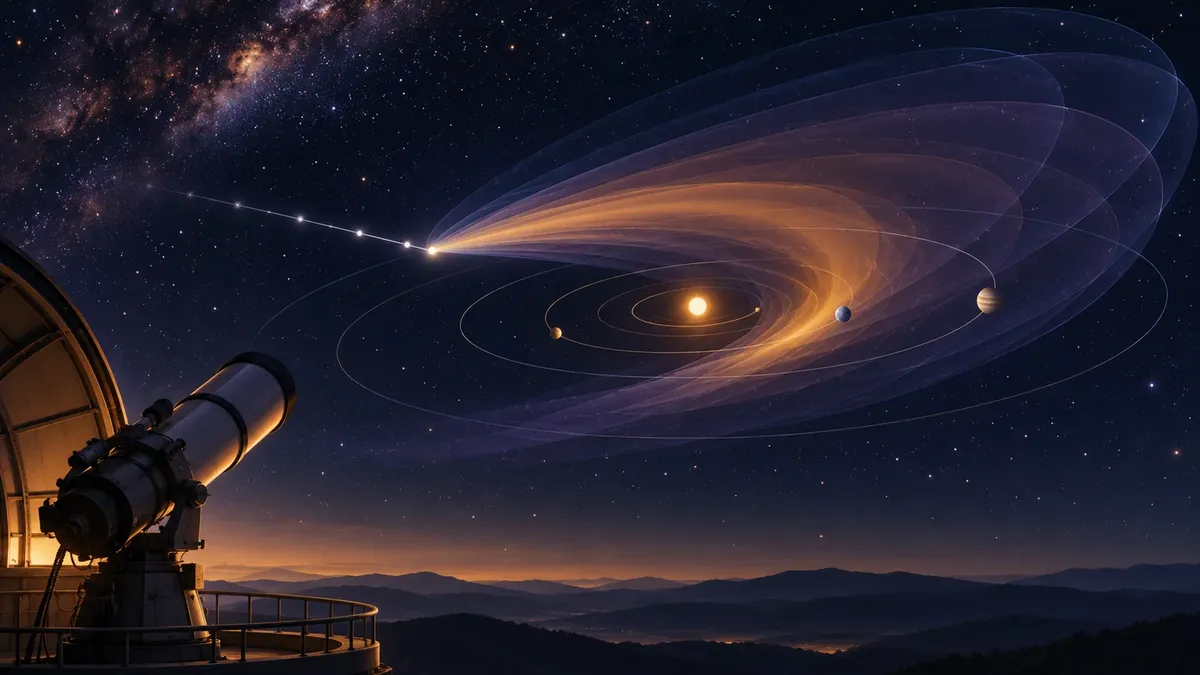
A few observations in one night show how an asteroid moves across the sky, but not how far away it is. That uncertainty complicates decisions about which discoveries deserve scarce telescope time. A new classifier, pneo, weighs possible orbits against a model of Solar System populations and reports a probability of near-Earth-object status. Its tests suggest it can improve candidate selection, though the gains depend on the population model and the samples tested.
A sky survey may spot a moving point of light only a few times in one night. Those observations reveal its position and apparent motion, but do not directly measure its distance or its motion toward or away from Earth. As a result, different distance and orbit possibilities can fit the same short tracklet. Brightness helps constrain those possibilities, but does not by itself settle the object’s distance or size.
This uncertainty matters because telescope time to confirm new objects is limited. The Vera C. Rubin Observatory is expected to produce a much larger stream of faint Solar System discoveries, adding pressure to follow-up programs. How can astronomers decide which candidates to observe first?
Turning tracklets into probabilities
Devanshi Singh, Mario Jurić and Željko Ivezić introduce pneo, a classifier that estimates the probability that a tracklet belongs to a near-Earth object (NEO). In the paper, NEOs are defined as objects whose orbits bring them within 1.3 astronomical units of the Sun.
Rather than choosing a single guessed distance, pneo considers possible distances and rates of approach or recession that fit the observed motion and correspond to bound orbits around the Sun. It uses apparent brightness to infer the object’s absolute brightness under each possibility, then weights the possibilities using a model of the numbers and orbital properties of NEOs and other small Solar System bodies. It adds up the support for NEO possibilities and compares it with the support for all modeled possibilities.
The result is a probability, not just a ranking score. The authors describe it as the exact Bayesian posterior under their adopted population model. “Exact” refers to the calculation given that model; it does not mean that the model perfectly describes the real Solar System.
The researchers implemented the method in open-source software and compared it with digest2, the classifier used to help determine which candidates are posted to the Minor Planet Center’s NEO Confirmation Page. Posting normally uses a digest2 score threshold, with review by the Minor Planet Center; the score is not itself a calibrated probability. The tests covered simulated tracklets, past NEO Confirmation Page discoveries, Rubin alert data, and Rubin Data Preview 2. The team examined calibration—whether predicted probabilities match the observed fraction of NEOs—and compared the share of selected candidates that were NEOs at similar NEO recovery, or completeness.
What the tests found
In simulations designed to represent Rubin’s observing depth, pneo’s selected candidates were 96% NEOs, compared with 48% for digest2 at the same completeness. Many of digest2’s false positives in this simulation were distant objects: their slow apparent motion allowed nearby NEO-like orbit possibilities, while pneo’s weighting gave greater support to the distant solutions.
Results from real data were more limited and depended on the sample. On the NEO Confirmation Page sample, pneo selected about 40% fewer non-NEOs at comparable NEO recovery. In the Rubin alert-stream tests, comparisons on labeled samples of known objects and objects Rubin had not associated found fewer non-NEOs selected by pneo at similar NEO recovery. The paper also reports a reduction in non-NEOs on Data Preview 2. These are results for the particular tested samples, not a measurement of performance across all future Rubin candidates. Some samples contain cataloged objects, which affects how representative they are of newly discovered faint objects.
Summed pneo probabilities predicted NEO counts close to those observed in several real-data tests. One exception was the sample of known objects in the alert stream, where pneo underpredicted the number of NEOs. The authors suggest that selection based on catalog membership may help explain this: known objects are not a neutral sample of everything a survey might detect.
A single-night tracklet cannot always distinguish an NEO from another asteroid, so pneo can return low or intermediate probabilities rather than a definitive answer. It also cannot repair faulty tracklets formed by mixing detections of different objects; those errors require separate filtering and tracklet-building steps.
Important uncertainties
The main uncertainty is the population model. Pneo uses the model maintained for digest2, based on an older synthetic Solar System population represented in coarse bins. The paper notes limitations, especially for faint and distant populations that are not well known. Since the simulated advantage depends on how these populations are represented, its size remains uncertain. A different population model could be substituted, but the effects would need further testing.
The main analysis treats measured position, motion and brightness as exact. Simulations suggest this is adequate for tracklets spanning at least 15 minutes; shorter arcs are more vulnerable to measurement errors. The method covers NEOs and other modeled non-NEOs, but not comets or interstellar objects, and it evaluates each night independently rather than combining evidence across nights.
The source is a November 2026 arXiv preprint, and the supplied material does not establish its peer-review or journal-publication status. The findings should therefore be read as the authors’ reported analyses, not as settled performance in routine operations. The suggestion that improved candidate purity could potentially double effective follow-up capacity is an implication, not a demonstrated operational result. The central idea is more modest: account for the range of possible orbits, and make the assumptions behind a candidate’s probability explicit.
- near-Earth objects
- asteroid follow-up
- Bayesian classification
- Rubin Observatory
- planetary defence
Related reading
Automatically matched by shared topic keywords. These links do not imply that the sources agree or establish a consensus.
Rubin’s hidden snapshots reveal comet tails and cosmic outbursts
Source published
Shared keywords: near earth objects
Testing Tomorrow’s Lunar Asteroid Telescopes in Earth’s Harshest Places
Source published
Shared keywords: planetary defence
GPS signals offer Rubin Observatory a way to track atmospheric water
Source published
Shared keywords: rubin observatory
How Rubin Data Classify Astronomical Sources
Source published
Shared keywords: rubin observatory
Reading the redshifts hidden in the glow of faint galaxies
Source published
Shared keywords: rubin observatory