TRANSMISSION // 2611.34786v1
A function-aware way to model starspots in planet searches
Source published
A new method models how stellar spectra change across wavelength and time. In effectively noiseless simulations of a spotted Sun-like star, it recovered compact spectral patterns more accurately than PCA when observations were sparse and irregular.
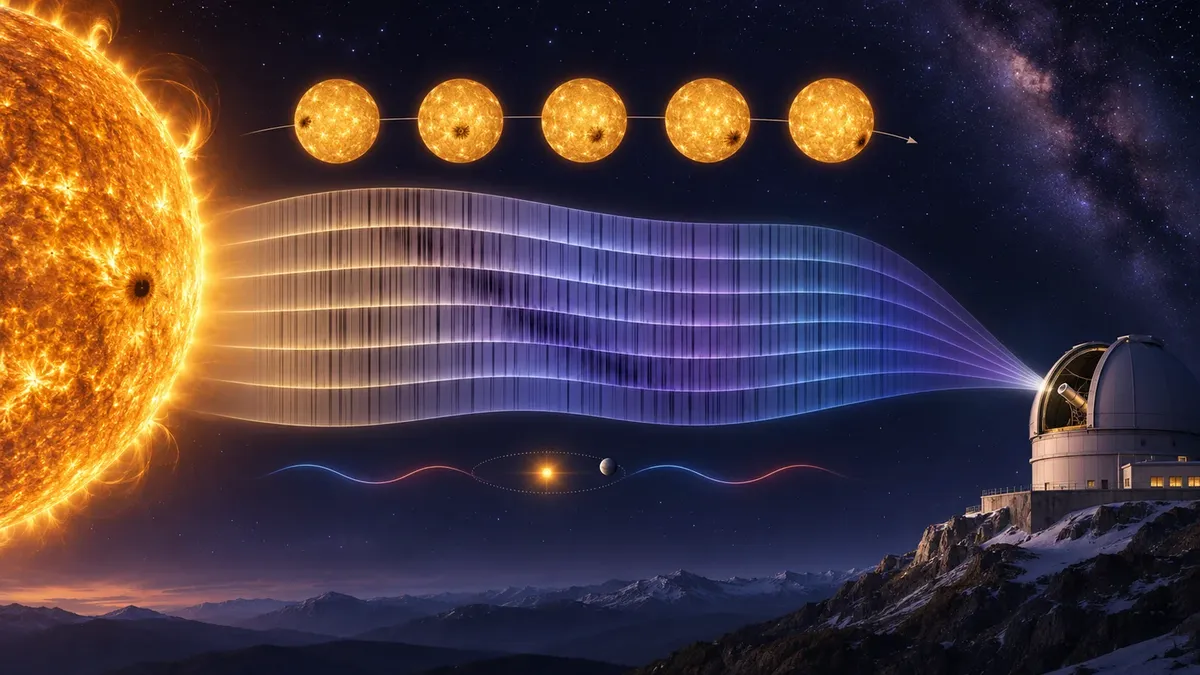
Tiny stellar wobbles can reveal planets, but changing starspots can imitate them. A study introduces a way to model changing spectra that accounts for when observations were taken—and tests it using simulated, effectively noiseless data.
Finding a small planet can mean looking for a tiny, repeating shift in its star’s spectrum. As a planet and star orbit their shared centre of mass, the star moves slightly toward and away from us, shifting the wavelengths of its spectral lines. But a star is not always steady: dark spots and other active regions change the light from its rotating surface, potentially masking or mimicking a planet’s signal.
A paper by Kevin Tao, Thomas Loredo and David Ruppert explores a way to represent these changing spectra. Its central question is whether a method that treats a spectrum as a continuous pattern across wavelength—and tracks how that pattern evolves over time—can build a more accurate compact model than principal component analysis (PCA), especially when observations are sparse or irregular.
Treating spectra as evolving patterns
Astronomers often use PCA to find a small number of patterns that capture differences among spectra collected at different times. These patterns can help describe stellar activity. But standard PCA treats each spectrum as a finite list of measurements and the observation times mainly as labels. It does not explicitly account for the gaps between observations or treat the spectrum and its evolution as continuous functions.
The authors instead use the asymmetric Hilbert–Schmidt decomposition (HSD), a mathematical method for approximating a two-variable function—in this case, brightness across wavelength and time—with a sum of simpler, separable patterns. Each component pairs a spectral pattern, called a “speclet,” with a time-varying pattern, or “modulator.” A small number of pairs can provide a compact description of the full dynamic spectrum.
To compare the approaches, the researchers generated spectra with SOAPv4, a stellar-activity simulation tool. Their main example was a Sun-like star with one equatorial spot covering 1% of its surface. They began with a finely sampled simulation spanning one stellar rotation, then repeatedly selected smaller, randomly chosen sets of observation times. This let them test how PCA and HSD performed as time sampling became sparser and less regular. They compared the recovered basis patterns with those from the full simulated sequence and assessed how well each method reconstructed the changing spectrum.
Better recovery in the simulated test
In this test, HSD recovered the leading spectral basis patterns more accurately than PCA across the tested time subsamples. Its advantage persisted when observations were sparse and irregular. The paper also reports lower reconstruction error for HSD at fixed model orders: with three or four pairs of patterns, its error was about an order of magnitude lower than PCA’s across much of the tested range. At the most heavily reduced sampling, 42 time points, the reported HSD error was still about three times smaller.
A starspot can distort spectral lines as it rotates across the star’s face. Some of these changing distortions resemble the small shifts used to measure stellar motion. A compact model that follows the spectrum’s evolution could therefore provide useful groundwork for separating activity-related changes from a planet’s Doppler signal.
That application remains ahead. The study tests how well the methods approximate simulated spectra; it does not show that HSD has detected a planet, improved a real planet estimate, or reached the precision needed to find an Earth-like world. The authors note that HSD is designed to minimize integrated squared error across wavelength and time. That is a measure of reconstruction quality, but it is not necessarily the measure that best protects radial-velocity estimates, which depend on how accurately spectral slopes and line shifts are represented.
What remains to be tested
A key caveat is that the simulated spectra were effectively noiseless. The comparison therefore does not establish how HSD performs when measurement noise is present. It also focuses on one simulated spot configuration and one portion of the spectrum; it does not establish performance with real observations, multiple spots, faculae or other kinds of stellar variability. The authors identify these as important directions for further study. They also note that real observing schedules may require more sophisticated treatment than the simple linear interpolation implicit in their time-integration rule.
The paper’s suggestion that spectral patterns may be similar across different spot configurations is preliminary, not a demonstrated general result. Whether patterns transfer across stars or activity types remains open. Applying the method to planet searches will also require statistical models that connect the spectral representation to radial-velocity estimates and address whether activity and planet signals can be distinguished in the available data.
This November 2026 preprint is research in progress, not a settled result. The evidence supports a narrower conclusion: for an effectively noiseless simulation of a spotted star and the tested sampling designs, HSD produced more accurate fixed-order spectral models than PCA. Further tests are needed to determine whether that advantage holds with noisy, real-world observations and translates into better planet searches.
- exoplanets
- radial velocity
- stellar activity
- starspots
- spectroscopy
- Hilbert-Schmidt decomposition
- PCA
Related reading
Automatically matched by shared topic keywords. These links do not imply that the sources agree or establish a consensus.
GJ 9404 b remains an uncertain planet candidate
Source published
Shared keywords: radial velocity, stellar activity
Four Sub-Neptunes Get New Mass Measurements
Source published
Shared keywords: radial velocity
TOI-2120 b: a small planet with a big composition question
Source published
Shared keywords: radial velocity
Gaia and Hipparcos map possible companions around 100,000 stars
Source published
Shared keywords: radial velocity
Stellar Wobbles Point to Planets for Future Imaging
Source published
Shared keywords: radial velocity