TRANSMISSION // 2611.34785v1
Can synthetic personas make AI training conversations sound more like real users?
Source published
PersonaFactory uses structured synthetic personas to vary the style of user prompts across languages. Its authors report stronger control and intent preservation, but the evidence comes from an abstract-described preprint evaluation.
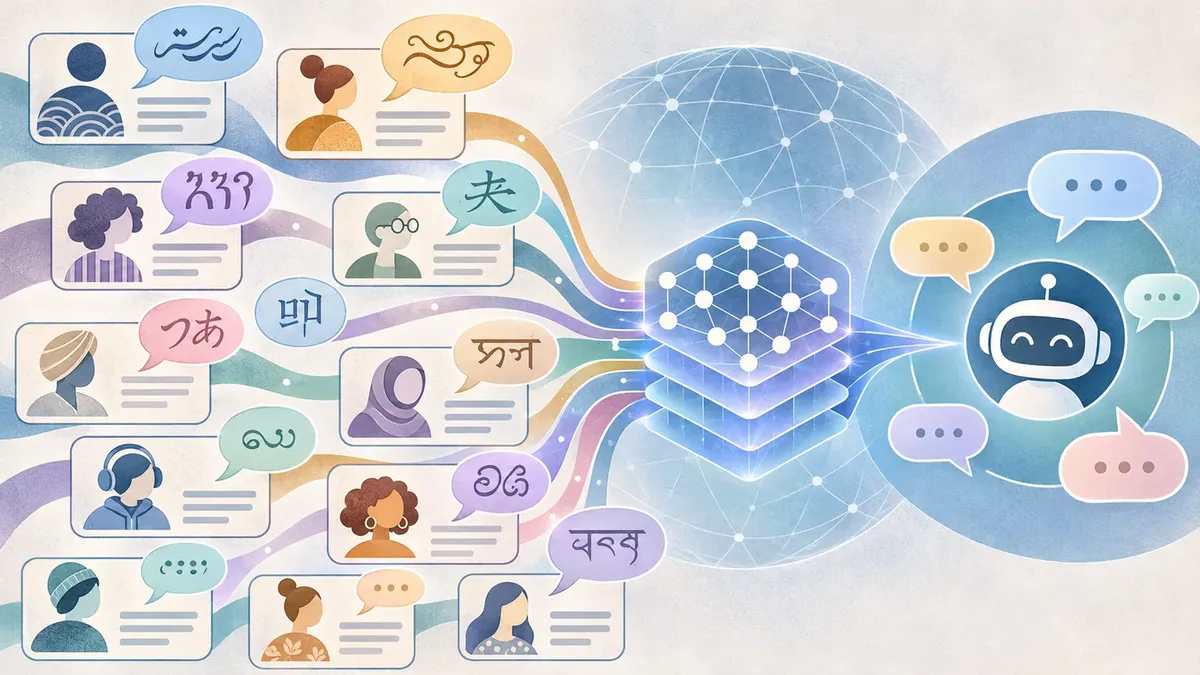
AI systems are often trained and tested on conversations that include simulated users. PersonaFactory aims to make those users less stylistically uniform, while keeping the original request intact. The reported results are promising, but the available source is only the paper’s abstract, so many details needed to judge the claims are missing.
Synthetic conversations can help train and evaluate AI assistants, but they may not capture the variety of ways people actually communicate. PersonaFactory, a new research pipeline, tackles this problem by creating fictional user profiles and using them to rewrite existing prompts in different voices. The goal is to add stylistic variety without changing what a user is asking for.
The authors describe a bank of more than 740,000 structured synthetic personas and about 1.24 million persona-styled conversations in 85 languages. They say the personas include details about users’ backgrounds and communication behaviors. Rather than relying only on a free-form description, the method represents style through attributes, which the authors say allows individual aspects of a persona’s voice to be controlled.
How the researchers assessed it
The team evaluated two related questions: whether personal features affect the style of generated prompts, and whether the rewritten prompts preserve the original intent. According to the abstract, they used a large language model as a judge alongside heuristic metrics—rule-based or otherwise automated measures—to assess how faithfully the system changed style and retained meaning.
They also tested whether conversations generated with PersonaFactory could be useful in training assistant models. The abstract reports comparisons on capability benchmarks, preferences for assistant replies to real user prompts at equal reply length, and how closely assistants adapted their reply style to users without explicit instructions to do so. A human expert evaluation assessed whether the synthetic conversations seemed plausible, including their intent preservation, naturalness of style, and multilingual authenticity.
What the abstract reports
The authors report that the structured, attribute-based representation preserved intent better than free-text persona descriptions from existing approaches, while achieving comparable style fidelity. In other words, they say it offered more control without sacrificing the ability to make prompts sound different.
The human evaluators reportedly found the generated conversations plausible, with favorable assessments across the qualities they examined. For downstream training, the authors report capability-benchmark performance comparable to that of original training data. They also say assistants trained with PersonaFactory conversations were preferred on real user prompts when reply lengths were matched, and adapted more closely to users’ styles without being explicitly steered.
These are the authors’ reported findings, not proof that synthetic personas reproduce the full range of human communication. The abstract does not provide benchmark names, sample sizes, scores, uncertainty estimates, or details of the human evaluation. Without those, readers cannot assess the size and reliability of the differences, how the tests were designed, or how broadly the results apply. The phrase “comparable” also does not, by itself, establish a formal statistical equivalence.
What remains uncertain
A fictional persona is a designed profile, not a real person. The reported evaluation therefore speaks to whether a pipeline can generate plausible, controllable training material under tested conditions—not whether its simulated users represent people generally. The abstract does not explain how personas were sampled, how the 85 languages were covered, or whether performance varied across languages and user groups. Nor does it provide enough information to evaluate the judge model’s role or the limits of the heuristic measures.
The findings could matter to researchers building training sets and evaluations: varied prompt styles may help expose assistants to less uniform interactions. But the abstract alone cannot establish whether that variety improves performance in everyday use, or whether the generated conversations introduce distortions of their own.
This account is based on the abstract of an arXiv preprint, not a full-paper review. Preprints may not have been peer reviewed, and the evidence available here omits methodological and numerical details. The authors’ claims should be read as preliminary until the full methods and results can be examined.
- synthetic data
- AI personas
- language models
- prompt augmentation
- multilingual AI
- AI evaluation
Reviewed cross-references
These connections were reviewed by a model, not independently fact-checked by a human. Similarity does not imply agreement; consult the original papers and the evidence below.
Can AI Personas Act Like the Traits They Claim?
Supporting evidence: Both studies report advantages for more structured persona representations in their own evaluations: PersonaFactory’s attribute-based style representation improved intent preservation relative to free-text persona descriptions at comparable style fidelity, while Zhang et al. found profile-enriched representations more internally consistent with self-reports than raw dialogue. These are complementary, not directly comparable outcomes; internal consistency does not establish fidelity to the source user, and neither result shows general superiority across tasks.
Model review: · openai-codex/gpt-6-luna
Evidence and provenance
Selected excerpts, not complete papers. PDF extraction can omit figures or damage equations, tables and reading order; sources may be preprints.
2611.34785v1 — Original paper
Excerpt reference:
static/papers/2611.34785v1.md:15-91
Basis: Paper text
Source SHA-256:1073daa4b081922b5e42bac4ccc1c6d1a705f30b1b94782584f38f607785b10a2611.34785v1 — Original paper
Excerpt reference:
static/papers/2611.34785v1.md:232-288
Basis: Paper text
Source SHA-256:1073daa4b081922b5e42bac4ccc1c6d1a705f30b1b94782584f38f607785b10a2611.30280v1 — Original paper
Excerpt reference:
static/papers/2611.30280v1.md:13-80
Basis: Paper text
Source SHA-256:677a8288df3f4ee76e404c575b0cb56bbda3bed6d24f51482e8ad990fc7cd4332611.30280v1 — Original paper
Excerpt reference:
static/papers/2611.30280v1.md:896-980
Basis: Paper text
Source SHA-256:677a8288df3f4ee76e404c575b0cb56bbda3bed6d24f51482e8ad990fc7cd433
Related reading
Automatically matched by shared topic keywords. These links do not imply that the sources agree or establish a consensus.
A multilingual test for AI ticket routing—and why its high scores need context
Source published
Shared keywords: ai evaluation, language models, multilingual ai
Can AI Personas Act Like the Traits They Claim?
Source published
Shared keywords: ai evaluation
Simulated city tests how AI investigators handle incomplete evidence
Source published
Shared keywords: ai evaluation, language models, synthetic data
When an AI persona helps—and when it gets in the way
Source published
Shared keywords: ai personas
Why AI survey respondents can seem too consistent
Source published
Shared keywords: ai personas