TRANSMISSION // 2611.34775v1
Four Faint Companions Found Around the Milky Way
Source published
A systematic search of UNIONS photometry identified four possible Milky Way satellites. Two may be ultra-faint dwarf galaxies, but their classifications and dark-matter content remain uncertain.
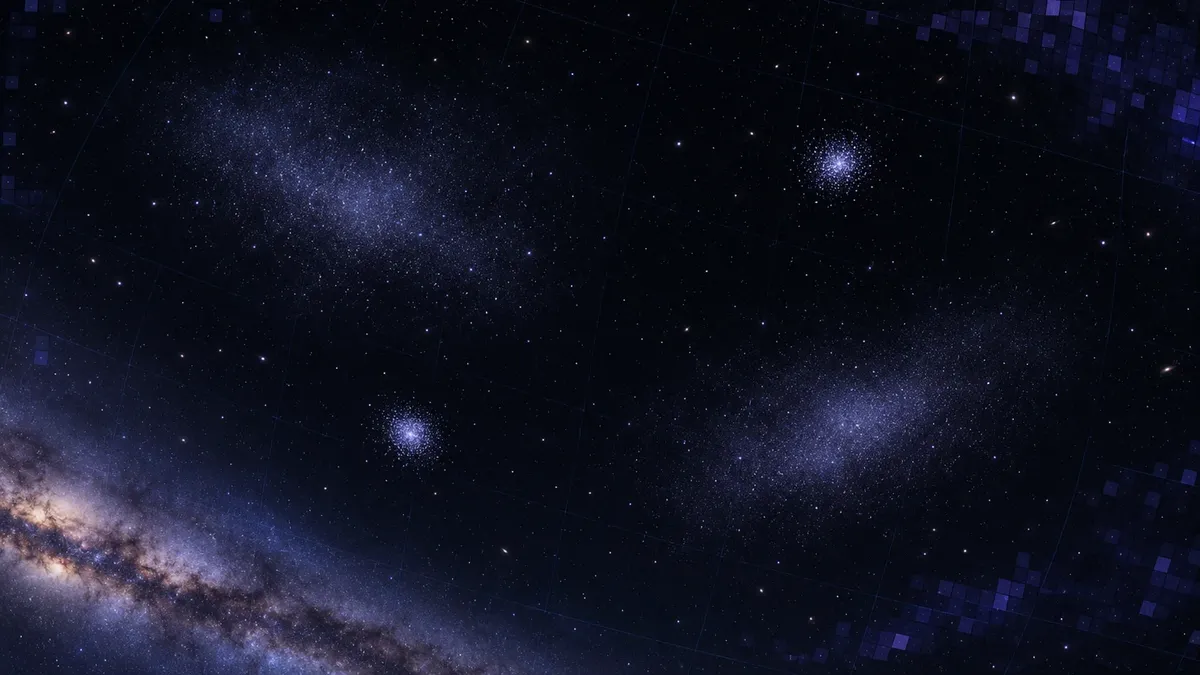
Tiny groups of stars can be difficult to classify: they may be dwarf galaxies or star clusters, and faintness leaves few clues. A search through northern-sky UNIONS survey data has identified four new Milky Way satellite candidates, including two that may be ultra-faint dwarf galaxies.
Astronomers report four newly discovered Milky Way satellite candidates in a systematic search through optical gri photometry from the Ultraviolet Near-Infrared Optical Northern Survey (UNIONS). The findings add possible companions to the census, but the evidence described in the paper’s abstract does not establish what all four systems are.
Classifying very faint stellar systems is challenging. Their measured brightness and size can offer clues, but appearance alone may not distinguish a dwarf galaxy from a star cluster. In this study, the authors identify two likely ultra-faint dwarf galaxy candidates and two much fainter systems whose classifications remain uncertain.
Two possible dwarf galaxies
The researchers name the first pair Boötes VI and Draco III. Both are estimated to lie at least about 100 kiloparsecs from the Galactic center—around 326,000 light-years. Their estimated absolute magnitudes in the V band are −2.7 for Boötes VI, with an uncertainty of +0.6 and −0.5, and −4.0 ± 0.6 for Draco III. Absolute magnitude compares intrinsic brightness at a standard distance; more negative values mean brighter objects.
The estimated half-light radius of each is about 50 parsecs, or roughly 160 light-years. This is the radius containing half the system’s measured light. The authors say these candidates are about twice as extended as the most extended Milky Way globular clusters with similar luminosities. Their size makes a galaxy classification plausible, but does not settle it. The authors say chemical and dynamical analyses will be needed to secure that classification.
Two tiny, extremely faint systems
The other discoveries are named UNIONS 2 and UNIONS 3. Their estimated absolute magnitudes are +0.4, with uncertainties of +0.6 and −0.9, and −0.7, with uncertainties of +0.6 and −0.8, respectively. Their estimated half-light radii are 5 ± 1 parsecs and 10 parsecs, with uncertainties of +3 and −2 for UNIONS 3. The researchers identify no giant stars in either system’s present-day stellar population.
Those measurements do not reveal whether these systems are galaxies or star clusters. Nor can their observed shapes establish whether they contain dark matter. The authors emphasize that both detecting and ruling out dark matter in systems this faint is difficult. The discoveries therefore provide targets for further investigation, not proof of dark matter in either object.
What the evidence can—and cannot—show
The four candidates do not all have the same evidential status. Boötes VI and Draco III are described as likely ultra-faint dwarf galaxies, with their relatively large sizes among the clues. But their classification remains provisional pending chemical and dynamical work. UNIONS 2 and UNIONS 3 are more compact and exceptionally faint; their nature and dark-matter content are unresolved.
The abstract describes a systematic search through UNIONS gri photometry, but does not provide enough detail to assess the selection criteria, search completeness, or possible sources of error. It also does not describe follow-up observations. The reported measurements and their uncertainties are useful estimates, not a complete account of every uncertainty involved in interpreting these objects.
This article is based on the paper’s abstract rather than a review of its full text. The source is an arXiv preprint; the supplied information does not establish whether it has been peer reviewed. The authors’ classifications should therefore be understood as candidates and conclusions reported in the preprint, not as settled determinations.
- Milky Way satellites
- ultra-faint dwarf galaxies
- UNIONS survey
- Boötes VI
- Draco III
- dark matter
Related reading
Automatically matched by shared topic keywords. These links do not imply that the sources agree or establish a consensus.
What a Few Stars Can Reveal About a Dwarf Galaxy’s Dark Halo
Source published
Shared keywords: ultra faint dwarf galaxies
Could dark matter explain unusually compact stars?
Source published
Shared keywords: dark matter
Could M87’s black hole reveal light dark matter?
Source published
Shared keywords: dark matter
Galactic dust offers a tentative clue to dark matter—not a verdict
Source published
Shared keywords: dark matter
A cosmological window for majoron dark matter
Source published
Shared keywords: dark matter