TRANSMISSION // 2611.34772v1
How BigRAID Drills RNO-G’s Greenland Boreholes
Source published
A field report describes BigRAID’s upgrades and reports no sticking events in 2025, while noting unresolved drilling and equipment problems.
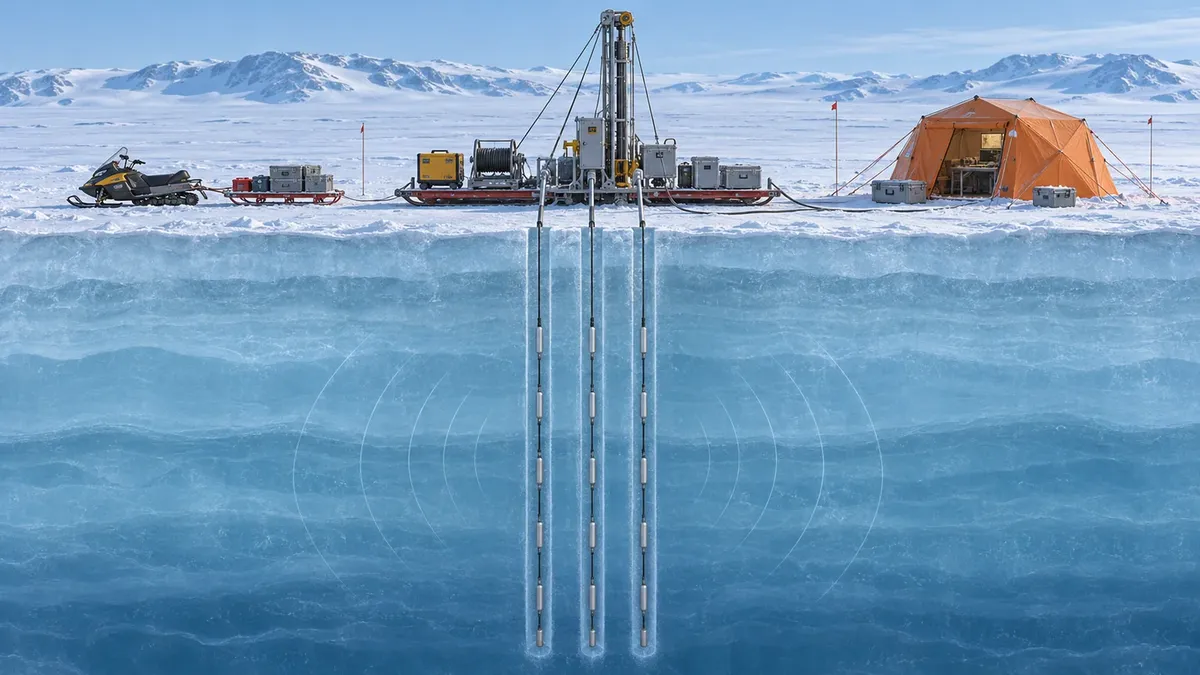
RNO-G needs deep boreholes for antennas that will search Greenland’s ice for radio signals from ultra-high-energy neutrinos. A preprint follows the BigRAID drill through four operating seasons, describing what improved and what still needs investigation.
Why drilling matters
The Radio Neutrino Observatory in Greenland (RNO-G) is designed to detect ultra-high-energy neutrinos. When one of these rare particles interacts in glacial ice, it can produce a brief radio pulse. Buried antennas are intended to detect that signal, but installing them requires large, deep holes in a remote, cold environment.
RNO-G’s first phase is planned to include 35 stations, each with three antenna strings in separate boreholes about 100 metres deep. The preprint says eight stations had been deployed by the time of its account; it does not give a deployment date alongside that figure. BigRAID is the mechanical drill used to make the holes. The paper describes it as a British Antarctic Survey (BAS) system adopted for RNO-G; the authors acknowledge BAS colleagues for building and operating it.
A drill that carries its cuttings
Rotating cutters break the ice into chips, which are collected inside the drill and brought to the surface. A snowblower then disperses the chips. The authors report that BigRAID produces dry boreholes about 285 millimetres in diameter. They say a two-person team can drill a 100-metre hole in approximately 12–15 hours, although setup, maintenance and other field work add to the effort.
The report covers drilling seasons in 2021, 2022, 2024 and 2025. The team paused drilling in 2023 to work on development and reliability. Across the operating seasons, the authors describe equipment changes and operational experience, including revised controls, automated drilling functions, sensors to monitor movement and redesigned components. This is a field-performance account, not a controlled comparison: equipment and operating conditions changed over time, so the report cannot isolate the effect of every upgrade.
Sticking and redesign
The drill became stuck during the 2021 and 2022 seasons and again in 2024. The paper links early incidents to factors including above-freezing conditions and ice forming on equipment. Later, inspection suggested that chips could collect around a protruding edge of the cutter head and jam the drill. Recovery sometimes involved excavation or sending heated propylene glycol down the borehole.
For 2025, the team introduced a cutter head with an outer profile flush with the drill barrel. The authors report zero sticking events that season, including under described stress-test conditions such as power loss while cutting and an overfilled barrel. They completed 11 full-depth science holes. That is an encouraging result from one season, not proof that sticking cannot happen under other conditions or in future operations.
Other changes addressed practical bottlenecks. In the deeper part of a hole, automation can perform much of the repeated drilling sequence while operators set parameters and supervise; the shallow section still requires manual steps. A redesigned snowblower traverse system reduced its travel time from about 120 seconds to 20 seconds. A tent-lifting modification also reduced the personnel needed for moving between holes from three to two.
What remains uncertain
Some problems persisted. Snow and ice could still interfere with the snowblower, and ice could form inside the drill barrel during transport. The team also observed that below roughly 50 metres, the drill sometimes failed to engage the ice effectively. Applying a small amount of isopropanol before drilling runs appeared to help, but the underlying cause was unclear. The authors identify this as an issue for further investigation, not a settled explanation of why the treatment helped.
BigRAID’s drilling performance is a practical step toward installing RNO-G’s antennas. This paper reports on drilling operations, not neutrino detections or the scientific sensitivity of a completed observatory.
The source is an arXiv preprint dated 2026. Although the extracted paper text gives Annals of Glaciology as its journal heading, the supplied material does not establish its publication or peer-review status. The results should be read as the authors’ report of field experience across a limited set of seasons, with both the 2025 improvement and unresolved issues in view.
- RNO-G
- BigRAID
- Greenland ice drilling
- neutrino observatory
- polar engineering
- field performance