TRANSMISSION // 2611.34756v1
How CARE-OPD makes long-horizon AI training more efficient
Source published
CARE-OPD combines student-relevant training histories, confidence checks and evidence-based replay to improve agent performance while reducing training time in reported experiments.
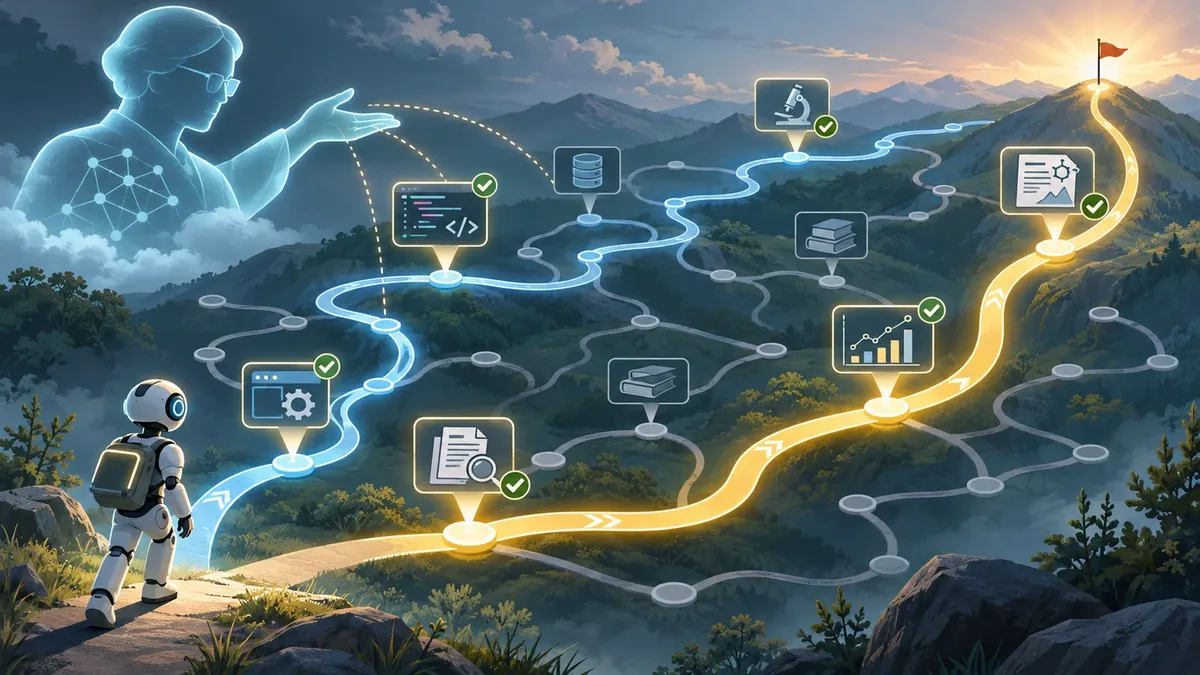
Training an AI agent to handle a long sequence of decisions can be slow: each new training update may require another lengthy run through an environment. A new preprint proposes a way to reuse past runs while choosing more carefully which situations and decisions the agent learns from.
Why long-horizon training is costly
An AI agent that fixes software or researches a question may take dozens or hundreds of steps, using tools and responding to changing results along the way. In on-policy distillation, a stronger model—the teacher—provides guidance on responses generated by a student model. In fully online training, those responses are tested in the environment, so each update depends on a fresh, potentially lengthy run.
Prefix replay offers a shortcut. Researchers first collect interaction histories, then use stored points in those histories as starting places for new student responses. The teacher evaluates those responses, but the new responses are not carried out in the environment. This can keep long environment runs off the training process’s critical path and let one collected history support repeated updates.
But replay raises two questions: do the stored histories resemble situations the student will encounter, and does training focus on the turns that matter? The authors of the preprint, “Collect for Coverage, Replay with Evidence,” introduce CARE-OPD to address both.
Collect histories, then choose turns
CARE-OPD sometimes begins a collected run with the student rather than the teacher. The student acts for an initial stretch, creating a history shaped by its own behavior; the teacher then completes the trajectory. This can expose training to situations missing from teacher-only runs, including those resulting from student mistakes.
Broader coverage can come at a cost: the teacher may be less certain when asked to assess a student response in an unfamiliar situation. CARE-OPD therefore uses the teacher’s confidence as a filter, rejecting the lowest-confidence responses in a training batch. The paper stresses that this is a measure of the teacher’s distributional certainty, not proof that a response is correct.
The method also chooses which turns to replay after the full trajectory is available. A judge examines the task, trajectory, execution feedback and outcome, then selects turns that later evidence suggests were consequential—for example, a diagnosis, correction or verification. The selected turns are replayed without exposing the student to future information from the trajectory.
What the experiments report
The authors evaluate CARE-OPD on software engineering and deep-research tasks, comparing it with online distillation and earlier prefix-replay approaches. On SWE-bench Verified, the Qwen3.5 student trained with CARE-OPD reaches 59.5% task success. The reported comparison with asynchronous online distillation is 57.1% success, with CARE-OPD using 45% less end-to-end training time and 44% fewer environment actions.
The paper also reports 49.6% answer accuracy on BrowseComp-Plus for CARE-OPD, compared with 47.2% for its asynchronous online-distillation baseline. These are results in the authors’ experimental setup, not guarantees of performance on other agents or tasks.
Ablation experiments offer clues about the method. Student-seeded histories worked better when paired with confidence gating than without it. On the software task, selecting turns using evidence from the completed trajectory improved success over uniform replay and over a randomly chosen subset of the same size. By contrast, a schedule that simply favors earlier turns showed only a small gain over uniform replay in the reported comparison. Together, these findings support the authors’ view that both the source of histories and the choice of replayed turns matter.
What remains uncertain
The approach does not eliminate environment interaction: trajectories must still be collected, and the researchers count the cost of collection and replay selection in their end-to-end training time. The pool is built using a frozen initial student and bounded student-led segments. Because the student changes during training, the authors note that the pool may become less representative over time; refreshing it could help but would add environment cost.
Replay also trains on responses that are not executed. Their real-world consequences are therefore unknown, and teacher confidence cannot establish correctness. The evaluations cover two task areas and particular model, tool and benchmark configurations, so the results do not show that CARE-OPD will work equally well elsewhere.
This work is an arXiv preprint, not evidence of peer-reviewed validation. Its findings are promising evidence for a more selective way to reuse agent histories, but independent evaluation will be important before drawing broader conclusions.
- AI agents
- on-policy distillation
- prefix replay
- long-horizon training
- CARE-OPD
- software engineering
Reviewed cross-references
These connections were reviewed by a model, not independently fact-checked by a human. Similarity does not imply agreement; consult the original papers and the evidence below.
Can Visual AI Learn from Four Histories?
Shared method: Both studies use prefix replay: the student generates fresh responses at stored histories and receives teacher supervision without executing those responses in the environment. The visual-agent study evaluates selected fixed trajectories in Navigation, Sokoban, and SpatialGym, whereas CARE-OPD addresses long-horizon software-engineering and deep-research tasks with student-seeded collection, confidence gating, and evidence-based turn selection; their results do not establish comparative performance.
Model review: · openai-codex/gpt-6-luna
Evidence and provenance
Selected excerpts, not complete papers. PDF extraction can omit figures or damage equations, tables and reading order; sources may be preprints.
2611.34756v1 — Original paper
Excerpt reference:
static/papers/2611.34756v1.md:13-65
Basis: Paper text
Source SHA-256:357b6b8f400772cbcda8f2b943160b3b45c747f3ae8035d1029fa5129b477b422611.34756v1 — Original paper
Excerpt reference:
static/papers/2611.34756v1.md:66-107
Basis: Paper text
Source SHA-256:357b6b8f400772cbcda8f2b943160b3b45c747f3ae8035d1029fa5129b477b422611.28618v1 — Original paper
Excerpt reference:
static/papers/2611.28618v1.md:188-263
Basis: Paper text
Source SHA-256:41198696f2c32cca796bc87e940ed8b704f8d8f0c8ddbd58ff29fbb80b279bf4
Related reading
Automatically matched by shared topic keywords. These links do not imply that the sources agree or establish a consensus.
ThunderSync aims to speed up agent training without stale policies
Source published
Shared keywords: ai agents, on policy distillation
Can Visual AI Learn from Four Histories?
Source published
Shared keywords: on policy distillation
Giving AI Agents the Right Roles in Program Evolution
Source published
Shared keywords: ai agents, software engineering
Meta² teaches AI agents when to change their working setup
Source published
Shared keywords: ai agents, software engineering
A Rename Is More Than a Find-and-Replace
Source published
Shared keywords: ai agents, software engineering