TRANSMISSION // 2611.34755v1
Why Fewer Quantum Parameters Can Still Run Slower
Source published
A CPU simulation of hybrid quantum physics-informed networks found that fewer trainable parameters did not mean faster calculations. The result is specific to one benchmark and setup.
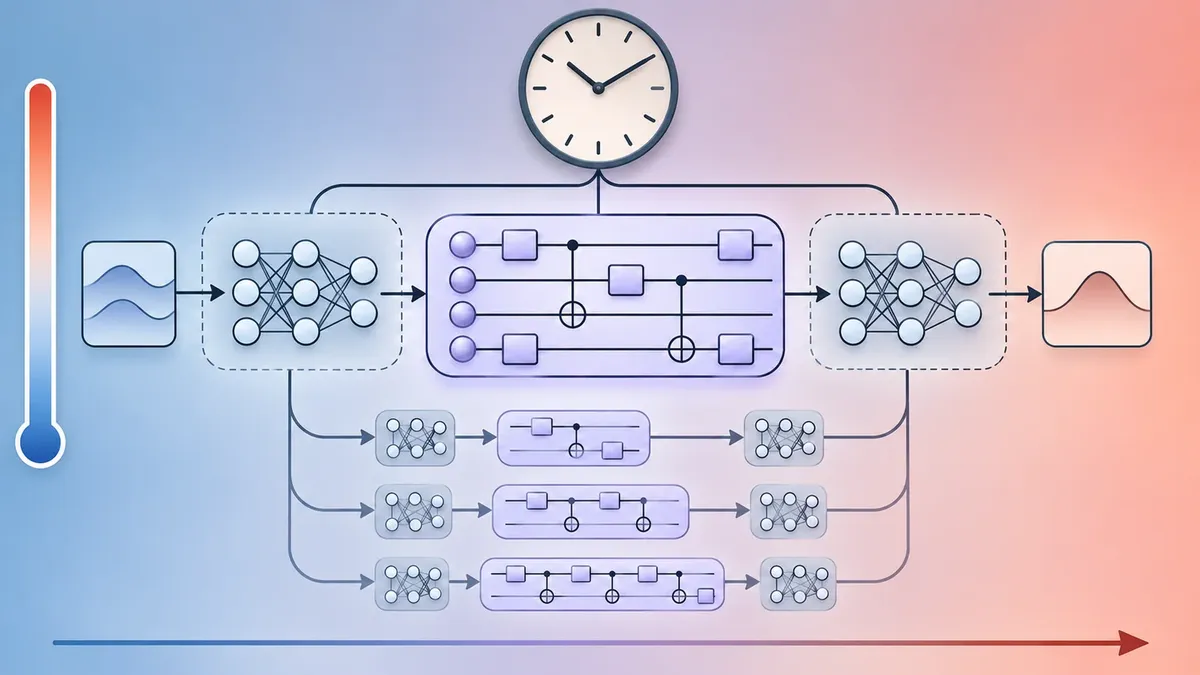
Hybrid quantum-classical neural networks can have fewer adjustable parameters than classical alternatives. But parameter count is not the same as computing time. In a seawater-temperature diffusion benchmark, researchers timed the calculations and derivatives these models need—and found that their simulated quantum circuits made the hybrid models much slower on the tested CPU.
A model with fewer adjustable numbers might sound cheaper to run. But in a hybrid quantum-classical neural network, the number of trainable parameters does not tell the whole story: simulating a quantum circuit on an ordinary computer can itself be expensive, and physics-informed models need more than a simple prediction. They also calculate derivatives to check whether their outputs satisfy a physical equation.
Leyan Lyu and Shabnam Jabeen studied that gap using a physics-informed neural network (PINN) for one-dimensional seawater-temperature diffusion. A PINN is trained not only to fit data, but also to respect a governing equation—in this case, one describing how temperature changes over time as it diffuses with depth. The researchers compared a classical PINN with four hybrid quantum-classical versions, varying the number of simulated qubits and circuit layers. They also built classical controls with the same surrounding classical layers as the hybrids, but with the quantum circuit replaced by a conventional layer.
Timing the work behind a physics-informed model
Rather than report just one overall speed, the researchers timed four increasingly demanding computations on a batch of points. First came the model’s prediction, or forward pass. Next were the first and second derivatives of that prediction with respect to the inputs. These derivatives are needed to evaluate the diffusion equation. The final stage calculated how the equation-based loss changes with the model’s adjustable parameters—the information used to update the model during training.
The quantum circuits were simulated on a CPU, not run on quantum hardware. The main timing comparison used 2,540 points per batch. Each model was measured across three random seeds; reported variation reflects differences among those seeds, not a confidence interval. The authors also varied qubit count, circuit depth, batch size, and simulator backend.
Fewer parameters, but longer runtimes
In the main comparison, the hybrid models took 14 to 56 times as long as the classical PINN for a forward pass, and 10 to 97 times as long for the parameter gradient of the equation-based loss. Against the size-matched classical controls, the hybrids were still about 9 to 85 times slower across the timed stages.
The hybrids had roughly 38 to 44 percent fewer trainable parameters than the classical PINN. But the quantum circuits accounted for only about 0.7 to 2.5 percent of each hybrid’s parameters. Most of the reduction came from the smaller classical layers around the circuit—not from replacing many parameters with a large quantum component.
Replacing the circuit with a classical layer in the size-matched controls was associated with stage times 89 to 99 percent below the hybrids’ times. This is a comparison between implementations, not a direct breakdown of runtime into circuit operations and other work: the difference also includes differentiation and software-framework overhead.
Parameter count was not a reliable speed guide even among the classical networks: the smaller, size-matched controls ran more slowly than the larger classical PINN in this setup. The study also found different scaling patterns across the tested ranges. Runtime grew approximately exponentially with qubit count and approximately linearly with circuit depth; increasing batch size produced sub-linear growth in the measured hybrid runs. One alternative simulator backend was 10 to 165 times slower than the main backend for the circuit-only forward pass under the same calling pattern. That comparison reflects the specific software setup, not a universal ranking of simulators.
What the timings do—and do not—show
The authors included a training check across six scenarios, covering three boundary-condition types and forward and inverse problems. It used a single seed. The classical PINN trained with Adam followed by L-BFGS was more accurate than every hybrid in those scenarios. Comparisons using Adam alone were mixed: some hybrids did better than a classical Adam-only control in some cases, but the authors caution against treating small differences as a reliable ranking. The optimizer schedules differed, and the size-matched controls were timed but not trained, so these results do not isolate the circuit’s contribution to accuracy.
The central finding is about computational cost in this particular experiment, not a verdict on every hybrid PINN. The study used one one-dimensional equation, one CPU workstation, one circuit design, and classical circuit simulation. It did not measure quantum hardware, GPU simulators, or other equations. Hardware avoids statevector simulation, but derivative estimation and measurement bring their own costs, which these timings do not establish. The authors also note that end-to-end training times came from single-seed runs on a shared workstation and are indicative rather than controlled comparisons.
This is an arXiv preprint, and the evidence provided here does not establish whether it has been peer reviewed. Its practical message is narrower but useful: parameter counts alone cannot establish that a hybrid model is faster. For these models, measuring each derivative stage—and specifying the hardware, simulator, and batch-handling method—gave a very different picture from counting parameters.
- physics-informed neural networks
- quantum computing
- hybrid quantum-classical models
- computational runtime
- PDE simulation
Reviewed cross-references
These connections were reviewed by a model, not independently fact-checked by a human. Similarity does not imply agreement; consult the original papers and the evidence below.
Stretching coordinates helps neural networks learn sharp solution changes
Shared method: Both studies use physics-informed neural networks to solve PDEs: the origin benchmarks hybrid quantum-classical PINNs on a seawater-diffusion problem, while Yu and Oseledets introduce learnable coordinate transformations for PINNs. Their methods and benchmarks differ, so this shared framework does not establish comparable performance.
Model review: · openai-codex/gpt-6-luna
Evidence and provenance
Selected excerpts, not complete papers. PDF extraction can omit figures or damage equations, tables and reading order; sources may be preprints.
2611.34755v1 — Original paper
Excerpt reference:
static/papers/2611.34755v1.md:45-113
Basis: Paper text
Source SHA-256:c30f0732dbd57f92819a2f77a549639b1b65f12725dc014f30d446490d8ec9342611.09053v1 — Original paper
Excerpt reference:
static/papers/2611.09053v1.md:70-150
Basis: Paper text
Source SHA-256:c6277b3ebc352d2be858590c31bca7be21b4bac1ec7a2e7afc81f852c3a6760d
Related reading
Automatically matched by shared topic keywords. These links do not imply that the sources agree or establish a consensus.
Putting sensitivity limits on hybrid quantum–classical AI
Source published
Shared keywords: hybrid quantum classical models
Stretching coordinates helps neural networks learn sharp solution changes
Source published
Shared keywords: physics informed neural networks
PINNeval asks physics-informed AI benchmarks to test the whole training pipeline
Source published
Shared keywords: physics informed neural networks
Can a language model build a neural network from physical laws?
Source published
Shared keywords: physics informed neural networks
A neural network follows photon orbits one slice at a time
Source published
Shared keywords: physics informed neural networks