TRANSMISSION // 2611.34753v1
A flexible new toolkit for fitting stellar orbits
Source published
The Python package periapsis fits binary orbits using astrometry, radial velocities or both. Tests on published systems show its range, while also illustrating how sparse data and prior choices can complicate results.
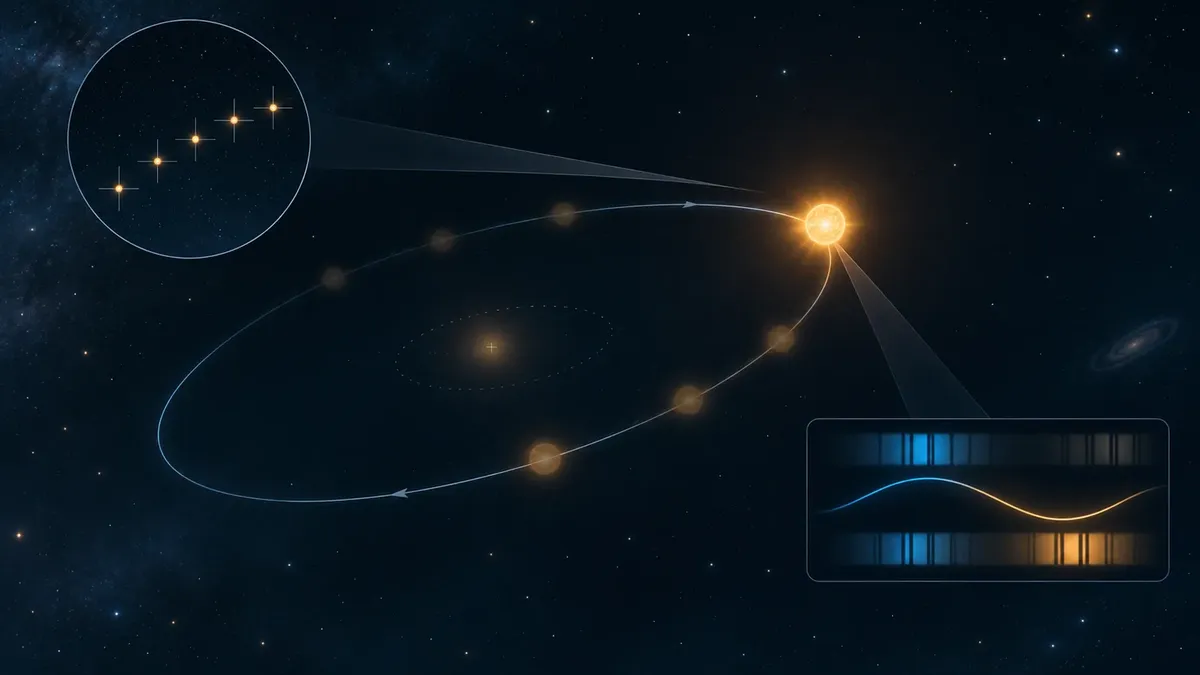
A star’s motion can reveal a companion that is difficult to see directly. But turning measurements of position and velocity into an orbit is not always straightforward. Astronomers introduce periapsis, a Python package designed to fit binary-star orbits across several kinds of observations and to report uncertainty and diagnostic information alongside its estimates.
A star’s orbit can be inferred from subtle clues: its position shifts across the sky, or its motion toward and away from Earth changes the wavelengths in its light. These measurements—astrometry and radial velocity—can reveal a companion that is too faint to see directly. Sparse observations, measurement noise and multiple plausible orbital solutions can make them difficult to interpret.
In a research manuscript, Evan Kerr and colleagues introduce periapsis, a Python package for fitting Keplerian orbits to these data. It handles two-dimensional astrometry, the one-dimensional scan measurements made by Gaia, radial velocities, or combinations of these observations. It can also fit data for both components of a binary when both have been observed.
From measurements to possible orbits
The package models how an orbit should appear in the observations, accounting for effects such as parallax and a star’s steady motion across the sky. It can also include instrumental offsets, long-term velocity trends, extra measurement scatter (called “jitter”), and the effect of a luminous companion on the measured position of an unresolved pair.
Rather than returning just one best-fitting orbit, periapsis uses Bayesian sampling to estimate a posterior distribution: a range of parameter values and how well each is supported under the model and the chosen prior assumptions. Users can select Markov chain Monte Carlo sampling with emcee or nested sampling with UltraNest. A “linearized” option solves some parameters analytically while sampling others, reducing the number of dimensions the sampler must explore.
The workflow includes ways to identify candidate periods and initialize the sampling. Results include parameter estimates, fit statistics and convergence diagnostics, as well as plots of orbits, residuals and posterior distributions. These checks are useful because a sampler may fail to explore all plausible solutions, even if its output looks precise.
Tests on previously studied systems
The authors demonstrate the package by fitting published observations of several systems: oMEGACat BH-2, Gaia BH3, candidates in the globular cluster NGC 3201, and the planet-hosting star 51 Peg. Across these examples, the resulting orbital parameters are generally consistent with earlier analyses. The examples also expose challenges: data can be sparse, solutions can have multiple modes, and results can depend on prior choices.
One NGC 3201 candidate illustrates the issue. Using the available radial-velocity data, the authors find two plausible families of orbital solutions. Small changes in the prior can make either family dominate, so they conclude that the existing data do not allow them to assign a reliable relative probability to the alternatives. This does not establish that either solution is correct; it shows how limited data and assumptions can shape an inference.
The paper offers specific advice for sparse data. The authors say UltraNestLinearFitter can struggle to converge when there are about ten or fewer observations. For such cases, they recommend MCMCFitter or MCMCLinearFitter, and suggest using at least five candidate peaks when initializing the MCMC fit. More generally, they recommend using the reduced-parameter nested-sampling method to look for multiple solutions, then a full-parameter fit for closer examination. The latter can require more computation.
What the demonstrations establish
The examples show that periapsis can work with varied observation types and recover useful fits for selected previously studied systems. They do not guarantee that every fit will be correct, or establish that the package outperforms other tools. Results still depend on the data, model assumptions, priors and whether sampling has adequately explored the possibilities.
The authors suggest future use with data releases such as Gaia DR4 and observations from the Roman Space Telescope. That is a prospective application, not a result demonstrated in these examples. The paper links to the package code and example notebooks on GitHub.
This article is based on the arXiv manuscript and its reported demonstrations. As with any software evaluation based on selected examples, broader experience and independent validation can clarify how well the tool performs across different systems and data conditions.
- binary stars
- orbit fitting
- astrometry
- radial velocity
- Bayesian inference
- Gaia
- astronomy software
Reviewed cross-references
These connections were reviewed by a model, not independently fact-checked by a human. Similarity does not imply agreement; consult the original papers and the evidence below.
A new orbit-fitting toolkit prepares for Gaia DR4
Shared method: Both papers describe Bayesian fitting of Keplerian orbits to astrometric and/or radial-velocity data. periapsis offers emcee and UltraNest sampling, while orbitize! v4 describes several sampling methods and adds joint Gaia DR4 epoch-astrometry fitting; this is a methodological overlap, not a performance comparison.
Model review: · openai-codex/gpt-6-luna
Evidence and provenance
Selected excerpts, not complete papers. PDF extraction can omit figures or damage equations, tables and reading order; sources may be preprints.
2611.34753v1 — Original paper
Excerpt reference:
static/papers/2611.34753v1.md:90-152
Basis: Paper text
Source SHA-256:d1fbe03eff8ae37a9faba1af7b80fb09cfa26ab5b16327161a2d0079035c4fe22611.34753v1 — Original paper
Excerpt reference:
static/papers/2611.34753v1.md:965-1017
Basis: Paper text
Source SHA-256:d1fbe03eff8ae37a9faba1af7b80fb09cfa26ab5b16327161a2d0079035c4fe22611.31357v1 — Original paper
Excerpt reference:
static/papers/2611.31357v1.md:114-127
Basis: Paper text
Source SHA-256:5c1dc2559e430345e0e67b684ae3d27eae4c89dedeb57de27d3109dedf05d46d2611.31357v1 — Original paper
Excerpt reference:
static/papers/2611.31357v1.md:128-202
Basis: Paper text
Source SHA-256:5c1dc2559e430345e0e67b684ae3d27eae4c89dedeb57de27d3109dedf05d46d
Fitting hidden companions to Gaia’s stellar wobbles
Shared method: Both papers present Bayesian Keplerian orbit fitting that can use astrometry and radial velocities. ExoPlanetLab specifically models Gaia epoch astrometry and describes validation and limitations; periapsis describes a broader set of astrometric and RV fitting options. The excerpts do not establish a direct comparison between the packages.
Model review: · openai-codex/gpt-6-luna
Evidence and provenance
Selected excerpts, not complete papers. PDF extraction can omit figures or damage equations, tables and reading order; sources may be preprints.
2611.34753v1 — Original paper
Excerpt reference:
static/papers/2611.34753v1.md:90-152
Basis: Paper text
Source SHA-256:d1fbe03eff8ae37a9faba1af7b80fb09cfa26ab5b16327161a2d0079035c4fe22611.34753v1 — Original paper
Excerpt reference:
static/papers/2611.34753v1.md:965-1017
Basis: Paper text
Source SHA-256:d1fbe03eff8ae37a9faba1af7b80fb09cfa26ab5b16327161a2d0079035c4fe22611.13770v1 — Original paper
Excerpt reference:
static/papers/2611.13770v1.md:16-74
Basis: Paper text
Source SHA-256:5ba619768998231d6bc9512ad8c6068b5184c2ca98bf123e973555b75f0051872611.13770v1 — Original paper
Excerpt reference:
static/papers/2611.13770v1.md:75-141
Basis: Paper text
Source SHA-256:5ba619768998231d6bc9512ad8c6068b5184c2ca98bf123e973555b75f005187
Three kinds of observations refine the orbit and masses of V819 Herculis
Shared method: Both papers use Bayesian inference with Keplerian orbital models. The V819 Herculis study jointly fits astrometry, eclipse-timing variations and radial velocities to derive a system-specific outer orbit and masses; periapsis is a general orbit-fitting package. This shared modeling approach does not imply shared data, implementation or results.
Model review: · openai-codex/gpt-6-luna
Evidence and provenance
Selected excerpts, not complete papers. PDF extraction can omit figures or damage equations, tables and reading order; sources may be preprints.
2611.34753v1 — Original paper
Excerpt reference:
static/papers/2611.34753v1.md:90-152
Basis: Paper text
Source SHA-256:d1fbe03eff8ae37a9faba1af7b80fb09cfa26ab5b16327161a2d0079035c4fe22611.09551v1 — Original paper
Excerpt reference:
static/papers/2611.09551v1.md:15-67
Basis: Paper text
Source SHA-256:a8d8d8e910107b80a19fcfd1c797b69987b84ca7d8b1d3728f94f99c32a1bb952611.09551v1 — Original paper
Excerpt reference:
static/papers/2611.09551v1.md:694-800
Basis: Paper text
Source SHA-256:a8d8d8e910107b80a19fcfd1c797b69987b84ca7d8b1d3728f94f99c32a1bb95
Related reading
Automatically matched by shared topic keywords. These links do not imply that the sources agree or establish a consensus.
A new orbit-fitting toolkit prepares for Gaia DR4
Source published
Shared keywords: astronomy software, bayesian inference, orbit fitting
Gaia and Hipparcos map possible companions around 100,000 stars
Source published
Shared keywords: bayesian inference, radial velocity
Testing Spectra for Hidden Stellar Companions
Source published
Shared keywords: binary stars
A survey of 63,254 stars puts the brown dwarf desert on a relative scale
Source published
Shared keywords: bayesian inference
GetGaia 2.0 sorts distant stellar systems from the Milky Way foreground
Source published
Shared keywords: astronomy software