TRANSMISSION // 2611.34747v1
A faster route to gravitational-wave waveforms
Source published
A JAX port of an existing gravitational-wave model aims to speed up waveform calculations on CPUs and GPUs while preserving the reference model’s results.
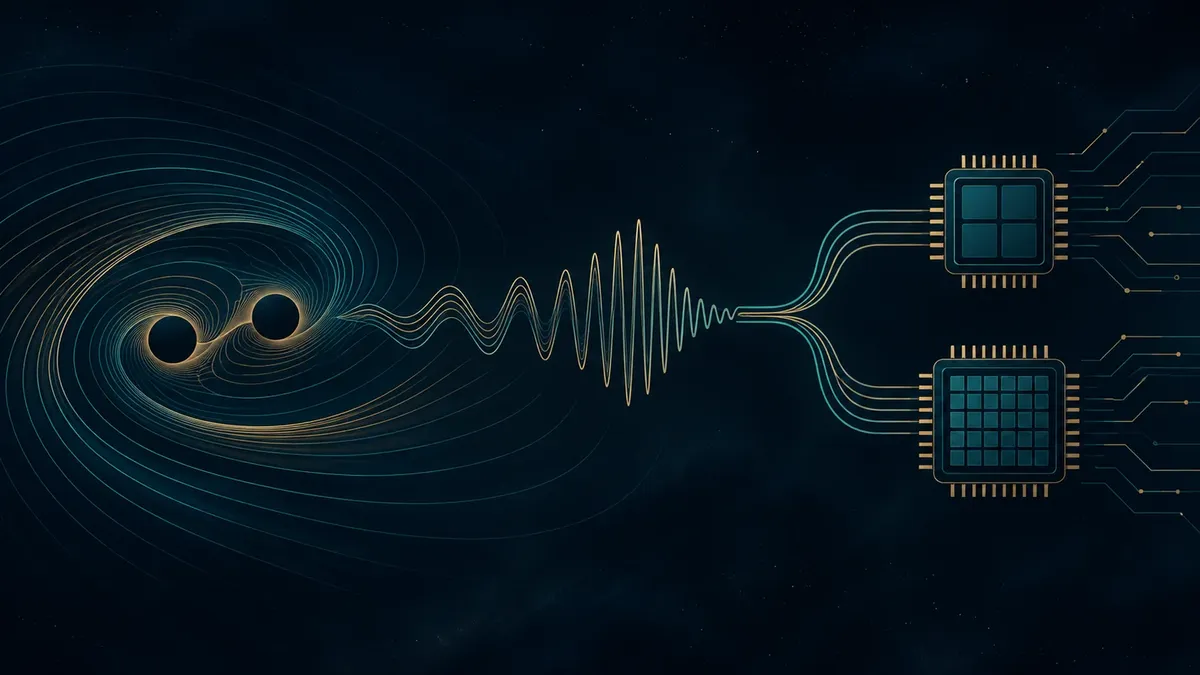
Gravitational-wave analyses may generate millions of samples for one signal, repeatedly, across many possible sources. Andrea Begnoni’s preprint introduces phenjax, a JAX port of an existing waveform model designed for that workload. Its reported speedups depend on hardware, batch size and signal length; its parameter-estimation test covers one simulated LISA case.
Gravitational-wave detectors do not directly reveal the properties of a merging pair of compact objects. Researchers compare measured signals with calculated waveforms—predictions of what a binary should produce for different masses, spins and orientations. Repeating those calculations can be computationally demanding, especially for long signals from massive black-hole binaries that a future space detector such as LISA could observe for days or months.
Andrea Begnoni’s preprint presents phenjax, a JAX port of the time-domain IMRPhenomT waveform family. It does not propose new gravitational-wave physics. Instead, it adapts an existing implementation to run calculations in batches, allow differentiation with respect to parameters, and execute on CPUs or GPUs using the same source code.
Rebuilding a waveform calculation
Phenjax follows the structure of the existing Python implementation, phenomxpy, and retains its model fits, modes and conventions. It supports aligned-spin models and several precessing models, using two prescriptions for the precession angles. A third option—calculating those angles by numerically integrating spin evolution—is described as planned, not yet available.
JAX can compile calculations for a particular array shape and apply them across many events at once. This makes batch evaluation possible, but creates constraints: events in a batch need compatible time-array lengths, and changing shapes can require recompilation. To handle populations with different signal durations, phenjax offers fixed-length grids or “bucketing,” which groups events of similar duration. The authors also implement alternative computational kernels, including a mixed-precision option that trades some numerical precision for speed.
The author compared phenjax with phenomxpy on seeded populations of 100 events per model. For the models tested, the average difference in the plus and cross waveform polarizations was on the order of a few parts in 10¹² of peak strain. The paper reports larger worst-case differences for some precession-angle calculations, while the noise-free mismatch remained below 10⁻¹¹ in the tested events. These are comparisons between implementations of the same model, not a fresh validation of the model against nature or a guarantee of accuracy for every possible signal.
Performance depends on the workload
On one NVIDIA H100 GPU, the precessing TPHM model for LISA-mass populations ran three to six times faster than phenomxpy when both evaluated one event at a time. With phenjax processing events in batches of eight, the reported advantage was 20 to 30 times. The author also estimates that one data-centre GPU can match the waveform-generation throughput of 1,300 to 2,700 CPU cores in the tested setup, using 25 to 45 times less energy per waveform.
Those figures are not universal conversion rates. They depend on the model, signal lengths, software and hardware, and how events are grouped. Batching can reduce repeated launch overhead, while bucketing avoids spending work on unnecessarily long arrays. But extra launches and compilation can offset those savings, particularly on fast GPUs. The paper advises users to benchmark configurations close to their own analysis rather than assume one setting is always fastest.
The author also tested phenjax in a global-fit analysis of one massive-black-hole-binary injection in the Sangria LISA challenge data, analyzed without the dataset’s other massive black-hole binaries. Four configurations—phenjax THM, phenjax TPHM with aligned spins, a tier-2 TPHM run, and phentax THM—recovered the same posteriors in this test. A 10,000-iteration run took 13 minutes with phenjax THM and 21.1 minutes with phentax THM on one H200 GPU. This is evidence from one simulated analysis, not a demonstration across real LISA observations or all global-fit problems. Waveform generation was only part of the total likelihood cost; the LISA response and other calculations also mattered.
What remains uncertain
Automatic gradients are available in the code but, the paper says, have not yet been reviewed and should be used carefully. The numerical precession-angle method is still planned. Benchmark results may not transfer to different hardware or analysis setups, and the Sangria injection itself was non-precessing, even though some tested configurations included precession-related waveform calculations.
This article is based on an arXiv preprint, which may not have undergone peer review. The paper says its supporting code and data are not yet publicly available; it states that the code and benchmark records described in a particular section are available upon request. That limits independent reproduction. The results support phenjax as an implementation and benchmarking effort, not as proof that every gravitational-wave analysis will become faster or more accurate.
- gravitational waves
- phenjax
- JAX
- waveform modeling
- LISA
- GPU computing
- compact binaries
Reviewed cross-references
These connections were reviewed by a model, not independently fact-checked by a human. Similarity does not imply agreement; consult the original papers and the evidence below.
Phentax adapts black hole waveform calculations for LISA’s crowded signals
Shared method: Both papers use JAX to make waveform calculations batchable: phenjax describes compilation by array shape and vectorization over events, while Phentax describes JAX compilation and vectorization over batches. This is a shared computational approach, not evidence of identical implementation details; phenjax covers aligned-spin and precessing variants, whereas the cited Phentax description restricts its model to non-precessing binaries. Phentax is a preprint, and these selected excerpts do not establish broader performance or scientific equivalence.
Model review: · openai-codex/gpt-6-luna
Evidence and provenance
Selected excerpts, not complete papers. PDF extraction can omit figures or damage equations, tables and reading order; sources may be preprints.
2611.34747v1 — Original paper
Excerpt reference:
static/papers/2611.34747v1.md:65-134
Basis: Paper text
Source SHA-256:dfb5bdae24267f48654ce87bd6c6b49759836176f5af7134470ce856790d691a2611.34747v1 — Original paper
Excerpt reference:
static/papers/2611.34747v1.md:459-529
Basis: Paper text
Source SHA-256:dfb5bdae24267f48654ce87bd6c6b49759836176f5af7134470ce856790d691a2611.08596v1 — Original paper
Excerpt reference:
static/papers/2611.08596v1.md:126-182
Basis: Paper text
Source SHA-256:7e374e1270d9e01e6c6316cac43587e4956625c4ceb2fe97bc705be94b123c0a
Related reading
Automatically matched by shared topic keywords. These links do not imply that the sources agree or establish a consensus.
Phentax adapts black hole waveform calculations for LISA’s crowded signals
Source published
Shared keywords: gpu computing, gravitational waves, waveform modeling
A sharper model for gravitational waves from triples
Source published
Shared keywords: gravitational waves, waveform modeling
A time-frequency route to modeling LISA’s response
Source published
Shared keywords: gravitational waves
How a black hole inside a star could make an eccentric pair
Source published
Shared keywords: gravitational waves
The Milky Way’s leftover signals could blur LISA’s search for a gravitational-wave background
Source published
Shared keywords: gravitational waves