TRANSMISSION // 2611.34743v1
JWST spectra find little evidence for early black-hole superwinds
Source published
A study of 67 early-universe little red and blue dots finds no qualifying [O III] superwinds, while other spectral clues suggest nearby gas is mostly bound. The limits have important caveats.
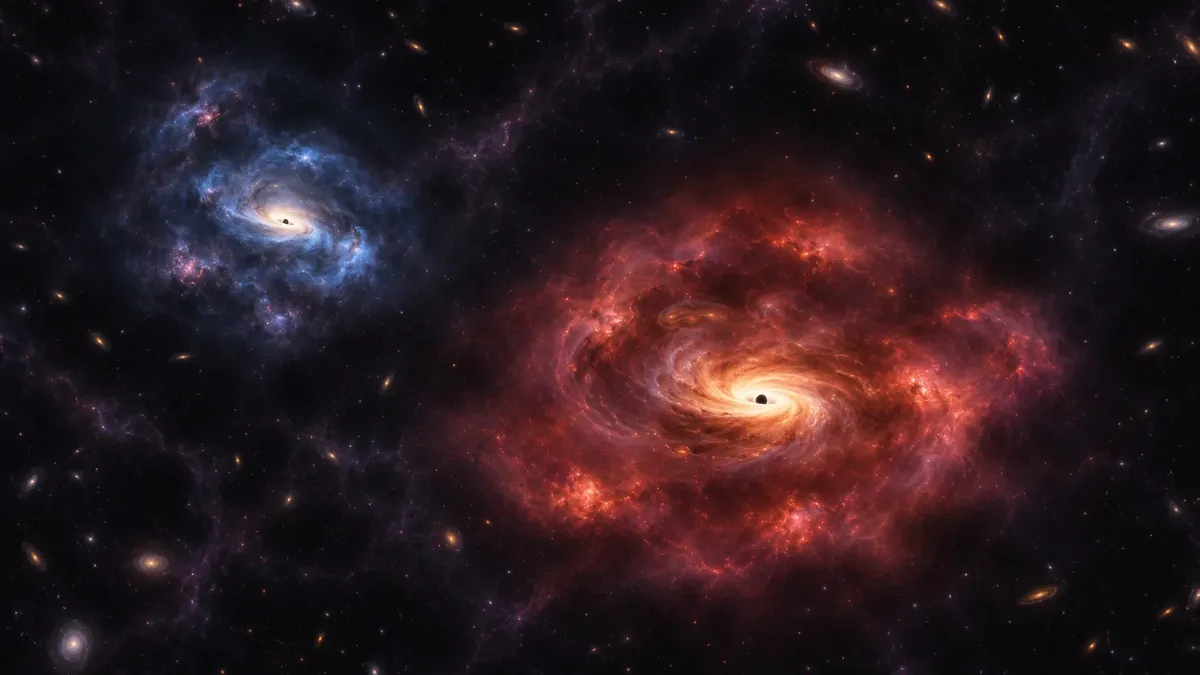
Black holes can influence galaxies by blowing gas out of them—but do young black holes do this during the universe’s first 1.5 billion years? A study of James Webb Space Telescope spectra finds no qualifying ionized superwinds in its sample of little red and little blue dots, while emphasizing that some kinds of outflow remain hard to detect.
Growing black holes can affect their host galaxies by heating or expelling gas. In many galaxy-formation models, this feedback helps limit both star formation and further black-hole growth. But how early does that process begin? A new study examines whether black holes in compact early-universe sources called little red dots (LRDs) and little blue dots (LBDs) drive powerful winds.
The researchers searched spectra from the James Webb Space Telescope’s NIRSpec instrument, using the DAWN JWST Archive. They selected 67 LRDs and LBDs with suitable spectra for their main search. These sources are seen within the first 1.5 billion years of cosmic history. The team looked for three kinds of spectral evidence: shifted light from ionized gas in the host, motion in broad hydrogen lines close to the black hole, and hydrogen absorption from gas along our line of sight.
No qualifying winds in the main search
The main test focused on a pair of lines from ionized oxygen, known as [O III]. A blueshifted, broadened component can signal gas moving toward us and away from a galaxy’s central region. The researchers fitted each spectrum with and without an additional [O III] component, then required a candidate to meet statistical and velocity criteria before counting it as a wind.
They found no qualifying [O III] winds in the 67 sources. This is not simply a case of looking for a signal their data could not detect: the team added artificial wind signals to the spectra and measured how often the analysis recovered them. They also compared the results with nearby active galaxies. Based on that calibration, they would have expected at least 7.2 detections if the early sources had winds like the local sub-Eddington comparison group, and 7.5 for the super-Eddington group. Both expectations are lower limits, because some very broad or slow winds were treated as undetectable.
For winds narrower than 1,500 kilometers per second, the researchers report 95% confidence upper limits on the fraction of sources with winds: 13% for a local sub-Eddington-like population and 19% for a super-Eddington-like one. These limits are below the corresponding observed fractions in the local comparison samples. They indicate a shortfall relative to those particular benchmarks, not proof that no outflow of any kind exists.
Clues from gas closer in
The other spectral tests also found little sign of escaping gas in the material they could probe. Broad hydrogen-alpha lines were generally centered close to narrower lines associated with the sources. Additional blueshifted components were not consistently present, and those identified in LRDs moved at less than the estimated escape speed near the black hole. Hydrogen absorbers along the line of sight were slower still: in the sources tested, their speeds were at most 8% of that escape speed. The authors interpret these findings as evidence that the measured gas is bound, rather than escaping as a superwind.
The study also compares observations with published proposals for how rapidly accreting black holes might produce the red colors and strong hydrogen lines seen in LRDs. The authors argue that the tested fountain-flow, black-hole-star and quasi-star models each conflict with at least one measured spectral property. This is a comparison with specific published model predictions, not an exhaustive test of every possible explanation.
What the result does—and does not—show
The findings challenge the idea that these objects regulate their host galaxies through the same ionized winds commonly observed in the local comparison sample. They do not establish why the winds appear absent, or show that black holes have no influence on their surroundings. The paper argues that gas may remain available for black-hole growth while the host is still small, but the observations establish a lack of detected wind signatures in this sample—not a complete account of how these systems evolve.
There are important limits. The main incidence constraints apply to [O III] winds narrower than 1,500 kilometers per second. The authors could not reliably rule out broader components, and [O III] does not trace hot, neutral or molecular outflows. The sample also contains only sources bright enough for the required spectra. Moreover, two separate, higher-resolution observations show slow blueshifted [O III] components, although the authors say these are below the speeds needed to escape. The headline zero therefore refers to the defined primary wind search, not to an absence of all moving gas.
The article is an arXiv preprint, so its conclusions should be considered in light of the methods, sample selection and stated caveats; the source provided here does not establish that it has been peer reviewed. The authors make their measurements and analysis code available through Zenodo, offering a route for other researchers to inspect and test the results.
- James Webb Space Telescope
- little red dots
- little blue dots
- black hole feedback
- galactic winds
- early universe
- NIRSpec
Related reading
Automatically matched by shared topic keywords. These links do not imply that the sources agree or establish a consensus.
Two unusually hot quasars may illuminate a Little Red Dot transition
Source published
Shared keywords: early universe, little red dots
Little Red Dots Thin Out, but Keep a Similar Brightness Profile
Source published
Shared keywords: early universe, james webb space telescope, little red dots
How JWST Could Trace the Seeds of the First Massive Black Holes
Source published
Shared keywords: early universe, james webb space telescope, little red dots
What polarized light reveals about Little Red Dots
Source published
Shared keywords: little red dots
Could primordial black holes explain Webb’s Little Red Dots?
Source published
Shared keywords: james webb space telescope, little red dots