TRANSMISSION // 2611.34740v1
A unary tracker offers a new route to quantum circuits
Source published
A proposed method uses an auxiliary register to track quantum-data labels, reducing some gate costs while trading for extra qubits and relying on specific assumptions.
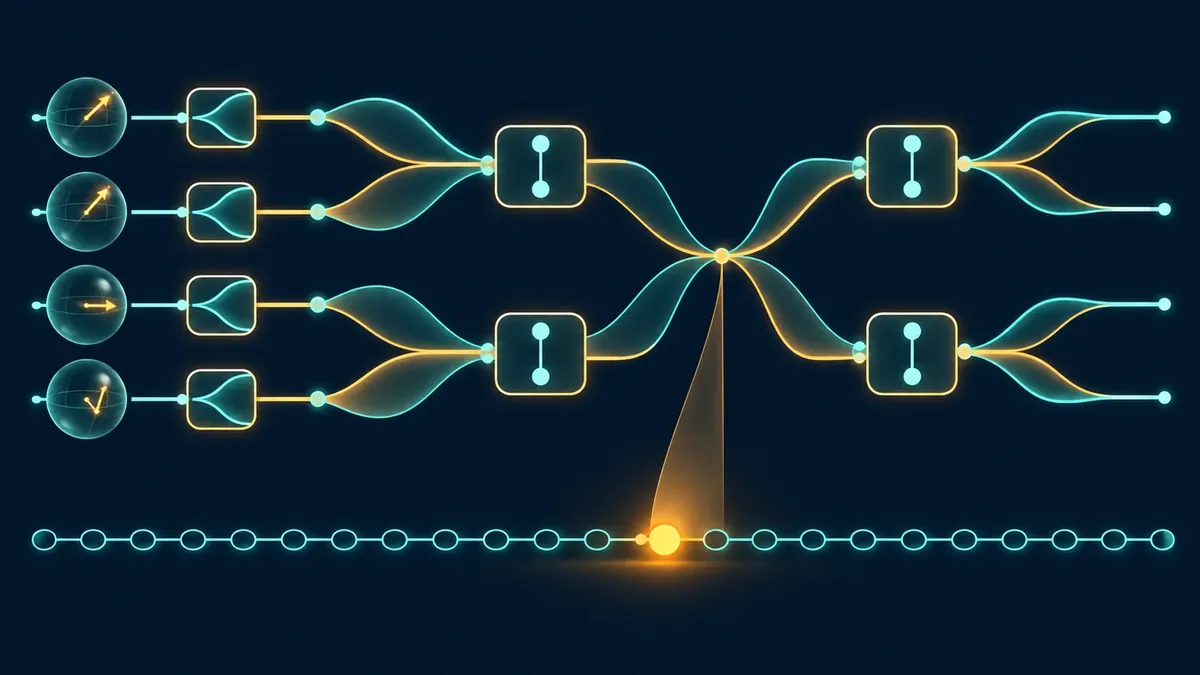
How can a quantum computer implement a general transformation while keeping costly operations in check? Fred Sun’s preprint proposes a unary-encoded register that follows the data’s computational-basis label, making certain lookups cheaper in a key gate-count measure. The gains depend on the unitary’s decomposition and come with resource trade-offs.
Implementing a specified quantum operation as a circuit is a basic but demanding task: a general operation on n qubits can require many elementary gates. Fred Sun’s manuscript, “Unitary Synthesis with a Unary Tracker,” explores whether a different way of keeping track of data can reduce some of those costs.
The paper focuses on two measures. One is T-count: the number of T gates, a type of operation that can be especially costly in fault-tolerant quantum computing. The other is space-depth volume, defined here as the number of qubits used multiplied by circuit depth. The work is theoretical; it presents circuit constructions and resource bounds, not experimental tests on quantum hardware.
Tracking a quantum label
In the first construction, the data remain in their usual binary representation. Alongside them, an auxiliary register uses a unary encoding to mark the data’s computational-basis label. In unary form, exactly one of many wires is marked, like a pointer indicating one position in a list.
The proposed method uses the cosine-sine decomposition, or CSD, which expresses a general unitary as a sequence of multiplexed single-qubit operations. In each such operation, other data bits select which single-qubit operation to apply. The auxiliary register tracks those labels as the circuit proceeds.
That tracking makes a particular task inexpensive in T-count: a classically specified Boolean lookup can be carried out using CNOT gates on the unary address. Updating the tracker when an operation mixes the two possible values of its target bit requires Fredkin gates. The paper counts this update cost by the number of mixing branches in the chosen CSD factorization. A branch is mixing when its operation can produce a superposition of both target values.
What the bounds say
For a classically specified n-qubit unitary, let N = 2ⁿ, let K be the number of mixing branches in the supplied CSD, and let L = n + log(1/ε), where ε is the target approximation error. The paper gives a measurement-free Clifford+T construction with T-count O(K + NL) and N + O(L) clean ancillary qubits. It assumes access to an ideal phase-gradient catalytic state, a special resource used in the construction.
The result shares some precision-dependent synthesis work across the branches of each CSD factor, rather than paying that precision cost separately for every branch. But it is not a uniform promise of a better bound for every unitary. K depends on the supplied factorization, not just on the unitary itself; for a dense factorization it can be Θ(N²). The author explicitly notes that this does not establish a general O(2ⁿ) T-count algorithm or a general asymptotic improvement over the state of the art. The method also uses O(N) auxiliary qubits, and its CNOT lookups may require substantial depth.
A second construction takes a different approach: it transfers the quantum state into unary form so that disjoint branches can operate in parallel. The construction uses the quantum Shannon decomposition to split a large unitary into smaller blocks, then reuses a smaller unary register block by block. With a ancillas, where n ≤ a ≤ N, arbitrary single-qubit gates, CNOTs, and unrestricted connectivity, the stated bounds are depth O(N²/a) and space-depth volume O(N²). This construction is exact under those assumptions. The paper says the volume matches an asymptotic lower bound for general unitaries, based on their number of continuous parameters.
What remains uncertain
These are asymptotic circuit-complexity results, not estimates of the full cost of building or operating a practical fault-tolerant machine. The bounds do not by themselves account for hardware connectivity constraints, noise, or the engineering cost of supplying the assumed phase-gradient state. The author identifies finding CSD factorizations with small K, and reducing the cost of tracker updates, as open questions.
The source is a preprint manuscript, not evidence here of peer review or independent replication. Its conclusions should therefore be read as proposed constructions and mathematical resource bounds under stated assumptions, rather than demonstrations of practical performance. The main contribution is a way to make some lookup and parallelization costs explicit—and a clear account of the extra workspace and unresolved bottlenecks involved.
- quantum computing
- unitary synthesis
- unary encoding
- quantum circuits
- T-count
- ancilla qubits
Reviewed cross-references
These connections were reviewed by a model, not independently fact-checked by a human. Similarity does not imply agreement; consult the original papers and the evidence below.
Compressed quantum circuits reproduce tunneling on two processor types
Supporting evidence: Both papers report resource benefits from exploiting unary structure, but in distinct settings: Sun uses a unary ancilla to track computational-basis labels during unitary synthesis, while Hanada et al. use a one-hot position register and free-fermion structure to compress single-mode dynamics. These results support only the bounded point that structure-aware unary constructions can reduce circuit costs; they do not establish that either construction’s gains transfer to the other task.
Model review: · openai-codex/gpt-6-luna
Evidence and provenance
Selected excerpts, not complete papers. PDF extraction can omit figures or damage equations, tables and reading order; sources may be preprints.
2611.34740v1 — Original paper
Excerpt reference:
static/papers/2611.34740v1.md:94-161
Basis: Paper text
Source SHA-256:f95b15bb62440b711ac42ab9fc9717d63cea54574d67d79d57280202aaa91acf2611.13079v1 — Original paper
Excerpt reference:
static/papers/2611.13079v1.md:120-157
Basis: Paper text
Source SHA-256:06ca265f9d0be114ac25d507b89647d898cbb88c81e78d53a98640c35bdce35d2611.13079v1 — Original paper
Excerpt reference:
static/papers/2611.13079v1.md:2861-2903
Basis: Paper text
Source SHA-256:06ca265f9d0be114ac25d507b89647d898cbb88c81e78d53a98640c35bdce35d
Related reading
Automatically matched by shared topic keywords. These links do not imply that the sources agree or establish a consensus.
RubriQ teaches AI to favor cheaper correct quantum circuits
Source published
Shared keywords: quantum circuits, quantum computing
Teaching quantum circuits to grow
Source published
Shared keywords: quantum computing
Using molecular spin symmetry to slim quantum circuits
Source published
Shared keywords: quantum computing
A shallow circuit imitates QPE outcomes
Source published
Shared keywords: quantum computing
Compressed quantum circuits reproduce tunneling on two processor types
Source published
Shared keywords: unary encoding