TRANSMISSION // 2611.34731v1
Can waveform models mimic black-hole origins?
Source published
In a mock catalog with no built-in mass–spin correlation, waveform-model differences shifted some estimates but did not create a statistically significant correlation between recovered mass ratio and effective spin.
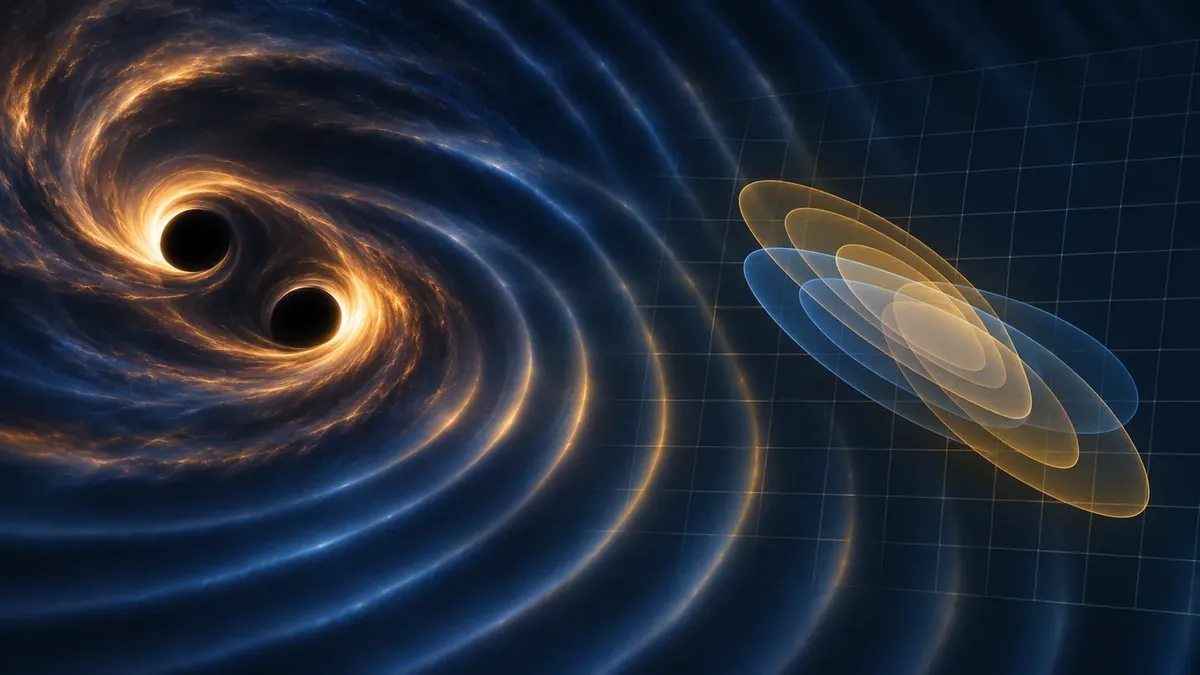
Black-hole spin and mass ratio can offer clues to how merging pairs formed, but gravitational-wave measurements can make them difficult to disentangle. A simulation study tests whether differences between waveform models create misleading patterns—and finds a limited, reassuring result, with important caveats.
Testing whether waveform differences can mimic formation clues
When two black holes merge, the gravitational waves they produce carry information about the pair. Researchers use the signal to estimate properties including the mass ratio, q—the lighter black hole’s mass divided by the heavier one—and effective spin, χeff, a summary of how the black holes’ spins project along the orbit’s angular momentum.
Patterns in these properties may help distinguish how black-hole pairs formed. But estimating them is challenging: changes in the waveform associated with mass ratio can partly resemble changes associated with spin. That measurement degeneracy raises a question: could differences between waveform models create apparent structure in a population, which might then be interpreted as evidence for particular formation channels?
A controlled simulation test
Upasana Das and Suvodip Mukherjee investigated this using simulated signals and parameter-recovery analyses. They generated a mock binary-black-hole population in which effective spin was drawn independently of mass. The simulated population therefore had no intrinsic mass–spin correlation by construction.
The mock catalog assumed a one-year observation and used an O5 detector-noise model for the two-detector H1–L1 network. The researchers applied a signal-to-noise ratio threshold of 12, retaining 276 detectable simulated events. These choices define the test; they are not a complete representation of every possible observing setup or astrophysical population.
They generated signals with NRSur7dq4, using it as a benchmark rather than as exact ground truth. They then estimated source properties with two other waveform models, SEOBNRv5PHM and IMRPhenomTPHM, and compared the recovered values with the injected ones. Recovering signals with NRSur7dq4 itself provided a reference for shifts that can occur even without changing waveform models. The researchers also compared their simulated results with reported parameter estimates for GWTC-5.0 events.
Shifts are not the same as a population pattern
Both alternative recovery models showed a tendency for effective-spin estimates to move toward intermediate values: strongly positive or negative injected spins were often recovered as less extreme. Mass-ratio estimates also shifted. The median joint displacement between recovered and injected parameters tended to increase toward lower mass ratios, though it varied across spin bins. The authors caution that some bins contain few simulated events, making their medians uncertain.
The shifts in mass ratio and effective spin were themselves correlated. That does not mean the recovered parameters showed a statistically reliable population correlation. In this mock catalog, the recovered mass-ratio and effective-spin values displayed a weak pattern, but it was not statistically significant. The authors found no evidence in this setup that waveform choice created an excess correlation in the recovered population beyond ordinary parameter-estimation effects.
This finding supports a narrow conclusion: for the mock population and detector conditions tested, the studied waveform differences did not manufacture a statistically significant mass-ratio–effective-spin correlation. It does not establish that correlations in real populations are generally unaffected by waveform systematics, nor does it rule out other biases or population structures.
What the event comparison does—and does not—show
The paper identifies simulated regions where individual parameter estimates can have larger shifts. Two catalog events, GW190403_051519 and GW240527_230910, fall near high-displacement regions under both recovery models. This comparison flags them as candidates for additional waveform-robustness checks. It does not show that either event’s measured parameters are actually biased, or that a particular formation channel is wrong. Other listed events were flagged under only one of the two models, underscoring that the results depend in part on the recovery model.
Important limits
NRSur7dq4 is an approximate model, not a perfect description of the physical signal. The paper gives its approximate domain as mass ratio q ≥ 1/6, spin magnitudes below about 0.8, and roughly 20 gravitational-wave cycles. Comparing recovery models against this benchmark cannot establish the absolute error relative to nature.
The injected systems also omit spin precession. Because precession adds modelling complexity and further parameter degeneracies, the authors describe their reported systematics as a conservative lower bound for generic precessing binaries. They also do not include orbital eccentricity, which can introduce additional degeneracies; the paper does not make the same explicit lower-bound claim for that omission.
This work is an arXiv preprint, and its conclusions should be read as results of a specific simulation and model comparison, not as proof that formation-channel inferences are immune to waveform uncertainty. Tests with more general binary signals and populations would help establish how broadly the result applies.
- gravitational waves
- binary black holes
- effective spin
- mass ratio
- waveform systematics
- formation channels
Related reading
Automatically matched by shared topic keywords. These links do not imply that the sources agree or establish a consensus.
What shapes black holes from the first stars?
Source published
Shared keywords: binary black holes, gravitational waves
A crowded peak, then a possible gap: the black-hole masses in gravitational-wave mergers
Source published
Shared keywords: binary black holes, gravitational waves
A Possible Black-Hole Merger History Meets a Spin Puzzle
Source published
Shared keywords: binary black holes, gravitational waves
Phentax adapts black hole waveform calculations for LISA’s crowded signals
Source published
Shared keywords: gravitational waves
Even powerful birth kicks struggle to reverse black hole binary orbits
Source published
Shared keywords: effective spin, gravitational waves