TRANSMISSION // 2611.34720v1
Simulations test a Pandora star-correction method
Source published
A preprint tests Gaussian processes on simulated Pandora data. The method improves recovery of combined starlight, but does not improve every atmospheric parameter in every scenario.
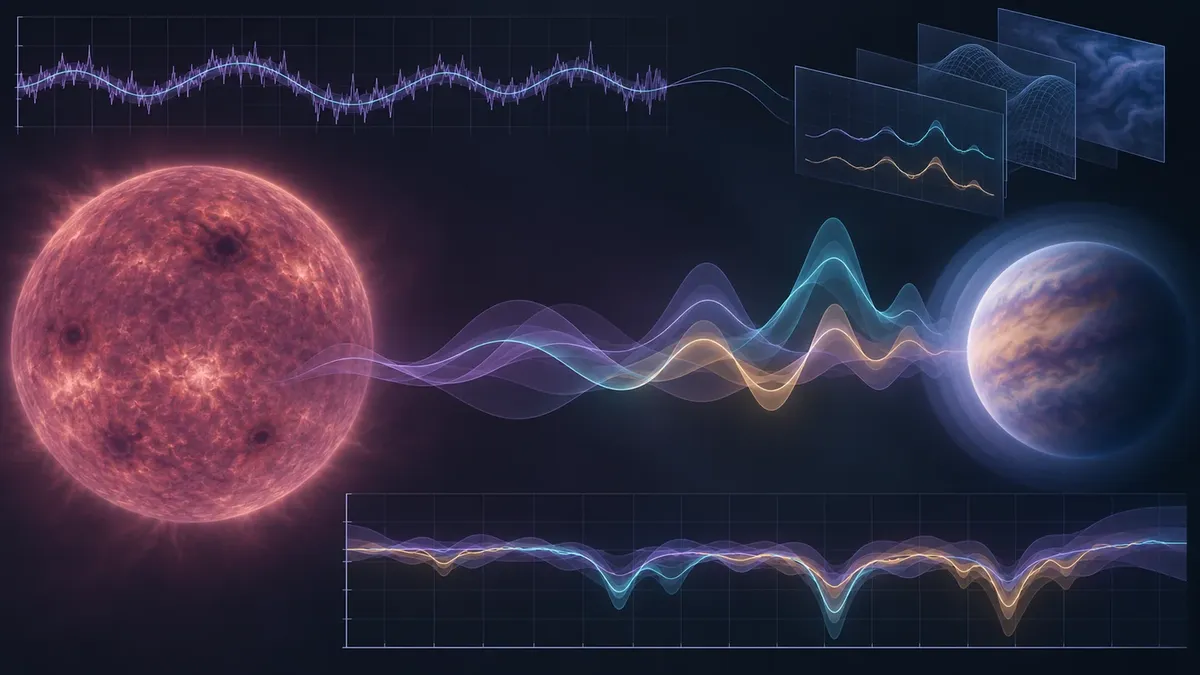
Starspots can imprint features on an exoplanet’s transit spectrum, complicating the search for atmospheric molecules. Researchers tested a proposed Pandora data-analysis method using simulations—not real Pandora observations—to see whether it could account for inaccuracies in stellar models.
When the star complicates a planet’s spectrum
When a planet passes in front of its star, some starlight filters through the planet’s atmosphere. Astronomers study the resulting spectrum for signs of molecules. But the star itself can affect that light: cooler spots on its surface can change the spectrum and imitate or obscure features attributed to the planet. This is a particular concern for active K- and M-dwarf stars.
A common way to correct for this stellar contamination is to model the star’s surface. If the model does not accurately represent the real star, the correction can introduce bias. This preprint asks whether simulated data like those planned for NASA’s Pandora SmallSat could help address that problem. Pandora is designed to collect visible-light photometry and near-infrared spectra of planet-hosting stars over repeated visits.
Treating stellar models as starting points
The researchers developed a framework using Gaussian processes, a statistical tool for representing correlated changes across wavelengths. Instead of treating stellar-model spectra as exact, they used them as starting points and allowed two Gaussian-process components to learn wavelength-dependent differences: one for the quiet photosphere and one for cool spots.
As a star rotates, the proportion of its visible surface covered by spots can change. The resulting shifts in the combined starlight provide clues about the underlying components. The team tested the method on eight simulated K- and M-dwarf activity scenarios. Each scenario had 20 binned out-of-transit epochs, drawn from ten simulated visits, and was set up to produce about 1% peak-to-peak variability in visible light. These are controlled simulations, not a broad test on observed stars.
To create a model mismatch, the simulated observations were generated using one PHOENIX stellar-model grid, while the main retrievals used another. The researchers also tested retrievals without that mismatch. They passed the inferred stellar-contamination factors into an atmospheric retrieval, so uncertainty in the stellar correction could be included rather than fixing the correction at a single estimate.
For the planetary test, they used a simplified, water-bearing atmosphere modeled after a WASP-69 b-like gas giant. It was a simulated example, not a new analysis of WASP-69 b itself.
What improved—and what did not
Across the simulated scenarios, the Gaussian-process method consistently improved recovery of the star’s disk-integrated spectrum: the combined light from the visible stellar disk. The flexible model also often represented stellar-model uncertainty more fully than the fixed-grid approach. However, uncertainty was not uniformly broader for every parameter or comparison; the paper notes exceptions, including cases where some non-GP atmospheric estimates had higher variance.
The atmospheric results were less uniform. In the representative WASP-69 b-like test, the flexible correction reduced some model-driven biases and produced atmospheric estimates more consistent with the simulated input. But improved recovery of the combined stellar spectrum did not guarantee improved recovery of every atmospheric parameter in every scenario. Degeneracies—where different combinations of stellar and atmospheric properties produce similar spectral patterns—can leave residual biases or worsen particular retrieval measures.
The observations constrain the combined starlight more directly than the separate photosphere and spot spectra. If spots contribute little light, their spectrum is especially hard to infer. In these simulations, learning the spot-related mismatch depended on how much spot coverage changed. The authors suggest comparing flexible and fixed-model fits alongside other diagnostic checks to judge whether Gaussian-process corrections are justified. A better fit alone cannot show that the mismatch comes from the stellar model; instrumental effects or other unmodeled features could also be responsible.
A simulation result, not an observational demonstration
The study tests a proposed method on simulated observations, not real Pandora data. Its model mismatch comes from one particular pair of stellar-model grids, used as a proxy for errors in real stars. The simulations assume stable, sinusoidal spot-coverage changes and include only a quiet photosphere and cool spots. They omit other surface features, such as faculae, and the atmospheric test assumes the planet crosses an immaculate part of the star. The atmospheric retrieval is deliberately simplified as well.
These choices help isolate the method’s behavior under controlled conditions, but limit how confidently results can be applied to real stars and observing schedules. The authors describe future work to test broader forms of model mismatch and more complex stellar surfaces and variability. The source is an arXiv preprint; its acknowledgement of an anonymous referee does not establish acceptance or publication. Further tests, including with real observations, are needed to establish how well the method works in practice.
- exoplanets
- Pandora mission
- stellar contamination
- Gaussian processes
- transmission spectroscopy
- stellar spots
Reviewed cross-references
These connections were reviewed by a model, not independently fact-checked by a human. Similarity does not imply agreement; consult the original papers and the evidence below.
Faster noise modelling could sharpen studies of exoplanet atmospheres
Shared method: Both studies use Gaussian processes to represent wavelength-correlated deviations and carry uncertainty into inference. Ko et al. use separate GPs for photosphere and spot model mismatch in simulated Pandora stellar retrievals; Fortune et al. develop scalable 2D GPs for correlated noise across time and wavelength. The applications and tested data differ, so the latter does not validate the Pandora results.
Model review: · openai-codex/gpt-6-luna
Evidence and provenance
Selected excerpts, not complete papers. PDF extraction can omit figures or damage equations, tables and reading order; sources may be preprints.
2611.34720v1 — Original paper
Excerpt reference:
static/papers/2611.34720v1.md:108-159
Basis: Paper text
Source SHA-256:f04da253e48a13cafda667f0a7d131453ade0a051ff03925b8d12f8e2795979e2611.34720v1 — Original paper
Excerpt reference:
static/papers/2611.34720v1.md:1565-1632
Basis: Paper text
Source SHA-256:f04da253e48a13cafda667f0a7d131453ade0a051ff03925b8d12f8e2795979e2611.09198v1 — Original paper
Excerpt reference:
static/papers/2611.09198v1.md:69-130
Basis: Paper text
Source SHA-256:337b34d032a5e353197d55e8f17996e071aa57a8c8dd5f681618d6b2e29a1ac72611.09198v1 — Original paper
Excerpt reference:
static/papers/2611.09198v1.md:20-68
Basis: Paper text
Source SHA-256:337b34d032a5e353197d55e8f17996e071aa57a8c8dd5f681618d6b2e29a1ac7
Related reading
Automatically matched by shared topic keywords. These links do not imply that the sources agree or establish a consensus.
TOI-1518 b’s orbit and atmospheric signals
Source published
Shared keywords: transmission spectroscopy
A star-blend check before the telescope looks
Source published
Shared keywords: stellar contamination
A fast-spinning pulsar reveals a changing companion star
Source published
Shared keywords: stellar spots
Modeling Haze Clues in JWST Sub-Neptunes
Source published
Shared keywords: stellar contamination
GJ 9404 b remains an uncertain planet candidate
Source published
Shared keywords: gaussian processes