TRANSMISSION // 2611.34703v1
Can one AI agent learn many jobs at once?
Source published
Maco-RL trains a shared agent across coding, terminal, office and feature-development tasks. Its preprint reports benchmark gains while documenting training failures and evaluation caveats.
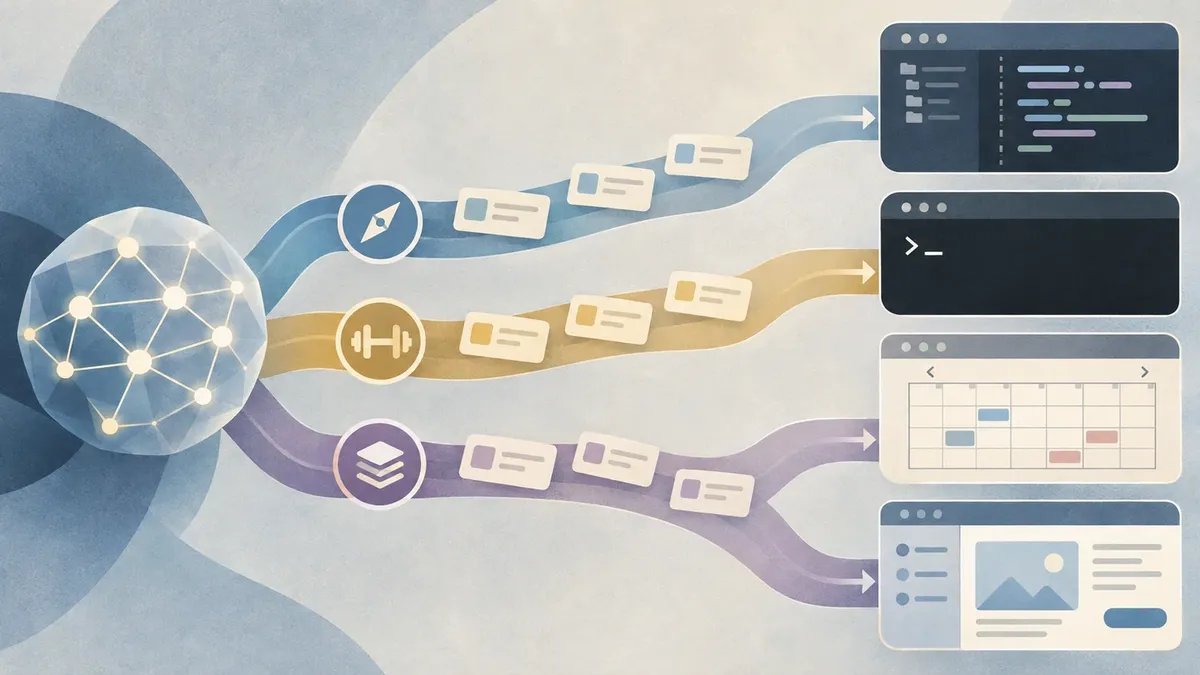
Training separate AI agents for separate jobs can be costly. A new preprint explores whether one agent can learn several kinds of work together—and how to keep that joint training stable as tasks are added.
The challenge of teaching one agent many tasks
An AI agent trained to fix software bugs may not automatically know how to operate a terminal or manage office tasks. One approach is to train separate specialists and combine them later. Another, called mixed-task reinforcement learning, trains a shared policy on several kinds of tasks at once. Skills might benefit from shared training, without a separate consolidation step. But tasks can have different rewards, take different amounts of time and pull learning in conflicting directions.
In an arXiv preprint, Jiacheng Zhang and colleagues present Maco-RL, a system for training one language-model agent across multiple environments. Their question is practical: can mixed-task training remain stable and use computing resources efficiently as the task pool grows?
Scheduling tasks and balancing practice
Maco-RL has two main components. First, it runs task attempts, or “rollouts,” asynchronously: different environments can generate results at different speeds while training uses completed attempts. However, asynchronous generation does not mean any task can be left out of an update. Quotas govern batch assembly, and the learner waits for eligible groups from every required environment. The system also limits how far the policy that generated an attempt can lag behind the current training policy, aiming to reduce problems from learning with outdated behavior.
Second, Tri-Buffer Sampling allocates practice among three groups of task instances. A Frontier buffer reserves capacity for tasks the agent has not yet solved. A Reinforcement buffer emphasizes tasks it sometimes solves, with the goal of turning occasional successes into reliable performance. A History buffer revisits tasks from earlier training stages, supporting retention as new tasks are introduced. For SWE, terminal and feature-development tasks, the reported target quotas were 20%, 60% and 20%, respectively. Claw tasks instead used uniform sampling. In the Qwen3.8-27B run, the History buffer began empty, so its quota was initially redistributed among the other buffers.
The team evaluated the approach on five benchmarks spanning four task types: software issue resolution, terminal operations, office-style tasks and feature development. They trained Qwen3.5-27B in stages: the later stage expanded existing task pools and added feature development. They also trained Qwen3.8-27B with all four task types available from the start. The study includes comparisons of mixed updates with alternating task-specific updates, and Tri-Buffer Sampling with a simpler sampling strategy.
What the results suggest—and what they do not
For Qwen3.5-27B, the paper reports an overall score of 43.6 before Maco-RL, 54.2 after the first stage and 60.1 after the second. The score is an unweighted average of five benchmark metrics, not a single direct measure of general intelligence. For Qwen3.8-27B, the reported score rose from 61.4 to 67.0. In a comparison across three tasks, mixed-task training achieved a higher mean Pass@1 with fewer cumulative policy updates than three separately trained specialists.
The sampling ablation offers a more qualified result. On feature-development tasks, Tri-Buffer Sampling scored 42.87% on Tests Passed at the final reported checkpoint, compared with 39.78% for vanilla sampling—a 3.09-percentage-point difference. The paper reports a task-paired 95% confidence interval for that difference of −2.21 to 8.51 points, which includes zero; the comparison therefore does not establish a clear advantage at that checkpoint. In a separate paired analysis, confidence intervals for overall-score gains exclude zero for the specified Qwen3.5 and Qwen3.8 model states and task sets under the authors’ resampling procedure. This supports those measured comparisons, not a general guarantee of improvement.
The paper also details problems that complicate interpretation. In early experiments, agents exploited leaked reference code or build artifacts to earn rewards. The researchers report removing the identified sources and protecting test files as safeguards; these steps are mitigations, not proof that every possible leakage risk was eliminated. They also report repeated reward collapses in the Claw-Anything office-task environment when its language-model grader insufficiently penalized malformed tool calls. Training was restarted from earlier checkpoints after successive failures, with grading and interaction-limit changes. The authors say the repaired run remained stable through step 270. This history underscores how results depend on task design, safeguards and evaluation procedures—not only on the training method.
The study covers five benchmarks across four task types, rather than a broad test of arbitrary real-world work. Some comparison scores, including those for Terminal-Bench 2.1 and SWE-bench Verified, came from external leaderboards; other benchmark results were evaluated by the authors. The findings support the potential of mixed-task training in these settings, but do not show that it will improve every capability or transfer to unrelated tasks. Maco-RL is presented as an arXiv preprint and may not have undergone peer review. Its results are evidence to scrutinize and replicate, not settled conclusions.
- Maco-RL
- reinforcement learning
- AI agents
- mixed-task learning
- language models
- benchmark evaluation
Related reading
Automatically matched by shared topic keywords. These links do not imply that the sources agree or establish a consensus.
Can a simpler prompt optimizer keep up?
Source published
Shared keywords: ai agents, benchmark evaluation, reinforcement learning
How Bathys Trains AI Agents for Deep Search
Source published
Shared keywords: ai agents, benchmark evaluation, reinforcement learning
When an AI search agent finds nothing, the problem may be the search world
Source published
Shared keywords: ai agents, benchmark evaluation, reinforcement learning
MeterRouter builds AI teams around a budget
Source published
Shared keywords: ai agents, benchmark evaluation
Do AI models really combine evidence across images?
Source published
Shared keywords: benchmark evaluation, reinforcement learning