TRANSMISSION // 2611.34698v1
Teaching Driving AI to Learn From Its Weak Spots
Source published
A failure-driven training loop creates targeted driving scenarios, measures where models still fail, and directs new training data toward those gaps. Tests show gains, but also reveal important limits.
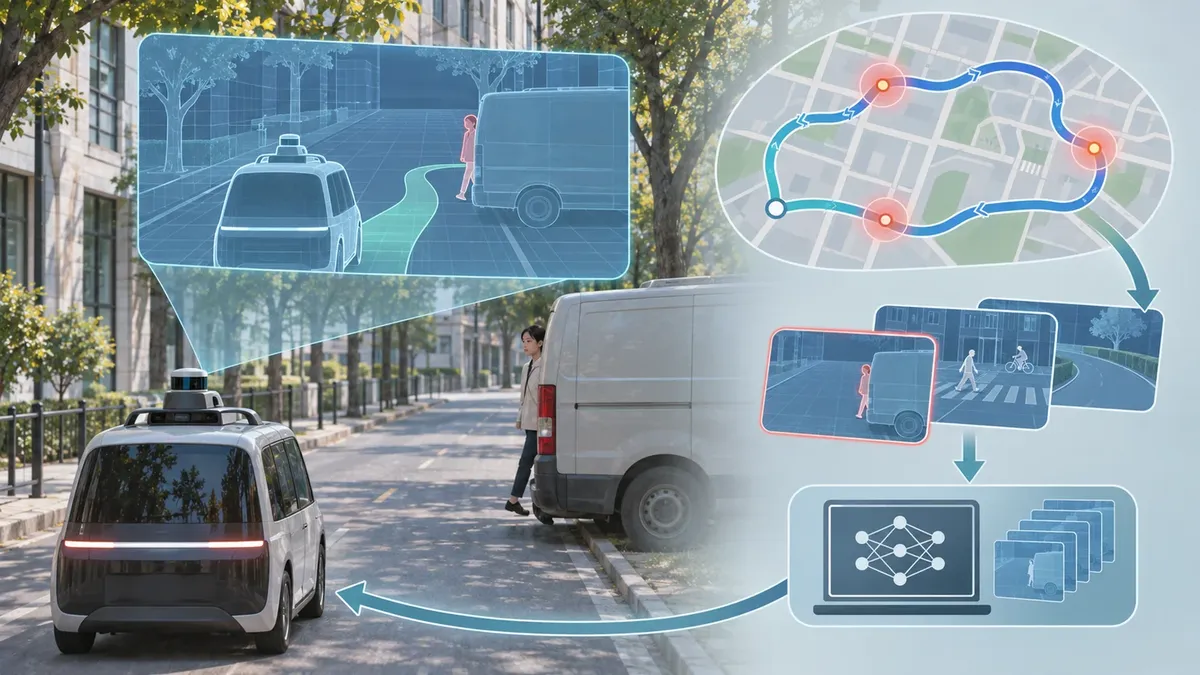
When an autonomous-driving model encounters a situation missing from its training data, how can developers expose and address the gap without relying on a large fleet of deployed vehicles? This preprint proposes a feedback loop that constructs new scenarios, maps model failures, and prioritizes the next round of training.
A training loop guided by failure
An autonomous vehicle may need to handle a situation its training data barely covers: a pedestrian stepping from behind a parked vehicle, for example, or a stop sign at an intersection. Simply measuring whether a model avoids a collision can miss how it does so. A vehicle that stops moving altogether may look safe by that measure, while being unable to drive normally.
A research team proposes a “failure-driven data flywheel” to make those weaknesses more visible and guide additional training. Rather than waiting for rare events to occur in a large fleet, the method creates controlled scenarios, checks specific driving behaviors, and focuses new training data on conditions where the model continues to fail.
Building scenarios and a failure map
The researchers reconstructed urban scenes from nuScenes driving logs using a 3D scene-rendering method. They inserted virtual road users and objects to create situations not present in the original logs. For pedestrian tests, a person emerged from behind a parked vehicle; the timing of the emergence varied to make the event more or less difficult. Each target scenario had a paired control with the same setting but no pedestrian, helping reveal whether a model slowed unnecessarily.
A rule-based driving expert supplied example trajectories for training. The researchers evaluated model predictions against individual behavioral requirements, including slowing before reaching the occluding vehicle, braking after the pedestrian appeared, waiting while the path was blocked, and moving again afterward. For each round, failure rates across scenario conditions formed a “failure map.” The next round generated more examples for conditions with higher failure rates, while retaining some original driving data to limit loss of existing capabilities.
The team tested two vision-language-action models, AutoVLA and ReCogDrive, as well as a non-VLA planner called LAW. A VLA model combines visual and language inputs with action generation. Tests covered both the hidden-pedestrian scenario and yielding at stop-sign-controlled intersections. The researchers used separate development and sealed test sets; the sealed set was not used to steer the iterative training process.
Gains, with a revealing caveat
After five training rounds, the critical-phase collision-free rate on the sealed pedestrian test set rose from 0.261 to 0.579 for AutoVLA, and from 0.390 to 0.765 for ReCogDrive. In paired control scenarios, unnecessary braking remained at or below 0.013 for those models. In simulated stop-sign tests, the stop-before-line rate rose from 0.100 to 0.897 for AutoVLA and from 0.000 to 0.667 for ReCogDrive when training began from the base models.
The finer-grained measures show that the headline collision score does not tell the whole story. Both VLA models learned to slow down before reaching the parked vehicle, but their braking response after the pedestrian appeared remained limited. In an ablation, removing paired control examples produced a higher collision-free score for ReCogDrive, but also more unnecessary braking and less progress in control scenarios. That result illustrates why a safety score needs to be read alongside measures of normal driving behavior.
The researchers also tested ReCogDrive on a full-scale vehicle on a closed track, using a pedestrian dummy. In five target trials, the open-loop post-trained model completed four safe passages, compared with one for the base model. These are small trial counts, and the result does not establish performance on public roads. The paper also reports a separate closed-loop post-training result in simulation: improvements from open-loop training did not automatically transfer to sustained interaction, underscoring that evaluation setup matters.
Sequential training suggests that a second capability can be added without erasing the first completely. After stop-sign training initialized from pedestrian-capable models, the stop-before-line rate reached 0.599 for AutoVLA and 0.358 for ReCogDrive; the pedestrian collision-free rate fell by 0.010 and 0.032, respectively.
What the evidence can—and cannot—show
The work offers a practical way to generate targeted examples when real-world examples are scarce, and its paired controls help distinguish an appropriate response from simply stopping. But the evidence is concentrated in two driving tasks, uses reconstructed scenes and a rule-based expert, and includes only five real-vehicle target trials for the reported comparison. The authors identify the limited post-emergence braking response and extension to other platforms as open challenges.
These results come from an arXiv preprint, which has not necessarily undergone peer review. Simulation and a closed-track test cannot establish safe performance across the variety of real roads, weather, people, and traffic. The findings support further testing of failure-guided training—not a conclusion that these systems are ready for unsupervised driving.
- autonomous driving
- vision-language-action models
- AI training
- simulation
- pedestrian safety
- preprint
Reviewed cross-references
These connections were reviewed by a model, not independently fact-checked by a human. Similarity does not imply agreement; consult the original papers and the evidence below.
Instant NuRec: A One-Pass Route to 3D Driving Scenes
Shared method: Both papers use 3D Gaussian Splatting to represent driving scenes: Luo et al. reconstruct nuScenes scenes and insert entities for scenario generation, while Instant NuRec predicts layered 3DGS worlds from multi-camera logs. Their pipelines and goals differ—targeted post-training data generation versus feed-forward scene reconstruction—so this is a shared representation technique, not evidence that one method improves the other.
Model review: · openai-codex/gpt-6-luna
Evidence and provenance
Selected excerpts, not complete papers. PDF extraction can omit figures or damage equations, tables and reading order; sources may be preprints.
2611.34698v1 — Original paper
Excerpt reference:
static/papers/2611.34698v1.md:182-237
Basis: Paper text
Source SHA-256:7fecf3d84a3e18cc10c7c250bbb90c070b643df081578010138e0262490f4ac52607.14203v3 — Original paper
Excerpt reference:
static/papers/2607.14203v3.md:66-108
Basis: Paper text
Source SHA-256:320d686b4080c5379706943d81164e032469d78004c460e5a6cf67c2b7002493
Related reading
Automatically matched by shared topic keywords. These links do not imply that the sources agree or establish a consensus.
Can AI-generated worlds keep up with robots and self-driving cars?
Source published
Shared keywords: autonomous driving
Instant NuRec: A One-Pass Route to 3D Driving Scenes
Source published
Shared keywords: autonomous driving
A convincing simulation can still fool a driving model
Source published
Shared keywords: autonomous driving
CoSafe coordinates safety interventions across self-driving cars
Source published
Shared keywords: autonomous driving
How AXE Selects Driving Paths in Simulation
Source published
Shared keywords: autonomous driving