TRANSMISSION // 2611.34691v1
A higher-energy form of acrolein detected in TMC-1
Source published
A sensitive radio survey found s-cis acrolein in TMC-1. Its abundance relative to the lower-energy form challenges simple equilibrium expectations, while the chemistry behind the ratio remains unresolved.
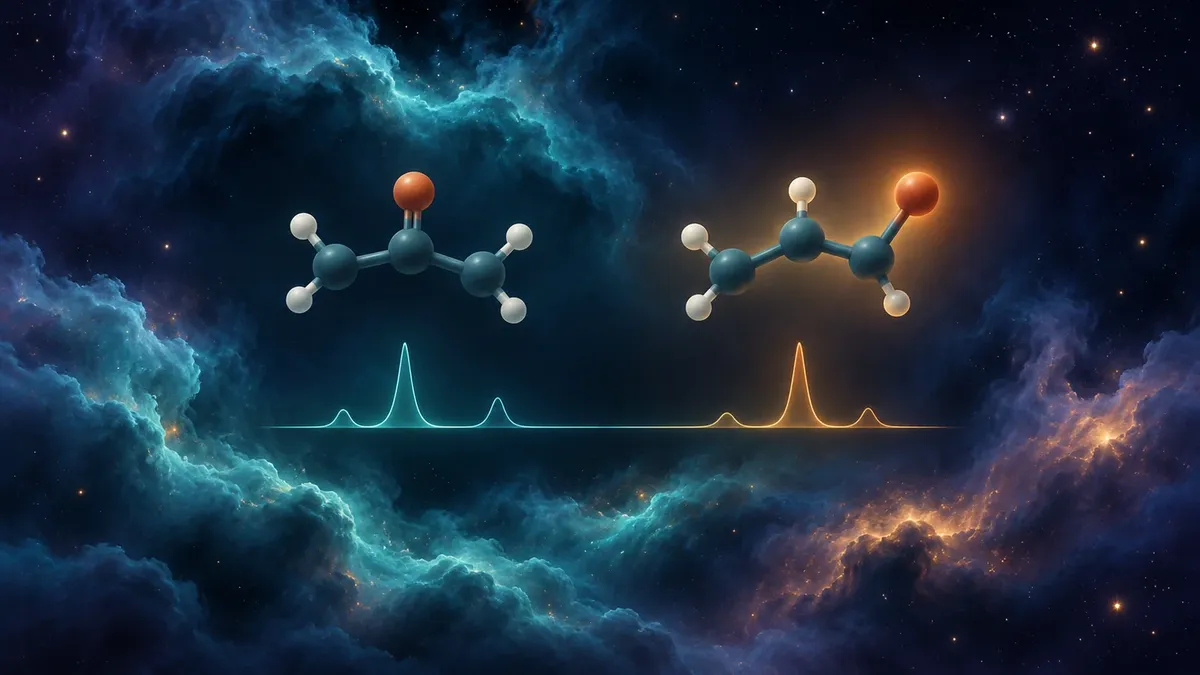
Molecules can take different shapes while containing the same atoms. In a cold interstellar cloud, the balance between two such forms may preserve clues about how molecules form and change. A new study reports the first detection of acrolein’s s-cis form in TMC-1—and a ratio that current chemical modelling does not yet explain.
A faint signal from TMC-1
Acrolein, also called propenal, has two conformers: forms that differ because part of the molecule rotates around a single bond. The lower-energy form is called s-trans; the higher-energy one is s-cis. Researchers had previously detected s-trans acrolein in the cold molecular cloud TMC-1. Now, using the Quijote radio line survey, a team reports detecting s-cis there as well.
The two forms are separated by about 1,025 kelvin in energy. That is not the cloud’s temperature: the study uses a rotational temperature of 7.5 K when modelling the observed lines. If the conformers were simply in thermal equilibrium at such a low temperature, the higher-energy form would be expected to be extraordinarily scarce. Instead, the measured s-cis-to-s-trans abundance ratio is 0.45 ± 0.11.
In other words, the higher-energy form is present at a substantial fraction of the lower-energy form’s abundance. The authors interpret this mismatch with equilibrium expectations as evidence that chemical processes, rather than temperature alone, shape the conformer populations.
Reading the molecule’s radio lines
The team used observations from the Quijote survey, made with the Yebes 40-metre telescope. The survey covers radio frequencies from 31 to 50 GHz; these observations were centered on TMC-1’s cyanopolyyne peak. The paper reports 1,509.2 hours of accumulated integration time for the survey and sensitivity that varies by frequency.
Molecules emit radiation at characteristic frequencies as they rotate. The researchers identified several transitions consistent with s-cis acrolein, including four above the study’s three-sigma noise threshold that were unblended or only slightly blended. The lines were narrow and aligned with TMC-1’s characteristic velocity, supporting their association with the cloud. Some transitions were affected by blending or instrumental artifacts, so not every line provided an equally clean measurement.
To estimate how much s-cis acrolein was present, the researchers fitted synthetic spectra to observed line profiles using the Madex code. They assumed a rotational temperature of 7.5 K, a source diameter of 80 arcseconds and a line width of 0.6 kilometres per second. The estimated column density—a measure of the number of molecules along the line of sight—was (1.0 ± 0.2) × 10¹¹ per square centimetre. The team compared this with a previously reported column density for s-trans acrolein to derive the conformer ratio.
A chemical lead, not a full explanation
The researchers also ran an exploratory gas–grain chemical model, simulating reactions in gas and on dust grains. In that model, the reaction between C₃H₅ and oxygen accounts for nearly all modelled acrolein production at the relevant times. However, the model tracks total acrolein, not how much of each conformer the reaction produces.
That distinction matters. In earlier work on a related molecule, the reaction pathway was found to favor the s-trans form. If the acrolein reaction has a similar preference, it would not by itself explain the observed amount of s-cis. Other routes, or processes that destroy or convert one conformer into the other, may matter. The paper discusses possibilities including gas-phase reactions, dust-grain chemistry and quantum tunnelling, but does not determine their relative contributions.
The result is a new constraint on interstellar chemistry, not a settled explanation. The abundance estimate depends on assumptions in the spectral model, including the adopted temperature; a rotational-diagram analysis could not reliably constrain temperature and column density from the available lines. The chemical model is exploratory and does not treat the conformers separately. The source is an arXiv preprint of a manuscript marked as an Astronomy & Astrophysics letter; the supplied material does not establish that peer review is complete. Further observations and conformer-specific chemical modelling will be needed to explain the unexpectedly substantial s-cis abundance.
- astrochemistry
- TMC-1
- acrolein
- interstellar molecules
- molecular conformers
- radio astronomy
Related reading
Automatically matched by shared topic keywords. These links do not imply that the sources agree or establish a consensus.
DCN/DNC Ratio Is Linked to Temperature in Massive Star-Forming Regions
Source published
Shared keywords: radio astronomy
Quieter satellites could protect radio astronomy and Earth-rotation measurements
Source published
Shared keywords: radio astronomy
How MAASAI coordinates astronomy analysis
Source published
Shared keywords: radio astronomy
FAST Reveals Filaments in a Magellanic Stream Field
Source published
Shared keywords: radio astronomy
A hybrid approach to calibrating radio arrays
Source published
Shared keywords: radio astronomy