TRANSMISSION // 2611.34677v1
A first-order digital filter for resonant signals
Source published
FOREST is a real, first-order digital resonant filter designed to produce two outputs 90 degrees apart at resonance. A model and initial FPGA tests support its operation, while broader performance remains to be established.
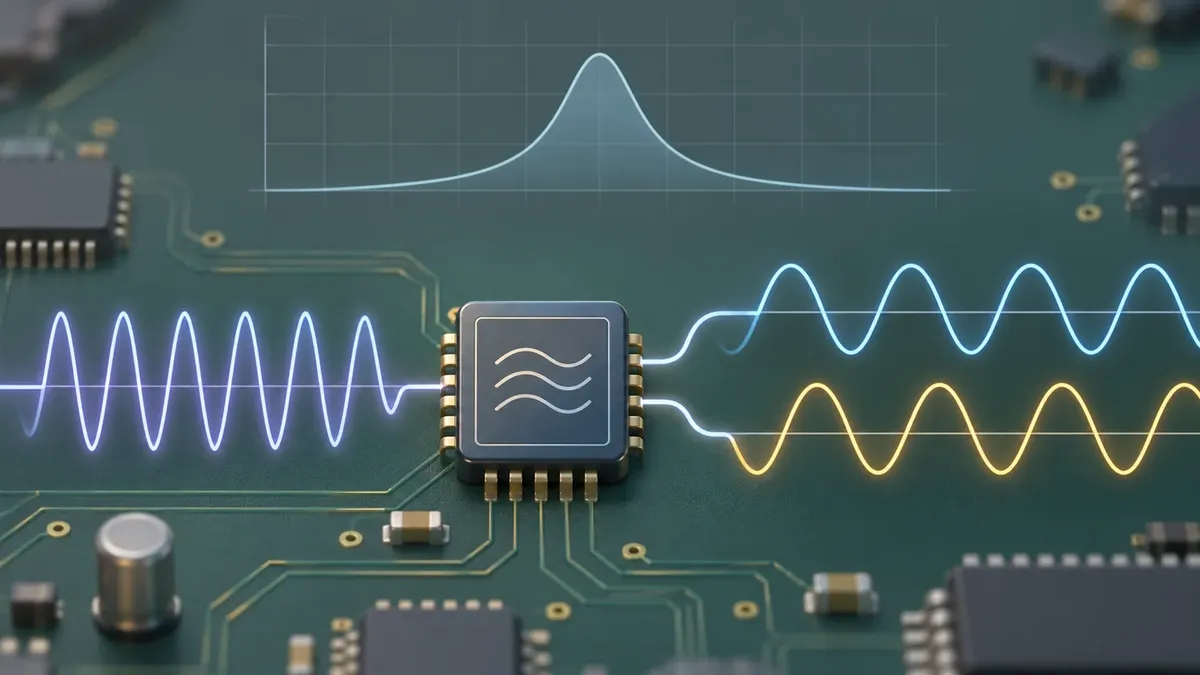
Resonant filters isolate signals near a chosen frequency, and two phase-related outputs can help track a signal’s frequency and phase. Edward J. Daw’s preprint presents FOREST, a first-order digital filter designed to provide both functions. It derives the algorithm, models its response and reports initial tests on FPGA hardware.
A resonance from a first-order design
Resonant filters are used when a system needs to follow a particular frequency, for example when measuring an alternating electrical signal or tracking changes in phase. Digital filters are often built from second-order sections. At high sampling rates, implementation choices can make coefficient precision and hardware resources important considerations.
Edward J. Daw’s paper introduces FOREST, short for “First-order resonant orthogonal state generator.” Its central idea is to reinterpret the mathematics of a resonator. A standard resonator has a pair of complex-conjugate poles—mathematical features associated with its frequency response. Splitting the transfer function into first-order pieces appears to leave complex coefficients. Daw shows that, after applying a digital transformation and taking the appropriate imaginary part, the resulting filter can be implemented with real coefficients.
FOREST is intended to do more than select a resonant frequency. It produces two outputs from one input: an in-phase component and a quadrature component, which is shifted by 90 degrees at resonance. These components can help determine a signal’s phase and frequency, making them useful in phase-locked loops and other signal-tracking systems.
From equations to hardware
The paper derives the filter algorithm from a continuous-time resonator’s transfer function, then converts it to a discrete-time form using the bilinear, or Tustin, transform. It represents the system in state-space form, a standard way to describe how internal values evolve from one sample to the next and how they produce outputs.
The author uses this model to calculate frequency responses for filters with different resonant frequencies and quality factors. Quality factor, or Q, describes how narrow and pronounced a resonance is: higher Q corresponds to a sharper response. The paper then reports an FPGA-based hardware implementation, using analogue-to-digital and digital-to-analogue converters, and measurements made with a vector network analyser.
In the model, the two outputs are separated by 90 degrees, as expected for an orthogonal state generator. Reported measurements show resonance widths and relative response levels consistent with the settings tested, and the measured output phases show the expected 90-degree difference. The paper describes a 50 MHz analogue bandwidth and measurements of resonances at 15 MHz, with tested Q settings from 125 to 16,000. At higher Q, the measured response showed more noise; the author suggests fixed-point arithmetic in the implementation as a possible source.
What the results do—and do not—show
The results support the feasibility of implementing this first-order resonant design in FPGA hardware. They do not establish that FOREST performs better than other filters or is ready for every proposed use. The paper discusses possible applications including mains monitoring, motor control, phase-locked loops and high-Q resonators, but the reported experiments are simulations and bench measurements, not demonstrations across those settings.
There are practical caveats. The paper notes that higher-Q measurements were noisier and that phase measurements became difficult when the output away from resonance was small. The clocks of the test board and network analyser were not synchronised, and the measured phase also included delay from the converter hardware. The author suggests that further implementation adjustments may reduce noise. These details matter when interpreting results, particularly for a filter intended to resolve narrow resonances.
The paper is marked as submitted to a journal, and the available source does not establish that peer review is complete. The hardware tests are described as initial, and there is no broad comparative benchmark against alternative designs. The work presents a specific design and an initial hardware test, not a settled assessment of performance across applications. Independent replication and testing in particular use cases would help clarify how it performs in practice.
- digital signal processing
- resonant filters
- FPGA
- orthogonal state generator
- phase-locked loops
- FOREST
Related reading
Automatically matched by shared topic keywords. These links do not imply that the sources agree or establish a consensus.