TRANSMISSION // 2611.34674v1
How a Massive Gas Envelope Could Keep a Super-Puff Bloated
Source published
A model suggests that super-puffs with large hydrogen-helium envelopes can remain unusually large for billions of years—but how they acquire and retain so much gas remains uncertain.
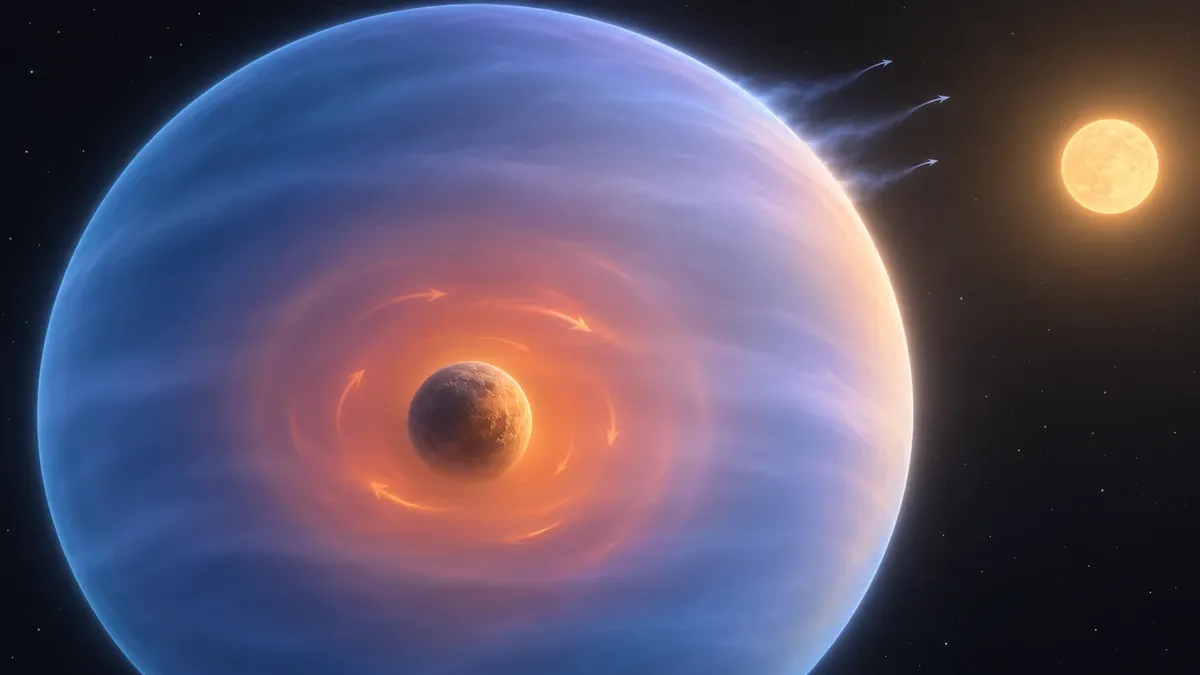
Some exoplanets are astonishingly light for their size: they weigh only a few to tens of Earths, yet can span nearly Jupiter’s width. A new thermal-evolution model explores whether a thick hydrogen-helium envelope could keep these “super-puffs” inflated long after they form.
Super-puffs pose a puzzle. Their measured masses are low, but their radii can approach Jupiter’s, giving them exceptionally low average densities. Some are found in systems billions of years old, and not all receive intense stellar heat. What keeps them so expanded when planets are expected to cool and shrink over time?
A study by Xiumin Huang and colleagues investigates one possible answer: a very large envelope of hydrogen and helium, or H/He. The researchers modelled how a planet’s rocky interior and gaseous envelope cool and contract together. Their calculations suggest that, under suitable starting conditions, the envelope itself can help preserve a super-puff’s large radius for hundreds of millions to billions of years.
Following a planet as it cools
The team used a one-dimensional model of planetary structure and thermal evolution. It calculates how pressure, temperature, density and energy change from a rocky core through the surrounding gas. The model includes hydrostatic balance and energy transport, with different treatments for regions where heat moves mainly by radiation or convection.
The researchers varied the planet’s total mass, the fraction of its mass in H/He, the level of stellar heating and the initial temperature of its rocky interior. They used Kepler-51 d—a particularly low-density planet—as a representative case. Its observed mass is about 5.6 Earth masses, its radius about 9.3 Earth radii, and its estimated age roughly 500 million years.
For that example, a model with an H/He envelope making up half the planet’s mass can produce a radius comparable to the observed one at the planet’s estimated age. Across the broader calculations, envelopes comprising roughly 40–60% of a planet’s mass can allow Jupiter-like radii to persist over billion-year timescales, provided the interior starts sufficiently hot. The exact envelope needed depends on factors including planetary mass and equilibrium temperature.
The envelope is more than insulation
The proposed explanation has two connected parts. First, a thick envelope acts like a thermal blanket: it slows the loss of heat from the rocky interior. Second, the envelope cools and contracts too, releasing energy through a process called Kelvin–Helmholtz cooling. That energy helps the gas retain the high entropy associated with an extended structure.
In the model, the envelope’s own cooling supplies most of the intrinsic luminosity when the envelope is very massive. A more modest envelope leaves the rocky interior’s cooling relatively more important. The calculations also find that, at fixed total mass, a larger envelope fraction generally produces a more extended planet. Greater stellar heating can further slow internal heat loss, although the authors find that envelope mass is a particularly important factor in their explored models.
These results describe a possible way to maintain a large physical radius; they do not show that every super-puff is explained this way. Other ideas include hazes or dust that make a planet appear larger during a transit, rings that increase the area blocking starlight, and extra internal heating. The study’s calculations do not rule out those possibilities.
What the model leaves open
A major limitation is that the calculations start with an envelope already in place. They do not model how the planet accreted that gas, or whether it would later escape into space. This matters because the most inflated cases require a very large gas supply: in some models, envelope mass approaches the mass of the rocky core. How a relatively small planet could acquire and keep so much gas without continuing to grow into a gas giant remains an open formation question.
The results also depend on assumptions about the envelope. The model uses solar-metallicity opacity and neglects heavy elements’ contribution to the gas equation of state. Enrichment could make an envelope more compact while also increasing its opacity and slowing heat loss; the net effect is uncertain. The study further assumes no mass loss and uses a simplified one-dimensional description, so its predicted envelope fractions should not be treated as direct measurements of real planets.
The authors’ conclusion is therefore conditional: massive H/He envelopes offer a viable explanation for long-lived super-puff radii in their calculations, especially when planets begin hot. The work does not establish that this is the explanation nature uses, nor does it solve how such envelopes form and survive. As an arXiv preprint, the study should also be regarded as a proposed model result rather than a settled scientific conclusion; the supplied source does not establish whether it has undergone peer review.
- super-puff exoplanets
- planetary atmospheres
- hydrogen-helium envelopes
- planetary cooling
- exoplanet formation
Related reading
Automatically matched by shared topic keywords. These links do not imply that the sources agree or establish a consensus.
A survey of 63,254 stars puts the brown dwarf desert on a relative scale
Source published
Shared keywords: exoplanet formation
A Python toolkit for simulating clouds on other worlds
Source published
Shared keywords: planetary atmospheres
Webb finds no confirmed planets around Altair—but leaves room for hidden worlds
Source published
Shared keywords: planetary atmospheres
How to Prioritize Temperate Exoplanets for Observation
Source published
Shared keywords: planetary atmospheres