TRANSMISSION // 2611.34672v1
A search for primordial ripples finds no convincing signal
Source published
Researchers combined measurements of the cosmic microwave background with galaxy and quasar clustering to look for oscillatory fingerprints from the early Universe. They found no statistically significant evidence for these features.
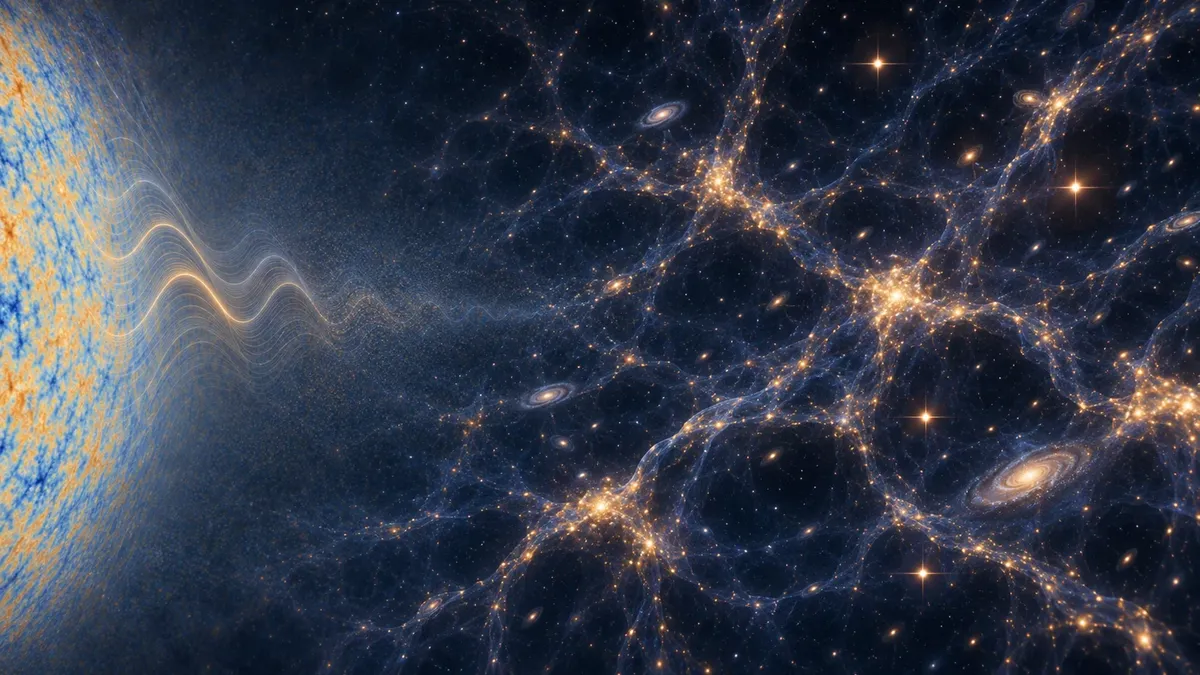
Could tiny ripples in the Universe’s oldest light and the later distribution of galaxies preserve clues about what happened in the earliest moments of cosmic history? A new analysis searched for such patterns in data from Planck, BOSS and eBOSS. Its conclusion is cautious: the tested models do not reveal a statistically significant signal.
Looking for traces of the early Universe
The early Universe was not perfectly smooth. Small variations in its density grew over time, eventually helping form the structures we see today. Some models of the very early cosmos predict that these variations might carry additional patterns—oscillations in the primordial distribution of matter. If present, such features could offer clues about the physics of the Universe’s earliest stages.
The study by Mario Ballardini and colleagues searched for these patterns in two kinds of evidence. The cosmic microwave background (CMB) is ancient light released when the Universe became transparent. Large-scale structure (LSS) refers to the later arrangement of galaxies and quasars across space. A feature in the early density pattern could leave imprints in both, though each dataset measures the Universe at a different stage and in a different way.
How the search was done
The researchers used Planck Public Release 4 data for the CMB, alongside galaxy-clustering measurements from the Baryon Oscillation Spectroscopic Survey (BOSS) and quasar-clustering measurements from its extended survey, eBOSS. They examined the CMB and LSS data separately, then fitted them together to test whether the combination provided evidence that neither dataset offered on its own.
For the galaxy and quasar measurements, the team analysed the full shape of power-spectrum multipoles. These describe how clustering strength varies with scale and direction. The analysis used a one-loop effective field theory model of large-scale structure, with a technique called infrared resummation applied separately to each oscillatory component. In broad terms, these modelling choices are intended to account for how cosmic structure evolves and how its patterns are affected over time.
The search tested four families of possible features: oscillations that repeat regularly in Fourier space or in its logarithm, with amplitudes that could be constant, localised, or decline as a power law. These are specific templates, not an unrestricted search for every pattern the early Universe might have produced.
No significant detection
The headline result is that none of the tested feature models produced statistically significant evidence in the CMB data, the LSS data, or their combination. Some fits to the LSS data improved when a feature was included: the best-fitting models lowered the fit statistic by about 6 to 10 units. But an improvement in the best fit alone does not establish a discovery, especially when a search tries many possible frequencies. After accounting for this “look-elsewhere effect”—the chance of finding a seemingly interesting fluctuation somewhere in a broad search—the reported global significance was no higher than 1.6 standard deviations.
For the CMB on its own, the most significant feature found in this analysis reached about 2.6 standard deviations. That is also not presented as significant evidence. When the datasets were combined, the CMB constraints remained essentially unchanged: the LSS data did not favour the frequencies preferred by the CMB.
Across the frequency range examined, the LSS limits on feature amplitudes were weaker than Planck’s by factors of 1.4 to 3. In other words, for these templates, Planck generally placed tighter bounds on how large a feature could be. Adding the BOSS and eBOSS measurements did not strengthen the constraints overall because their preferred patterns did not line up with those preferred by the CMB data.
What the result can—and cannot—tell us
A null result is not proof that primordial features never existed. It says that this analysis found no statistically significant evidence for the particular oscillatory patterns it tested in these datasets. Other feature shapes, different models, or future and more precise observations could lead to different constraints. Nor does a modest improvement in fit by itself show that a feature is physically real; random fluctuations can also improve a fit when extra possibilities are tested.
There is an important source limitation: this article is based on the paper’s abstract, rather than its full text. That means details such as data cuts, parameter choices, validation tests and the authors’ fuller discussion of uncertainties cannot be independently assessed here. The work is identified as an arXiv preprint, so its peer-review status is not established by the supplied source. The findings should therefore be read as the authors’ reported analysis, not as a final verdict on all possible signals from the early Universe.
- primordial features
- cosmic microwave background
- large-scale structure
- Planck
- BOSS
- eBOSS
- cosmology
Reviewed cross-references
These connections were reviewed by a model, not independently fact-checked by a human. Similarity does not imply agreement; consult the original papers and the evidence below.
No convincing cosmic ripple yet
Supporting evidence: Both analyses report no statistically compelling primordial oscillatory-feature signal: Ballardini et al. find no significant evidence in Planck PR4 and BOSS/eBOSS, while Hannestad et al. find no robust axion-monodromy oscillation using Planck, DESI BAO and Pantheon+, with ACT and SPT added in a second data combination. This is compatible evidence from separate analyses, not a direct replication: the feature templates and datasets differ.
Model review: · openai-codex/gpt-6-luna
Evidence and provenance
Selected excerpts, not complete papers. PDF extraction can omit figures or damage equations, tables and reading order; sources may be preprints.
2611.34672v1 — Original paper
Excerpt reference:
static/papers/2611.34672v1.md:15-77
Basis: Paper text
Source SHA-256:81a34a2f94743ebecdefda324656e887c1f427792e3ebdde3bd4e3fa02ea62ca2611.27265v1 — Original paper
Excerpt reference:
static/papers/2611.27265v1.md:17-102
Basis: Paper text
Source SHA-256:86ede39b167836965eca39e15bc8c2ba74dfed217c44ceb6b5d87de33e47f1f32611.27265v1 — Original paper
Excerpt reference:
static/papers/2611.27265v1.md:1479-1514
Basis: Paper text
Source SHA-256:86ede39b167836965eca39e15bc8c2ba74dfed217c44ceb6b5d87de33e47f1f3
Related reading
Automatically matched by shared topic keywords. These links do not imply that the sources agree or establish a consensus.
Can Ripples in the Universe’s Oldest Light Reveal When New Physics Acted?
Source published
Shared keywords: cosmic microwave background, primordial features
ACT’s cosmic map looks ordinary overall—with a few curious patches
Source published
Shared keywords: cosmic microwave background, large scale structure
DES Year 6 tests the cosmic picture
Source published
Shared keywords: cosmic microwave background
Cosmic microwave background could limit exceptionally massive primordial black holes
Source published
Shared keywords: cosmic microwave background
Separating the CMB’s Early-Universe Clues from Later Effects
Source published
Shared keywords: cosmic microwave background