TRANSMISSION // 2611.34671v1
DemoFoundry turns robot simulations into realistic training videos
Source published
DemoFoundry pairs executable robot actions from physics simulation with generative video rendering. In tests of three manipulation tasks, policies trained on its data did better than raw-simulation training, though evidence is limited to a particular setup.
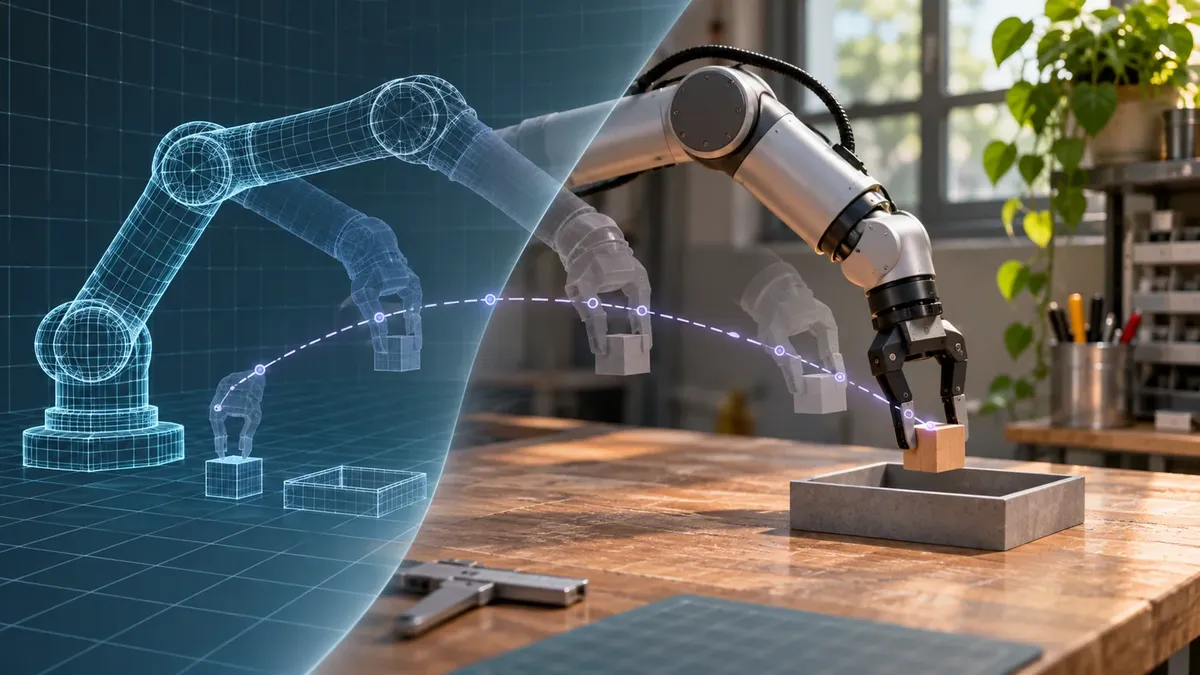
Robot-learning systems need examples that show what a robot sees and what it does. DemoFoundry aims to generate both together: simulated actions provide the control labels, while a video model makes the scenes look more like real environments.
The data problem
Training a robot policy—software that chooses actions from observations—takes examples of robots interacting with objects. Collecting those examples by teleoperation takes human time. Simulation can generate interactions at scale, but its images may look unlike the real world. Video generation can make convincing scenes, yet may show physically inconsistent movements and does not automatically provide a reliable record of the robot’s actions.
DemoFoundry, a research preprint by Ruixiang Wang and colleagues, tries to combine the strengths of simulation and video generation. Its central idea is to let an executable program determine the robot’s behavior and use a generative model to produce the corresponding visual observations. The study asks whether this can yield useful training data for real-robot policies without collecting human demonstrations for each target task and scene.
How the pipeline works
The researchers first built a video renderer using examples from four existing robot datasets: DROID, AgiBot World, RoboMIND and RH20T. A coding agent reconstructed task-relevant objects and scenes from recorded episodes, then replayed the recorded robot actions in a physics simulator. The team compared the resulting simulated videos with the original recordings and refined reconstructions when object silhouettes did not align. Pairs that failed their checks after up to three refinement rounds were discarded. The paper reports 1,884 accepted real–simulation video pairs.
For a new task, the agent receives a scene reference, a robot and camera specification, and an instruction. It reconstructs relevant geometry and writes a program to carry out the task in simulation. The simulated run supplies robot states and actions, along with a proxy video. A trained video renderer then turns that proxy into a more realistic-looking video, conditioned on a reference image. Automated checks select successful simulated trajectories for rendering and policy training.
This division of labor matters: the actions come from program execution, rather than being inferred from generated video. The method still depends on simulation for the interaction and on generative models for appearance, so it does not remove the possibility of errors in either stage.
What the tests found
The researchers assessed visual quality and action–video consistency, then trained two kinds of policy on a real robot platform. Their experiments covered three tasks: placing a can in a tray, stacking blocks and inserting a pen into a holder. In held-out real–simulation pairs, the adapted renderers scored better on the paper’s image and video quality measures than the tested baselines. Their action–video checks also indicated close alignment between rendered movement and the simulator’s actions. These results support the claim that paired training improved rendering in the evaluated data; they do not establish that generated video is physically exact in every scene.
In real-robot trials, policies trained on DemoFoundry data alone performed better on average than policies trained on raw simulation alone. For the two policy types, reported three-task averages were 46.7% versus 12.2%, and 60.0% versus 27.8%, respectively. The results also show that adding generated demonstrations to real demonstrations improved the averages in this particular experiment. The authors report gains as more generated data was used, but that finding comes from the tasks and training setup they tested—not a guarantee that performance will keep rising in other settings.
What remains uncertain
The evaluation is limited to three manipulation tasks on one real-robot platform, and the policies were tested for 30 trials per task in the reported comparisons. Success on these tasks does not show that the approach will transfer to different robots, objects or kinds of interaction. The paper also identifies multi-view consistency and visual drift across repeated video-generation steps as unresolved challenges. Simulation checks can filter some failures, but they cannot by themselves prove that every rendered detail matches the physical world.
The paper estimates that generation costs can fall below teleoperation costs at scale. That is a projection based on the authors’ stated assumptions about computing and human data-collection costs, not a direct demonstration that every deployment would be cheaper. The authors say they plan to release the paired dataset upon publication; the preprint therefore does not establish that it is already available.
DemoFoundry is presented in an arXiv preprint, which may not have undergone peer review. The results are promising evidence that executable simulation and generative rendering can be combined for robot training, but independent replication and broader testing are needed to judge how far the approach generalizes.
- robot learning
- robotics
- synthetic data
- generative video
- simulation
- robot demonstrations
Reviewed cross-references
These connections were reviewed by a model, not independently fact-checked by a human. Similarity does not imply agreement; consult the original papers and the evidence below.
AI coding agents build a robotics simulation benchmark
Shared method: Both papers use coding agents to produce executable robotics code for simulation: DemoFoundry agents write task-control programs, while Gym-Anything agents build simulations. Their scopes differ—Gym-Anything also implements and audits simulation physics—so this is a shared code-generation approach, not evidence that either system’s results validate the other’s.
Model review: · openai-codex/gpt-6-luna
Evidence and provenance
Selected excerpts, not complete papers. PDF extraction can omit figures or damage equations, tables and reading order; sources may be preprints.
2611.34671v1 — Original paper
Excerpt reference:
static/papers/2611.34671v1.md:105-175
Basis: Paper text
Source SHA-256:1d073e5cf685e43c224f66090809d3eedb8275038955a7a4cf29712ea974bc082610.40565v1 — Original paper
Excerpt reference:
static/papers/2610.40565v1.md:142-182
Basis: Paper text
Source SHA-256:59fc060799672807fe1e6c81c991eb10565ecfe604c44b91bf61c4671e7ce834
Related reading
Automatically matched by shared topic keywords. These links do not imply that the sources agree or establish a consensus.
How RoboRecast adapts robot demonstrations to new situations
Source published
Shared keywords: robot learning
DexWAC: Teaching robots to act, predict and evaluate
Source published
Shared keywords: robot learning
Teaching Robot AI to Focus on Motion, Not Scenery
Source published
Shared keywords: robot learning
Teaching robot policies to anticipate their next move
Source published
Shared keywords: robot learning
Teaching a robot model to predict what its actions will change
Source published
Shared keywords: robot learning