TRANSMISSION // 2611.34668v1
A few copies may help certify quantum magic
Source published
A theoretical proposal uses moments of the discrete Wigner function to certify and quantify nonstabilizerness. Its abstract reports different results for pure and mixed states, but does not provide details needed to assess the method fully.
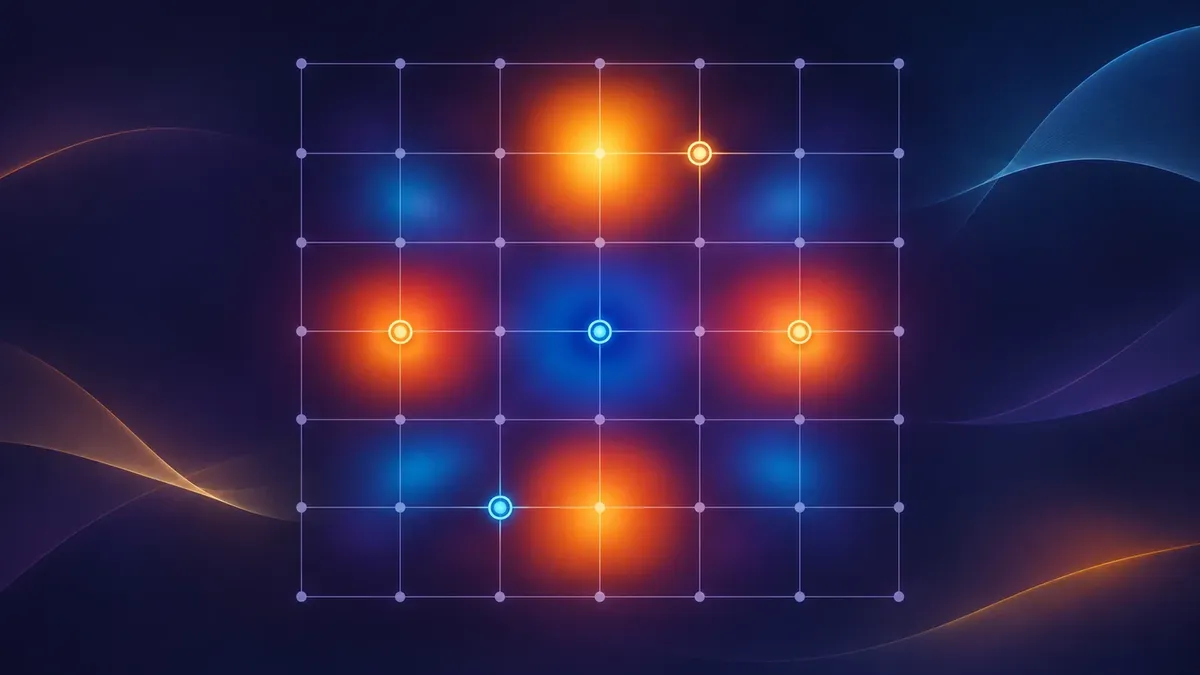
Quantum “magic” is a resource for universal fault-tolerant quantum computation beyond stabilizer circuits. A new proposal aims to certify this resource without reconstructing a quantum state’s full discrete Wigner function.
A different way to test for quantum magic
Stabilizer states and Clifford operations form an important framework for quantum computing, but universal fault-tolerant computation requires resources beyond it. Those resources are often called magic, or nonstabilizerness. Certifying their presence can be difficult: approaches such as full state tomography or optimization over stabilizer states can become prohibitive as systems grow, according to the authors.
In Magic Moments: An Operational Approach of Certifying Nonstabilizerness from Few Copies, Kunal Sharma, Sudip Chakrabarty, Saheli Mukherjee, Bivas Mallick and Ananda G. Maity propose using moments of the discrete Wigner function. This is a mathematical representation of a quantum state. Their approach is intended to test for magic without reconstructing the full Wigner-function distribution.
What the abstract reports
The authors say each moment can be evaluated as the expectation value of a two-outcome observable on a few copies of the state. They describe measuring it with a constant-depth Clifford circuit and a number of measurement rounds independent of the number of qudits. A qudit is a quantum information unit that can have more than two basis states, unlike a qubit.
For pure states of any number of qudits, the abstract describes the criterion as necessary and sufficient. For mixed states, the authors construct a hierarchy of conditions involving higher moments, which they say reaches the exact negativity threshold. The abstract does not specify at which stage that threshold is reached or give enough detail to judge how the hierarchy works in particular cases.
The authors also report lower bounds on sum negativity and mana—quantities used to describe nonstabilizerness—and say these bounds can constrain the negativity factor in quasiprobability simulation.
What is not yet established here
The evidence available for this article is the paper’s abstract, not its full text. It does not provide derivations, examples, formulas, copy counts, or precision requirements, so those details cannot be evaluated here. The abstract characterizes the proposed tools as experimentally accessible; it does not report an experimental demonstration. How the proposal performs in an actual experiment remains an open question based on the available source.
The paper is an arXiv preprint, which may not have been peer reviewed. Its claims should therefore be understood as the authors’ reported theoretical results, not as independently established or experimentally validated findings. The abstract presents a possible route to certifying and quantifying magic; assessing its practical reach will require the full paper and further scrutiny.
- quantum computing
- quantum magic
- nonstabilizerness
- discrete Wigner function
- qudits
- quantum measurement
Reviewed cross-references
These connections were reviewed by a model, not independently fact-checked by a human. Similarity does not imply agreement; consult the original papers and the evidence below.
When quantum magic cannot be distilled
Supporting evidence: Both papers show that Wigner-negativity tests have a limited reach: the moment study says its negativity-based criteria miss some magic states with nonnegative Wigner functions, while the bound-magic study describes Wigner-positive nonstabilizer states in odd dimensions. The comparison is about this limitation, not a shared criterion: the moment results concern odd-prime-dimensional qudits, and the bound-magic paper’s multi-qubit result uses a different construction.
Model review: · openai-codex/gpt-6-luna
Evidence and provenance
Selected excerpts, not complete papers. PDF extraction can omit figures or damage equations, tables and reading order; sources may be preprints.
2611.34668v1 — Original paper
Excerpt reference:
static/papers/2611.34668v1.md:930-1028
Basis: Paper text
Source SHA-256:7dbeb46e67ec9856be7c8f85e301e7c20640d498b4ad253b4575e4dc14f7445d2611.34872v1 — Original paper
Excerpt reference:
static/papers/2611.34872v1.md:61-138
Basis: Paper text
Source SHA-256:5312f90c5ef6b6aaa0857d3a6801d08685c41382d0f2db4e43442cb0518472ff
Related reading
Automatically matched by shared topic keywords. These links do not imply that the sources agree or establish a consensus.
When quantum magic cannot be distilled
Source published
Shared keywords: quantum computing, quantum magic
Why measuring quantum resources can take so many samples
Source published
Shared keywords: quantum magic, quantum measurement
When Scattering Can Produce Quantum Magic
Source published
Shared keywords: quantum computing, quantum magic
A guided search for quantum “magic”
Source published
Shared keywords: quantum computing, quantum magic
How topology makes quantum magic visible as entanglement
Source published
Shared keywords: quantum magic