TRANSMISSION // 2611.34664v1
A connected spectrum for tensors
Source published
A preprint proves path-connectedness for the asymptotic spectrum of complex tensors at each fixed order of at least three, and a closed-interval result for each fixed tensor.
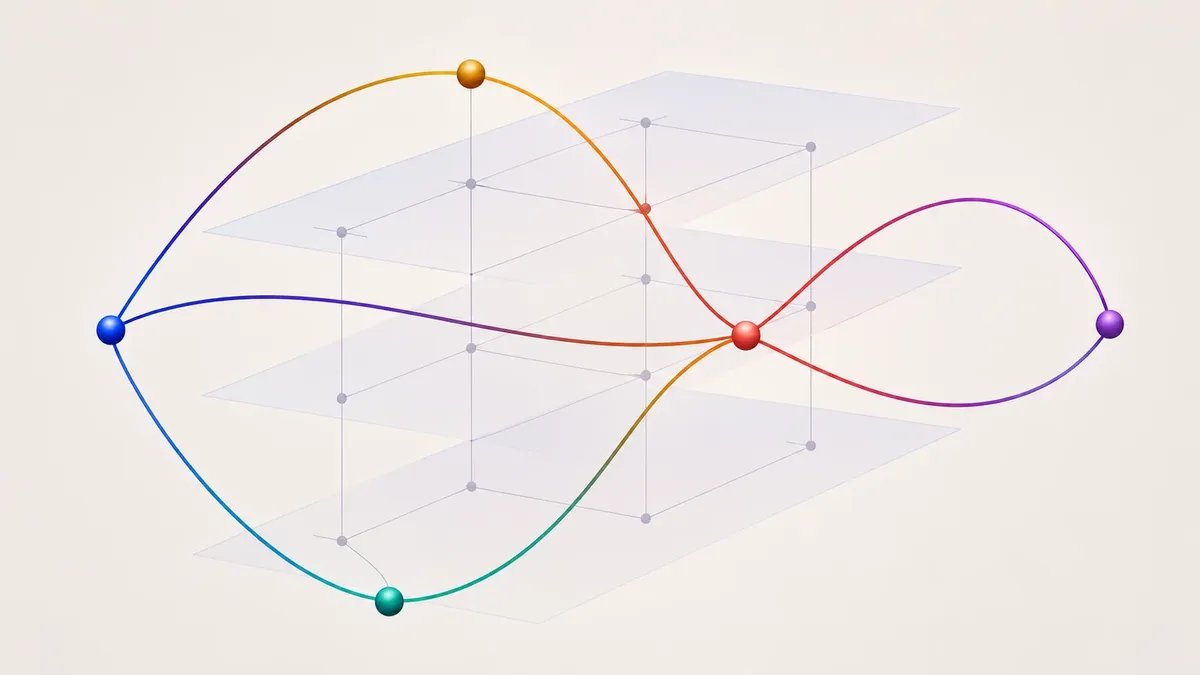
How can mathematicians compare the complexity of tensors when many copies are combined? A new preprint establishes a structural result: for complex tensors of any fixed order three or higher, their asymptotic spectrum is path-connected. Evaluating that spectrum at a fixed tensor gives a closed interval.
The question behind the theorem
The paper by Péter Vrana and Jeroen Zuiddam concerns the asymptotic spectrum of tensors: a mathematical framework for studying asymptotic questions about tensor complexity. Its central question is structural: how are the points in this spectrum related? In particular, can any two be joined by a continuous path, or are there separations in the mathematical space?
The available source is the paper’s abstract, which states the result but does not give a general-audience definition of the spectrum. The explanation here therefore focuses on what the authors say they prove, rather than supplying a more detailed formal construction.
What the authors prove
For complex tensors of every fixed order k ≥ 3, the authors prove that the asymptotic spectrum is path-connected. More specifically, every spectral point can be connected by a path to every “one leg versus the rest” flattening rank. A flattening is the construction named in the abstract; the source excerpt does not provide its full definition.
The authors also state a consequence: evaluating the asymptotic spectrum at any fixed tensor gives a closed interval. This answers a question attributed in the abstract to Volker Strassen. The interval result does not, by itself, say that the interval has positive length or that its values correspond to distinct practical techniques.
The abstract describes earlier knowledge as limited to specific families of tensors or specific families of spectral points. The new theorem is presented as extending the connectedness result to all complex tensors of each fixed order at least three.
How the proof is organized
To establish the theorem, the authors develop a general method for interpolating between spectral points. They say the method applies to certain algebraic systems called Strassen semirings when two conditions hold: an appropriate decomposability property, expressed through an information-theoretic “method of types,” and a cover property inspired by slice rank.
For tensors and asymptotic rank, the abstract identifies decomposition into symmetric-group irreducible representations as the source of the “types” used in the method. It also says the approach applies to other objects and asymptotic problems, including graphs and Shannon capacity. For graphs, the authors say it matches an interpolation developed by Vrana in 2019.
The abstract additionally reports new results and simpler proofs concerning the asymptotic spectrum of rectangular matrix multiplication, polynomial multiplication and non-crossing (laminar) quantum functionals. It does not spell out these results, so their precise statements and significance cannot be assessed from the abstract alone.
What the result does—and does not—say
Path-connectedness is a precise mathematical property: points in the spectrum can be joined by continuous paths, in the sense specified by the theorem. It should not be read as evidence of a literal physical landscape, nor does it identify a best tensor method or show that one algorithm outperforms another. The closed-interval conclusion describes the set of values obtained for a fixed tensor; it does not establish that those values are all practically distinguishable.
This account is based on the arXiv abstract, not an examination of the full proof. The cited record is version 1 of a preprint, and the supplied source does not establish whether it has been peer-reviewed. The detailed assumptions, proof, and scope of the additional results require consultation of the full paper. The claim reported here is a mathematical theorem, but this source basis limits how much of its technical development can be explained or independently assessed.
- tensor complexity
- asymptotic spectrum
- complex tensors
- path-connectedness
- mathematics