TRANSMISSION // 2611.34662v1
Checking the Rules Behind Maintenance Decisions
Source published
A four-organization blockchain testbed checked cryptographic proofs of maintenance calculations. The results are promising, but simulations and a single-host setup leave real-world performance uncertain.
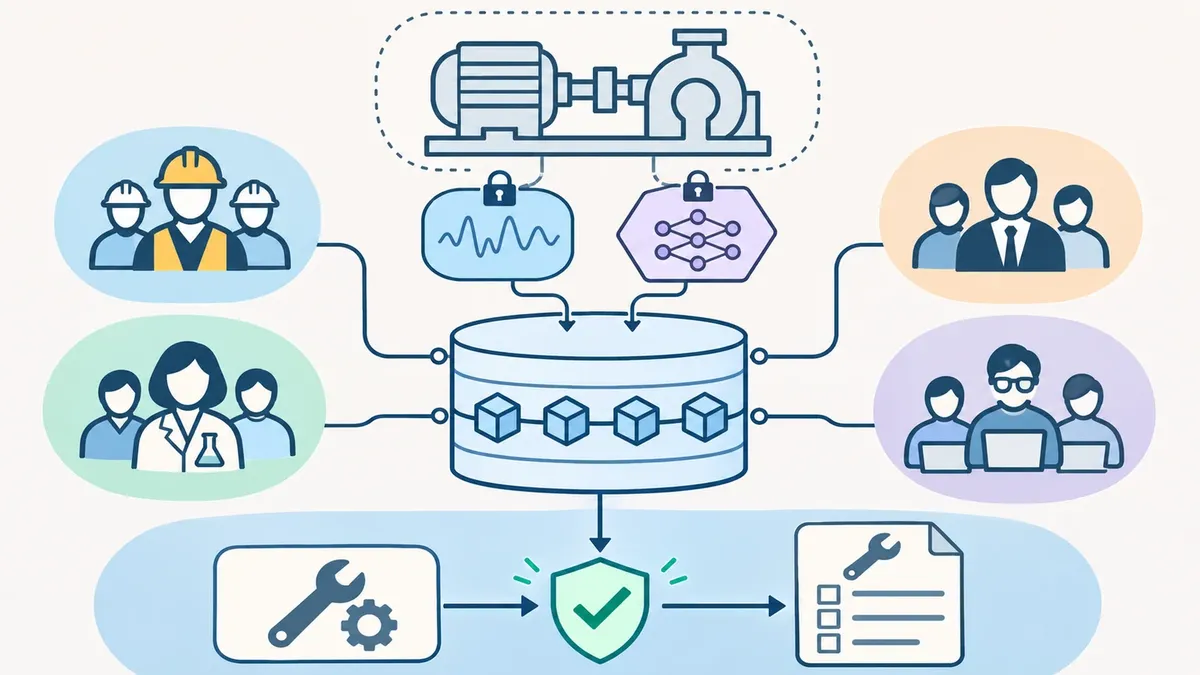
A ledger can record who submitted a maintenance recommendation. But can it check that the recommendation came from the agreed model and rules? A proposed system called VeriPsM adds a proof check before work-order release. Its testbed results show what this approach caught in specified cases—and what remains untested.
When equipment needs attention, a maintenance recommendation can cross company boundaries. A supplier may run a model, while a plant operator provides the machine’s current condition, a contractor carries out approved work, and a quality or safety function sets the decision rules. A shared ledger can record these hand-offs. But recording a recommendation does not, by itself, show that the agreed model and policy produced it—or that the recommendation was not changed later.
A new preprint proposes a way to check that calculation before releasing a work order. Its system, VeriPsM, uses a permissioned blockchain: a ledger shared among identified organizations. The supplier provides a cryptographic proof that the registered model and approved rules produced the proposed action. Other participants can check the proof without receiving the supplier’s model weights or the plant’s raw sensor data.
What the proof is meant to establish
The workflow ties a prescription to the machine’s current condition record, a registered model, and an approved policy. That policy specifies candidate actions, their costs, resource limits, and a risk threshold. The proof is intended to show that the model produced the relevant maintenance forecasts and that the selected action was optimal among the eligible options under those registered rules.
In the testbed, four organizations had distinct roles: an operator committed the asset’s current state; an equipment supplier registered the model and submitted prescriptions; an auditor approved the policy and verification key; and a maintenance contractor received authorized work orders and recorded execution receipts. Before release, endorsing blockchain peers checked that a prescription referred to the current asset state and approved model and policy, and that its proof verified. The paper says urgent safety stops would continue through the plant’s normal manual procedure.
This is different from checking only references or signatures. The paper’s hash-only mode checked commitments and freshness. It could reject prescriptions that changed which asset state, model, or policy was referenced, but it accepted some alterations that changed the decision while leaving those references intact. VeriPsM’s proof is designed to check the calculation behind the action as well.
What the researchers tested
The authors implemented the workflow on Hyperledger Fabric, with one peer for each of four organizations. Using a public aircraft-engine benchmark, they compared proof-based authorization with recomputation from disclosed inputs, hash-only checks, and endorsement signatures alone. Each mode received a valid prescription and the same nine specified alterations. These were designed test cases, not a broad sample of real-world attacks.
Proof-based authorization rejected all nine alterations. Hash-only checks rejected five that changed references, but accepted four that changed the decision while keeping those references intact. Endorsement alone accepted all nine. Recomputing the decision from disclosed inputs rejected the same decision changes, but accepted a corrupted proof attached to the correct action. These results describe the tested cases; they do not show how the systems would handle every possible fault or attack.
The researchers also used a semi-synthetic simulator to explore maintenance consequences. In the central simulated setting, the proved decision rule had a mean cost of 31,845 normalized units and no late maintenance events. Across the simulated scenarios, the authors report zero late events for the proved rule. In the central setting, a threshold-based heuristic also had no late events, with a higher mean cost of 45,105 units. These are model outputs, not observed savings or failure rates at an operating plant. In simulations of alterations that hash checks accepted, postponing prescribed work lowered apparent short-term spending but increased late events; substituting major overhauls raised modeled costs.
On this testbed, proof verification inside endorsing peers took a median of 0.703 milliseconds. For short transaction bursts across three fresh ledgers, the reported throughput ranges overlapped across proof-based, hash-only, and endorsement-only modes. This is a limited performance measurement, not evidence of equivalent performance under sustained, multi-site industrial workloads.
What remains uncertain
The paper is a preprint, and its evaluation has important limits. The benchmark contains 59,702 labelled records from four engines; data for eight other engines lacked local outcome labels and were excluded from fitting and accuracy reporting. The authors describe the prognostic fit as exploratory. Maintenance consequences came from a simulator and three specified tampering scenarios, not from real repairs or a live factory trial.
The Fabric testbed used one peer per organization on a single host, local test certificates and proof-setup keys, and short transaction bursts. It stopped at the ledger boundary: there was no live connection to a computerized maintenance management system to create and track real work orders. The study also does not test maintenance planning across multiple machines competing for shared crews, spare parts, or shutdown windows.
A valid proof can show that a calculation followed a registered model and policy. It cannot establish that sensor measurements were trustworthy, that the model was suitable, or that approved rules reflected appropriate costs and safety priorities. The authors identify industrial-data validation, multi-host testing, stronger proof-key management, and maintenance-system integration as future work.
For now, VeriPsM is a demonstration of a verification layer, not evidence of a deployed industrial system or a guarantee of safe maintenance. Its central question is narrower: did this prescription follow the model and rules the organizations had agreed to use?
- prescriptive maintenance
- permissioned blockchain
- verifiable computation
- industrial AI
- maintenance authorization
Related reading
Automatically matched by shared topic keywords. These links do not imply that the sources agree or establish a consensus.