TRANSMISSION // 2611.34650v1
Does cosmic shear support evolving dark energy?
Source published
An HSC Year 3 lensing analysis finds a modest preference for evolving dark energy when combined with distance measurements—but the lensing data alone do not establish it.
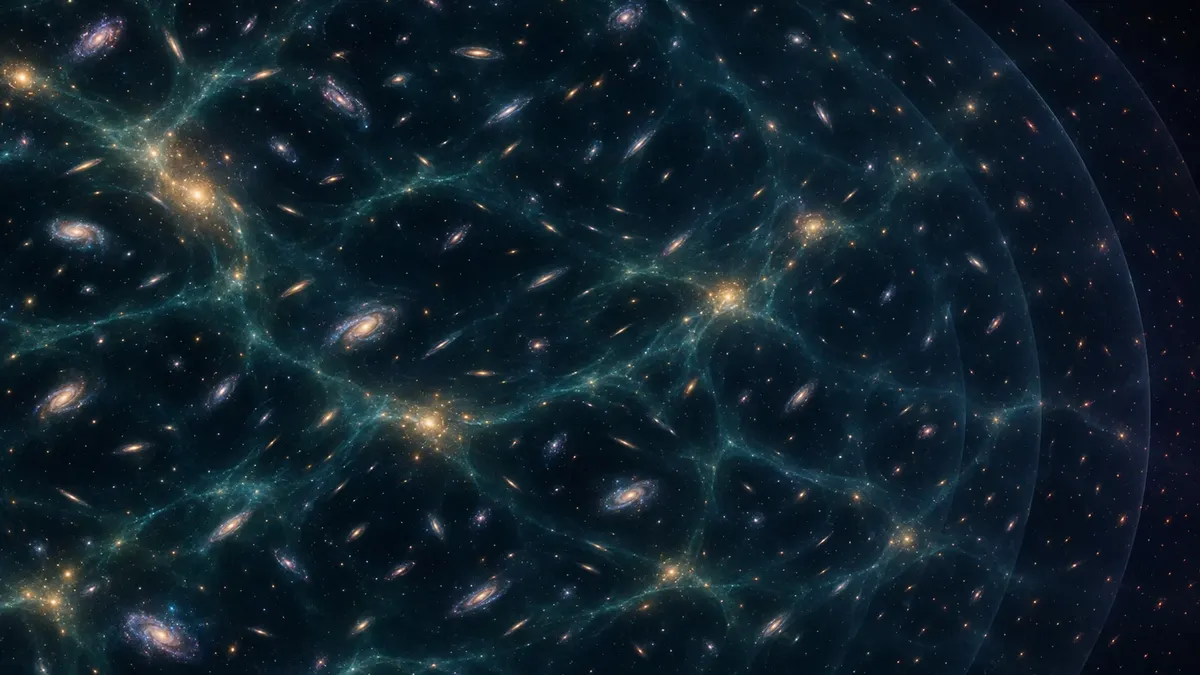
A new analysis combines subtle distortions in millions of distant galaxies with measurements of cosmic distances to test whether dark energy has stayed constant. Its result is suggestive, not decisive: the preference for change comes mainly from the distance data, while the lensing measurements help track how matter is clumping.
Dark energy is the name given to whatever is driving the Universe’s accelerated expansion. In the standard cosmological model, it behaves like a constant over time. Some recent combinations of distance measurements have instead hinted that its influence may evolve. Shreya Mukherjee and Surhud More ask whether another kind of evidence—cosmic shear—supports that possibility.
Cosmic shear is the slight, correlated distortion of distant galaxy shapes by the gravity of matter between those galaxies and Earth. Its pattern carries information about both the Universe’s geometry and the growth of cosmic structure. That makes it a useful cross-check: a model that changes the expansion history can also change how structure develops.
The researchers analysed real-space shear correlation functions from the Hyper Suprime-Cam Year 3 survey. The catalogue contains more than 25 million galaxies across about 416 square degrees, sorted into four redshift groups spanning 0.3 to 1.5. Rather than fitting galaxy shapes individually, the analysis measures how their distortions correlate across the sky. It compares two extensions to the standard model: one where dark energy’s equation of state is constant, and another where it can vary with time.
The lensing measurements do not tightly constrain dark energy on their own. Cosmic shear alone leaves substantial degeneracies: different combinations of matter density, structure growth and dark-energy properties can produce similar signals. To help separate those possibilities, the researchers combine the lensing data with DESI’s second data release of baryon acoustic oscillation measurements, a recalibrated five-year Dark Energy Survey supernova sample called DOVEKIE, and a prior on the baryon density from Big Bang Nucleosynthesis. This combination does not use cosmic microwave background data.
With a constant equation of state, the combined analysis finds w = −0.936, with reported uncertainties of +0.074 and −0.067. This is statistically consistent with the value w = −1 expected for a cosmological constant. In the time-varying model, it reports w₀ = −0.832 (+0.071/−0.059) and wₐ = −1.23 (+0.66/−0.44). The authors describe this as a 2.4-sigma preference for evolving dark energy. That is an indication in the combined dataset, not a discovery or proof that dark energy changes.
The source of the preference matters. The authors say it is driven primarily by the geometric distance measurements, rather than by lensing independently revealing evolution. Meanwhile, the combined estimates of S₈—a measure of the present-day amplitude of matter clustering—are 0.774 (+0.027/−0.034) for the constant-w model and 0.772 (+0.031/−0.030) for the evolving model. The paper reports these as consistent with the baseline HSC Year 3 result under the standard cosmology. Allowing dark energy to vary therefore does not substantially change the combined estimate of the lensing amplitude.
There are important limits. The analysis uses scale cuts to avoid regions where small-scale baryonic physics or large-scale systematics could complicate interpretation, and it accounts for several astrophysical and observational uncertainties. The authors also caution that parts of their modelling pipeline were developed and validated for the standard cosmology, rather than fully calibrated for evolving dark energy. In particular, the nonlinear matter and baryonic-feedback prescription needs further validation in these extended models. They call for dedicated tests using simulated data generated under evolving-dark-energy assumptions.
The supplied source is an arXiv paper version; the available material does not establish its peer-review or publication status. The findings should be understood as the authors’ reported analysis, with the modelling caveats and modest statistical preference in view. The study tests whether lensing-based structure measurements are compatible with hints from distance measurements. It does not show that cosmic shear alone has detected evolving dark energy.
- dark energy
- cosmic shear
- weak gravitational lensing
- Hyper Suprime-Cam
- DESI
- cosmology
Reviewed cross-references
These connections were reviewed by a model, not independently fact-checked by a human. Similarity does not imply agreement; consult the original papers and the evidence below.
Combining Cosmic Probes to Test Dark Energy
Shared method: Both studies use weak-lensing measurements alongside probes of cosmic expansion to constrain extensions of ΛCDM. The HSC-Y3 study combines cosmic shear with DESI DR2 BAO, DES supernovae and BBN priors to constrain wCDM and w₀wₐCDM; the EFTofDE study adds DES Y3 3×2pt measurements to expansion-history probes to constrain dark-energy perturbations. Their datasets, model frameworks and parameter constraints differ, so this is a methodological connection, not a direct comparison of results.
Model review: · openai-codex/gpt-6-luna
Evidence and provenance
Selected excerpts, not complete papers. PDF extraction can omit figures or damage equations, tables and reading order; sources may be preprints.
2611.34650v1 — Original paper
Excerpt reference:
static/papers/2611.34650v1.md:12-65
Basis: Paper text
Source SHA-256:5b1dc7731d50e057631c6c1ee371648f7c46218cefcd8950bed79ce7ae061fb22606.31977v3 — Original paper
Excerpt reference:
static/papers/2606.31977v3.md:12-86
Basis: Paper text
Source SHA-256:31cd23b2dbacad3260fea38aff3e71b69f69cf8193d4a7e6c3a1057a14f9cd54
Related reading
Automatically matched by shared topic keywords. These links do not imply that the sources agree or establish a consensus.
DES Year 6 tests the cosmic picture
Source published
Shared keywords: dark energy, weak gravitational lensing
DES cosmic shear sharpens a view of matter
Source published
Shared keywords: cosmic shear, weak gravitational lensing
A late-time dark-matter supply could soften a cosmological trade-off
Source published
Shared keywords: weak gravitational lensing
Galaxy Distortions Put Limits on Giant Primordial Black Holes
Source published
Shared keywords: cosmic shear, weak gravitational lensing
Can Cosmic Structure Help Explain Acceleration?
Source published
Shared keywords: dark energy