TRANSMISSION // 2611.34644v1
Why robot models may need to predict meaning, not pixels
Source published
MotionRep predicts future visual features and 3D object motion together. In benchmark tests, the authors report more accurate motion estimates and strong performance on unseen scenes, but real-world motion labels can be noisy.
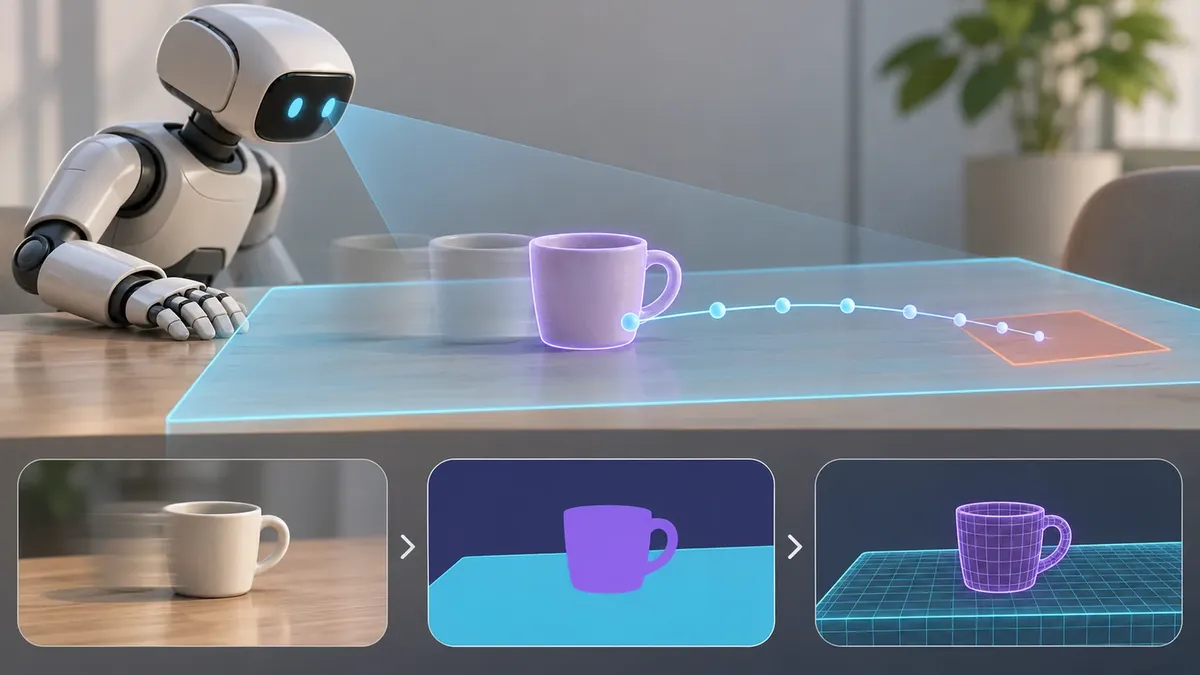
A robot anticipating a moving object needs more than a plausible-looking future image. MotionRep is designed to predict both a future visual representation and the object’s movement in 3D, using visual features intended to preserve information about objects and spatial structure.
A robot reaching for a cup has to anticipate where the cup will be—not merely produce a convincing picture of the next moment. Many visual world models predict the future in a compressed form of video, where the representation is designed to help reconstruct pixels. The authors of a new preprint argue that this can devote effort to appearance details that matter less for predicting motion.
Their proposed alternative, called MotionRep, predicts two things together: future visual features and the three-dimensional movement of points on a target object. The idea is to give the motion prediction a forecast of the scene’s meaningful structure, rather than relying on a future representation shaped primarily by pixel reconstruction.
A compressed visual future
MotionRep uses features from DINO, a pretrained vision model whose representations are intended to capture information about objects and spatial structure. Because these features are large and not directly suited to diffusion-based generation, the researchers introduce DINO-VAE to compress them into a smaller latent representation. The paper describes compression across both time and feature channels, with training objectives intended to retain useful semantic and geometric information.
The model takes an initial observation, 3D query points on the target object, and a language instruction. A diffusion transformer then predicts future DINO features and 3D object flow together. Flow here means the displacement of each queried point from its starting position over time. Joint attention lets the two predictions interact: the visual stream can inform motion, while motion can inform the predicted visual state.
The authors also use different noise schedules for the two streams. During generation, the visual representation is denoised ahead of the 3D flow, so a progressively refined visual prediction can guide the motion forecast. The model is trained in two stages: first to predict future visual representations, then to model those representations jointly with object flow.
How the researchers tested it
The paper evaluates MotionRep on simulated and real-world manipulation benchmarks and compares it with methods that predict flow directly, methods that generate video and then estimate 3D motion, and models that generate visual states and flow together. Its main motion measures include average displacement error across predicted points and times, final displacement error, and the share of point-time predictions within specified distance thresholds.
For an out-of-distribution test, the researchers evaluate on RoboMIND 2.0, which they say was excluded from training. They also test whether DINO-VAE retains useful information through classification, depth-estimation, and segmentation probes, and use component-removal experiments to examine the design choices.
What the results suggest
The authors report that MotionRep has lower trajectory errors than the listed comparison methods across the three WorldFlowBench groups: Sim7, Real3, and SpatialCog. On RoboMIND 2.0, it also records lower reported displacement errors than the listed competitors. These are benchmark results, not evidence that a robot using MotionRep will necessarily handle unfamiliar objects or tasks reliably in everyday settings.
In the paper’s efficiency test, MotionRep uses three denoising steps and reports a latency of 2.21 seconds under the authors’ stated evaluation setup. The comparison table reports more steps and longer latencies for the listed methods. Such timings depend on the hardware and implementation, and they do not by themselves establish real-time performance in a deployed robot.
The authors’ analyses suggest that the compressed DINO features retain semantic and geometric information. Their ablations also report worse motion-prediction metrics when future DINO generation, DINO-VAE, pretraining, or the separate noise schedules are removed. This supports the proposed design within these experiments; it does not isolate every possible explanation for the benchmark gains.
What remains uncertain
The paper identifies a practical limitation: real-world 3D motion labels are difficult to obtain accurately. For some real-world data, the researchers estimate object trajectories from video using segmentation and 3D tracking tools, so errors in those tools can affect the supervision and evaluation. They also point to longer-horizon tasks and more complex dynamics as future work.
MotionRep is described in a preprint, which may not have undergone peer review. The findings are therefore best read as the authors’ reported results, not as settled consensus. They show promise for predicting object-centric motion in the tested benchmarks, while leaving open how well the approach transfers to longer tasks, noisier observations, and real robotic operation.
- robotics
- world models
- object motion
- DINO
- 3D object flow
- robot manipulation
Reviewed cross-references
These connections were reviewed by a model, not independently fact-checked by a human. Similarity does not imply agreement; consult the original papers and the evidence below.
WorldFlow predicts motion in both pixels and 3D
Shared method: Both models jointly generate a visual future and 3D motion: MotionRep predicts future DINO representations with 3D object flow, while WorldFlow jointly denoises future video and query-conditioned 3D trajectories. Their visual representations, conditioning, and generative architectures differ, so this is a shared high-level modeling approach, not evidence that one method or its results transfer to the other.
Model review: · openai-codex/gpt-6-luna
Evidence and provenance
Selected excerpts, not complete papers. PDF extraction can omit figures or damage equations, tables and reading order; sources may be preprints.
2611.34644v1 — Original paper
Excerpt reference:
static/papers/2611.34644v1.md:63-140
Basis: Paper text
Source SHA-256:80aa13f8cb708ed248da90ef3cba4315a5e3b9a705b538da69e888931ced77102610.39278v3 — Original paper
Excerpt reference:
static/papers/2610.39278v3.md:86-140
Basis: Paper text
Source SHA-256:4cce00abe647e8bfcd55fd3e7f9611ef349a0c318741a343b7a2c01f0e6669e8
Related reading
Automatically matched by shared topic keywords. These links do not imply that the sources agree or establish a consensus.
Robots learn from the grasp that goes wrong
Source published
Shared keywords: robot manipulation, world models
How a robot can decide when not to correct itself
Source published
Shared keywords: robot manipulation, world models
A smoother way for robot AI to imagine what actions do
Source published
Shared keywords: robot manipulation, world models
A graph-based approach to robot world-model drift
Source published
Shared keywords: world models
WorldPhy Tests Robot World Models’ Physics
Source published
Shared keywords: robot manipulation, world models