TRANSMISSION // 2611.34642v1
Timing J1912-4410’s slowing white dwarf
Source published
Optical timing estimates that J1912-4410’s white dwarf is spinning down. The result suggests spin-down may not power all its emission, but uncertainty leaves that possibility open.
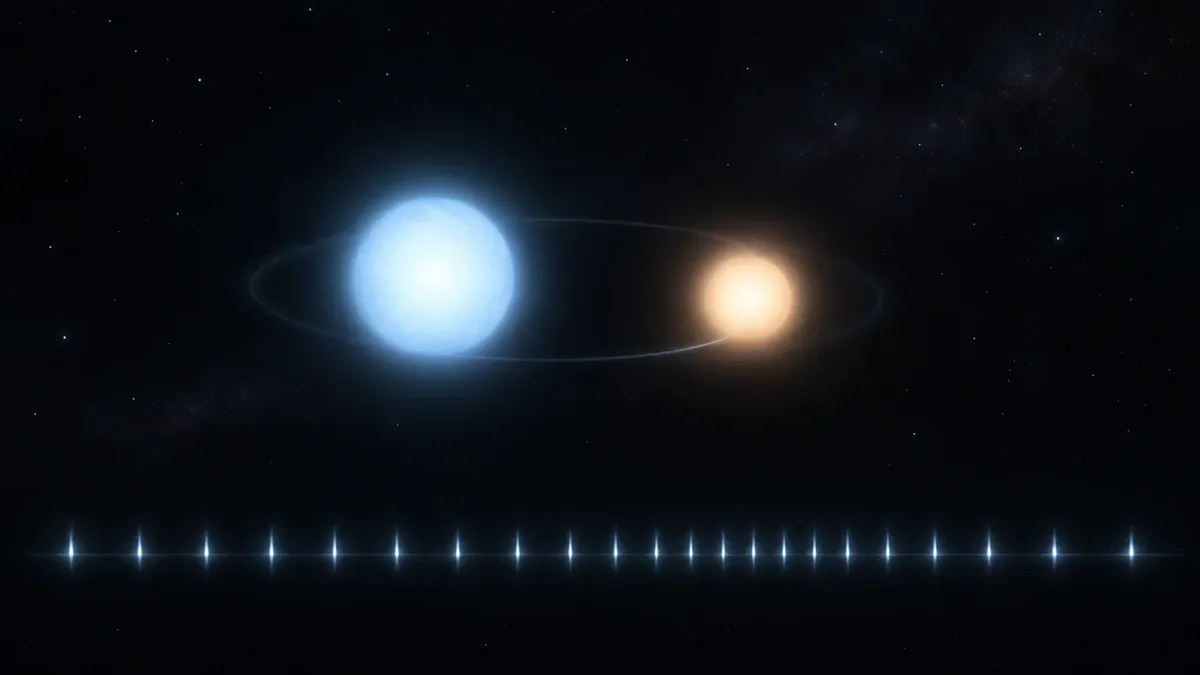
J1912-4410 is a rare binary system whose white dwarf produces repeating pulses. By tracking their timing over four years, researchers estimated how the star’s spin period is changing and considered whether the energy released as it slows could explain the system’s emission.
White dwarfs are compact stellar remnants. In a white dwarf pulsar, a magnetic white dwarf and a cool companion produce periodic pulses across a range of wavelengths. Those pulses can act as a clock: changes in when they arrive may reveal whether the white dwarf’s rotation is changing.
J191213.72-441045.1, or J1912-4410, was the second white dwarf pulsar discovered. Possible signs of accretion—material transferring onto the white dwarf—raise questions about how its emission is powered. In the prototype system AR Scorpii, the white dwarf’s lost rotational energy has been proposed as the source. Could that explanation also fit J1912-4410?
Estimating a changing spin period
Callum Hodge and colleagues analysed optical observations made with ULTRACAM, a fast camera on the ESO New Technology Telescope in Chile. The observations span 28 nights from 2022 to 2026, using several colour filters. The analysis relied mainly on the g-band data, which offered many data points and relatively small timing errors.
The researchers identified pulse arrival times and fitted them with timing models. A linear ephemeris assumes a constant period; a quadratic ephemeris includes a period derivative, allowing the period to change over time. An F-test favoured the quadratic model over the linear one. This supports the reported changing-period fit, but is not proof of a physical explanation for the timing changes.
The team’s estimate for the change in spin period is 4.13 × 10⁻¹² seconds per second: the period is increasing, meaning the white dwarf is spinning down. The u-, g- and r-band ephemerides agree with one another, although the principal estimate comes from the g band. Results from the i band were inconsistent and its fits often failed to converge. The authors say more i-band observations are needed to determine whether this reflects limited data or a real wavelength-dependent timing difference.
There is another complication. The pulse-timing residuals—differences between observed and predicted arrival times—show a pattern across the binary’s orbit. The researchers modelled this with a Fourier series when fitting the timing. They also found that the underlying orbital modulation changed over the four years of observations. The cause is unclear, and the authors caution that the residual pattern and its interpretation need further investigation. Simulations suggest overlapping periodic signals might produce a similar pattern, but more complete simulations are needed to test that possibility.
What powers the emission?
Using the estimated spin change and estimates of the white dwarf’s mass and radius, the researchers calculated a spin-down power of about 9 × 10²⁵ watts. This is approximately the same order of magnitude as an earlier estimate of the system’s bolometric luminosity—the energy it emits across wavelengths.
That comparison suggests spin-down alone may not easily account for all the emission: it would require near-perfect conversion of lost rotational energy into radiation. The authors consider it more likely that another source, such as accretion, contributes. But they cannot rule out a scenario powered entirely by spin-down. Their 95% confidence range for the calculated power is broad, from about 1 × 10²⁵ to 2.2 × 10²⁶ watts, largely because the white dwarf’s mass and radius are uncertain. More precise estimates of both the spin-down power and the system’s luminosity would help clarify the energy budget.
The study also examines the proposed synchronar model for AR Scorpii. In this model, spin-down power is dissipated in the companion’s atmosphere through magnetic reconnection, accelerating particles that produce non-thermal emission. Applying the model to J1912-4410, the authors estimate a required white dwarf magnetic field of 110 ± 50 megagauss. This exceeds a previously reported upper limit of about 50 megagauss, so the model appears unlikely to fit, given that constraint.
Together, these results suggest J1912-4410 may differ from AR Scorpii in its energy sources or emission mechanism. They do not establish what powers its emission, or show that all white dwarf pulsars differ. Further observations of J1912-4410 and other systems will be needed to test whether the class is diverse.
This work is a preprint, and its manuscript reports that it is under peer review; that does not establish that review is complete or that the paper has been accepted. The conclusions are therefore the authors’ current interpretation. The paper says the data are available from the authors on reasonable request.
- white dwarf pulsars
- J1912-4410
- stellar spin-down
- ULTRACAM
- binary stars
- accretion
- astrophysics
Reviewed cross-references
These connections were reviewed by a model, not independently fact-checked by a human. Similarity does not imply agreement; consult the original papers and the evidence below.
A Radio Transient Reveals an Accreting White Dwarf
Supporting evidence: Hodge et al. find possible accretion in the white-dwarf pulsar J1912-4410 and argue its emission may differ from AR Sco; Mo et al. identify the separate LPT ASKAP J1448-68 as an accreting white-dwarf binary. Together these findings support the bounded point that LPTs with white-dwarf counterparts can include accreting systems, but do not establish that the two objects share an emission mechanism.
Model review: · openai-codex/gpt-6-luna
Evidence and provenance
Selected excerpts, not complete papers. PDF extraction can omit figures or damage equations, tables and reading order; sources may be preprints.
2611.34642v1 — Original paper
Excerpt reference:
static/papers/2611.34642v1.md:200-252
Basis: Paper text
Source SHA-256:89ba044ce38da0ef747a085564a229325afc8a8311c65606965c173fcae094df2611.34642v1 — Original paper
Excerpt reference:
static/papers/2611.34642v1.md:752-809
Basis: Paper text
Source SHA-256:89ba044ce38da0ef747a085564a229325afc8a8311c65606965c173fcae094df2609.35980v3 — Original paper
Excerpt reference:
static/papers/2609.35980v3.md:15-68
Basis: Paper text
Source SHA-256:661b854bdd89423d9cd9c3427a61068766108cca18864a2570ef4a2103197c4e
Related reading
Automatically matched by shared topic keywords. These links do not imply that the sources agree or establish a consensus.
DQ Tau’s molecular gas follows a slower rhythm than its accretion bursts
Source published
Shared keywords: binary stars
How two young stars may draw gas from a shared reservoir
Source published
Shared keywords: binary stars
Weighing a magnetic white dwarf through hot gas and a companion’s motion
Source published
Shared keywords: binary stars
A Radio Transient Reveals an Accreting White Dwarf
Source published
Shared keywords: binary stars
Neutron star binaries may get their chance after a cluster’s black holes leave
Source published
Shared keywords: binary stars