TRANSMISSION // 2611.34635v1
Can tiny language agents learn to act from scratch?
Source published
ZeroHero trains compact language agents through expert demonstrations and reinforcement learning. Results vary across three simulated tasks, and language quality remains uncertain.
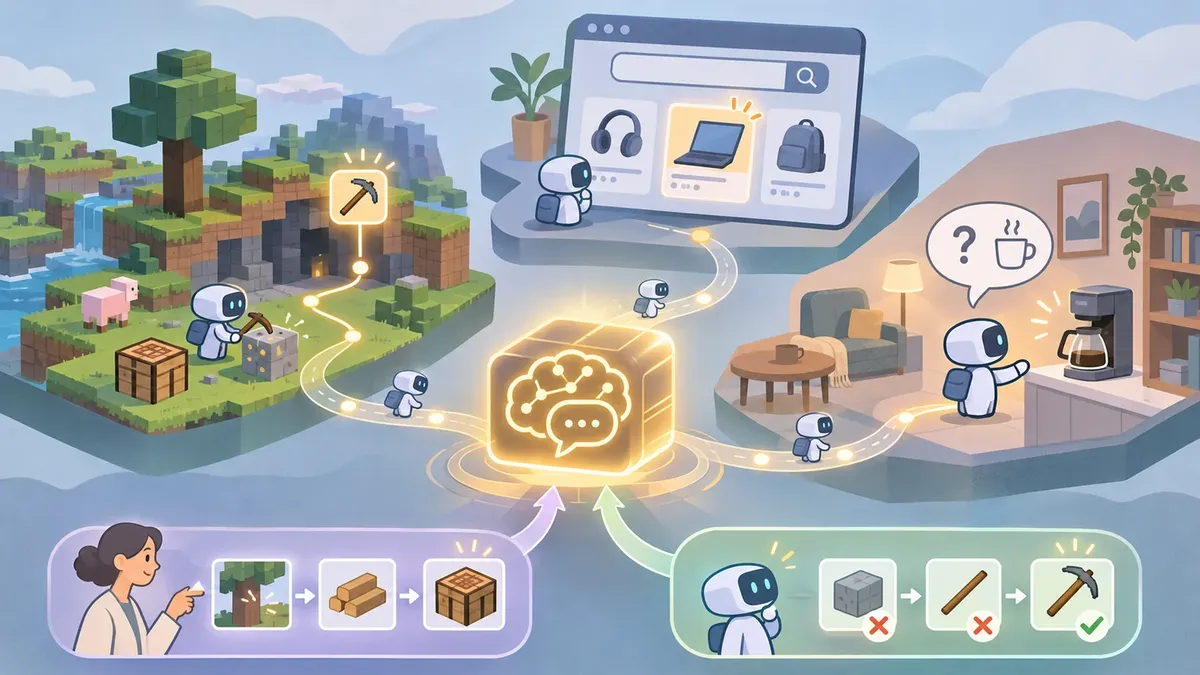
Large language models can guide interactive tasks, but they are costly to run. ZeroHero asks whether much smaller models, trained from scratch for specific environments, can learn to understand and produce language while making sequences of decisions.
A small agent, trained for a specific job
A language agent does more than answer a question: it may need to interpret what is happening, choose an action, and respond to what follows. Large language models can handle such tasks, but running them can demand substantial computing resources. ZeroHero explores a different route: train a compact model from scratch to work in one environment, using a larger model’s demonstrations and then letting the compact model learn through its own attempts.
The paper tests this idea in three simulated settings. In Crafter, an open-world survival game, the agent reads textual descriptions, reasons about what to do, and selects actions. In WebShop, it turns a shopping request into searches and product choices. In Alfworld-Dialogue, it can ask questions to fill in missing details before carrying out household tasks.
From examples to trial and error
For each setting, the researchers first used a larger language model as an expert and collected successful interaction sequences. A student model, randomly initialized and containing 5 million, 10 million, or 50 million parameters, was trained to predict the expert’s responses from the interaction history. Those responses could include reasoning, search queries, commands, or questions, depending on the task.
Next, the student interacted with its environment and was trained with proximal policy optimization, or PPO, a reinforcement-learning method that adjusts behavior based on rewards. The researchers also tested a variant called PPO-RA, or reasoning alignment. Alongside environment rewards, it uses expert supervision to guide the language the student produces. This aims to address a gap: a task reward can indicate whether an action worked, but does not directly tell the model whether its accompanying words or reasoning were useful.
Uneven results across tasks
Demonstrations gave the models a foothold in all three settings, but the pattern depended on the task. More training examples generally improved Crafter and WebShop results, though gains were uneven. In WebShop, the 10-million-parameter model outperformed the 5-million model on the largest demonstration set; the 50-million model added only a small further improvement. In Alfworld-Dialogue, model size and demonstration quantity did not translate into a simple, consistent ranking: on the largest dataset, the 10-million model did better than both the smaller and larger versions.
Further interaction sometimes let a student exceed its demonstration expert. In Crafter, PPO-trained agents surpassed the study’s expert reference during training. In Alfworld-Dialogue, the paper reports a three-seed mean test success rate of 74.4% for a PPO agent, compared with 67.9% for its expert. WebShop was a different story: even the stronger aligned run finished below its expert reference during training.
Reasoning alignment was not a universal boost. At matched interaction budgets, PPO-RA performed better than plain PPO in the reported Crafter and WebShop comparisons. In Alfworld-Dialogue, however, the aligned run reached lower validation success than plain PPO. The authors also examined repeated phrases in Crafter responses, but their repetition measure does not establish whether explanations were meaningful or correct. They explicitly leave the semantic quality of the agents’ reasoning and questions unresolved.
The paper also scales the approach to a visual version of Crafter. Its 12.6-million-parameter agent began with randomly initialized vision and language components, learned from demonstrations, and then received PPO-RA training. It averaged 8.96 achievements per episode after imitation training and 19.19 after one billion environment decisions, out of 22 possible achievements. This shows progress in that particular simulated task—not general competence in visual environments.
What the evidence does—and doesn’t—show
The results suggest that a compact, task-specific agent can learn language-mediated behavior through a combination of examples and interaction. They do not establish that small models can generally replace large ones. Each student was trained separately for a particular environment, and its expert, data, task interface, and rewards were also specific to that setting. In Alfworld-Dialogue, for instance, a separate question oracle supplied answers from private task information; the student saw the answers only when it asked. That design is useful for studying clarification, but it is not equivalent to unrestricted real-world dialogue.
The experiments are also simulations with defined success rules. Performance in them does not by itself show how an agent would behave in messy, changing environments. The contrasting effects of reasoning alignment are a reminder that improvements in one setting may not carry over to another.
Finally, this is an arXiv preprint: its claims should be treated as provisional, not as settled scientific consensus. The article above draws on the supplied paper text; the study’s broader conclusions would benefit from independent replication and evaluation beyond these environments. The central question remains open: how small can a language agent be while still acting reliably—and which parts of its performance will transfer beyond the task it was trained to do?
- small language models
- AI agents
- reinforcement learning
- language models
- ZeroHero
Reviewed cross-references
These connections were reviewed by a model, not independently fact-checked by a human. Similarity does not imply agreement; consult the original papers and the evidence below.
Teaching Small AI Agents When to Ask for Help
Supporting evidence: Both studies report improved task performance after post-training in their tested settings: ZeroHero reports gains from PPO-based interaction training for compact agents, while ADAPT reports gains from a multi-stage advice-seeking recipe. This supports the bounded point that post-training improved performance in these evaluations, not that the methods or gains transfer across tasks; the environments, training procedures, and outcome measures differ.
Model review: · openai-codex/gpt-6-luna
Evidence and provenance
Selected excerpts, not complete papers. PDF extraction can omit figures or damage equations, tables and reading order; sources may be preprints.
2611.34635v1 — Original paper
Excerpt reference:
static/papers/2611.34635v1.md:1014-1086
Basis: Paper text
Source SHA-256:047e3c3a0086f9e4bf008b3501eddd52210caf9a740d8a754f65abfd86949cd32611.27443v1 — Original paper
Excerpt reference:
static/papers/2611.27443v1.md:15-73
Basis: Paper text
Source SHA-256:752518ddda5986a2e1f01f484ff69c822c10a614e940e6c3cf10bca113199a1f
Related reading
Automatically matched by shared topic keywords. These links do not imply that the sources agree or establish a consensus.
Teaching Small AI Agents When to Ask for Help
Source published
Shared keywords: ai agents, reinforcement learning, small language models
Delegent cuts AI-agent costs by handing off the legwork
Source published
Shared keywords: ai agents, small language models
Can Reinforcement Learning Help Small Models Translate the Law?
Source published
Shared keywords: language models, reinforcement learning
Compressing Small Language Models: When Combining Techniques Helps—and When It Fails
Source published
Shared keywords: small language models
A search for smarter bit budgets in small language models
Source published
Shared keywords: small language models