TRANSMISSION // 2611.34634v1
Teaching Quantum Circuit Search to Scale
Source published
LatentRL-QAS uses a shared representation of quantum circuits to transfer search across qubit counts. In tests on five- and six-qubit entangled states, it outperformed a baseline under the reported search budget.
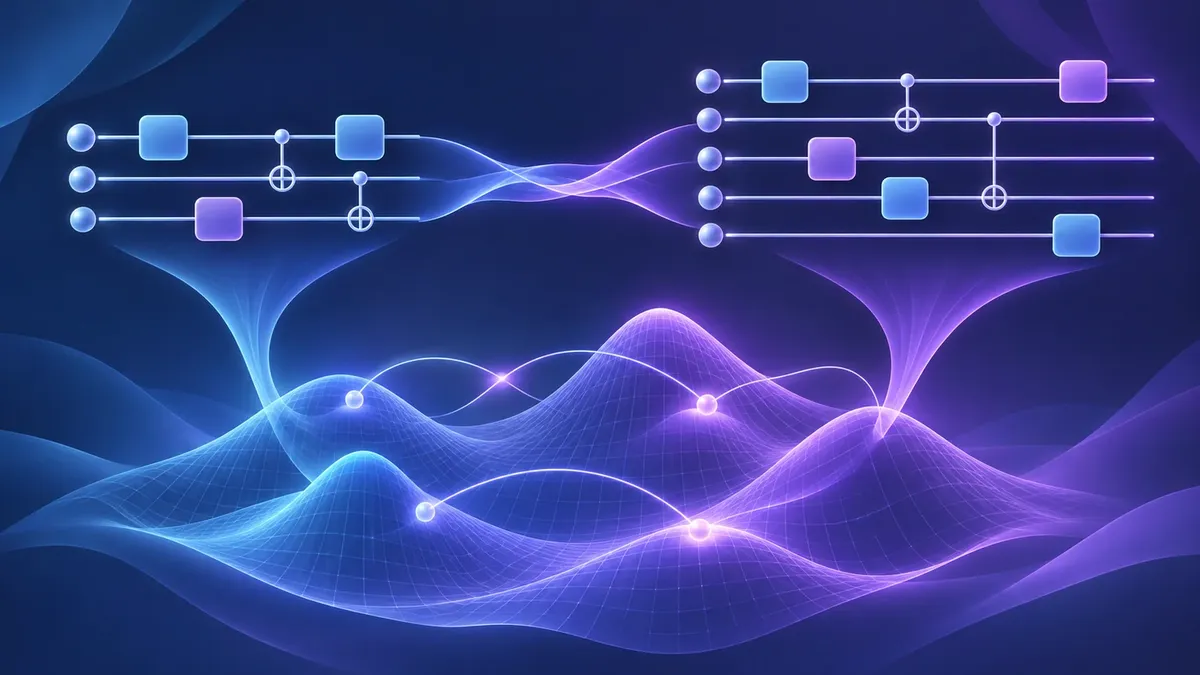
Quantum circuits become harder to search as the number of qubits grows. A new reinforcement-learning method aims to make that search transferable by reusing a shared representation of circuits, rather than carrying an agent’s learned network into a larger problem. The reported results concern a specific test task, and the available evidence here is an arXiv abstract, not a full paper review.
Designing a quantum circuit can mean searching through many possible arrangements of gates to find one that performs a desired task. Reinforcement learning can guide that search: an agent tries choices, receives feedback, and learns which choices are useful. But transferring that learning to circuits with more qubits is difficult. The agent’s description of the problem, its available actions and often its neural network all grow as the system grows.
In LatentRL-QAS, Maria Ilektra Plakitsi, Sebastian Feld and Akash Kundu propose a way to separate the agent’s search machinery from the number of qubits. Their method represents circuits in a shared “latent space”—a learned representation that allows circuits with different numbers of qubits to be handled within the same framework.
Searching in a shared representation
The method uses a circuit variational autoencoder. The abstract says it encodes a circuit as one token per gate and maps circuits with any number of qubits into the same latent space. It does not provide further detail about how the representation is trained or reconstructed.
Rather than choosing and adding gates directly, the reinforcement-learning agent navigates this space. According to the abstract, this keeps the agent’s state, action set and network the same size across qubit counts. The latent space is periodically refreshed with circuits the agent has newly discovered. When moving to a larger system, it is grown using solutions from a smaller one.
This differs from copying a trained neural network or replaying an agent’s past experience. The authors describe the transferable element as the circuit representation itself. The agent can thus search within a representation intended to span different system sizes.
A test with highly entangled states
The researchers evaluate the method by searching for absolutely maximally entangled (AME) states. The abstract identifies these states as a resource for quantum error correction, but does not define their mathematical properties.
The abstract reports that LatentRL-QAS discovered five- and six-qubit AME states without being shown them in advance. It says the method prepared them in 89–99% of evaluation episodes. Under the same search budget, the baseline RL-QAS method did not find them, even when its network was 10 to 17 times larger.
The authors also report that LatentRL-QAS remained robust under depolarizing noise, with single-qubit gate errors amplified tenfold and two-qubit gate errors fivefold relative to IBM quantum hardware. The abstract does not say whether this evaluation used a simulation or hardware, so its setting cannot be specified more precisely from the available source.
What the result does—and does not—show
The central result is a proof of concept for transferring a circuit representation across two system sizes on one specific search task. It does not establish that the approach will work equally well for other quantum optimization problems, circuit families or substantially larger systems. Nor does the abstract provide enough detail to assess the exact training setup, statistical variation, computational costs or how broadly the baseline comparison applies.
That qualification matters because the source available for this article is the paper’s abstract only. The work is listed as an arXiv preprint, and the supplied material does not establish whether it has been peer reviewed. The reported results are best treated as preliminary claims pending examination of the full paper and independent follow-up.
If the approach generalizes, a shared latent representation could help quantum architecture search build on earlier searches rather than start afresh when the number of qubits changes. For now, the evidence supports a narrower conclusion: in the authors’ AME-state tests, LatentRL-QAS transferred across five- and six-qubit cases and succeeded where the stated baseline did not, under the reported budget.
- quantum computing
- quantum architecture search
- reinforcement learning
- quantum circuits
- latent representations
- quantum entanglement
Reviewed cross-references
These connections were reviewed by a model, not independently fact-checked by a human. Similarity does not imply agreement; consult the original papers and the evidence below.
Quantum error correction that adapts as noise drifts
Shared method: Both papers use reinforcement learning in quantum-circuit design: LatentRL-QAS searches for circuits preparing AME states, described as a resource for quantum error correction, while Guatto et al. use multi-agent reinforcement learning to construct complete QEC cycles. The tasks and RL frameworks differ, so this establishes a methodological connection, not comparable performance or evidence that one method benefits the other; these selected preprint excerpts do not establish how representative either application is.
Model review: · openai-codex/gpt-6-luna
Evidence and provenance
Selected excerpts, not complete papers. PDF extraction can omit figures or damage equations, tables and reading order; sources may be preprints.
2611.34634v1 — Original paper
Excerpt reference:
static/papers/2611.34634v1.md:13-50
Basis: Paper text
Source SHA-256:71865fe8ad1e8d4dcba56f5697516e3e3eab0996caf49f3961a76e63874cff1b2509.03974v3 — Original paper
Excerpt reference:
static/papers/2509.03974v3.md:166-261
Basis: Paper text
Source SHA-256:2b39b4f4981db9427f4cfb61c9f450590b7fdedff5f02e2077a80883aca7cc02
Related reading
Automatically matched by shared topic keywords. These links do not imply that the sources agree or establish a consensus.
RubriQ teaches AI to favor cheaper correct quantum circuits
Source published
Shared keywords: quantum circuits, quantum computing, reinforcement learning
Quantum error correction that adapts as noise drifts
Source published
Shared keywords: quantum circuits, quantum computing, reinforcement learning
A quantum model aims to rethink Transformer design
Source published
Shared keywords: quantum computing, reinforcement learning
When does neutrino entanglement matter? Quantum simulations test the limits
Source published
Shared keywords: quantum computing, quantum entanglement
Can an AI Reuse Advice from Similar Situations?
Source published
Shared keywords: latent representations, reinforcement learning