TRANSMISSION // 2611.34625v1
Red-clump stars reveal a moving Milky Way warp
Source published
Red-clump star motions point to a rapidly precessing Milky Way warp whose kinematic signature is offset from the position-based estimate. Its detailed shape remains uncertain.
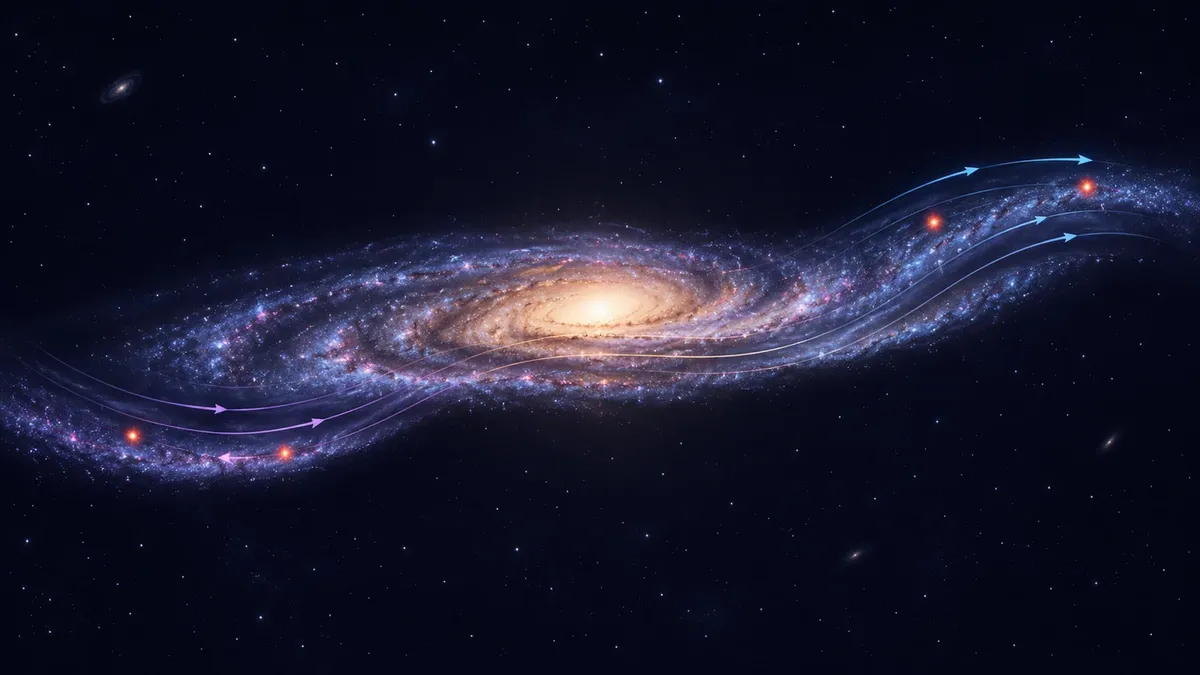
The Milky Way’s disc is bent, and different stars can trace its shape differently. James E. Turner and Paul J. McMillan examine the motions of red-clump stars to investigate whether the Galaxy’s warp is changing over time—and how its motion compares with the warp mapped from stellar positions.
The Milky Way is not a perfectly flat disc. Its outer regions bend above and below the central plane, and astronomers can trace that bend using different populations of stars. Because those populations vary in age and history, they may not trace the same warp in the same way. This study asks what red-clump stars’ motions reveal, and whether that motion matches the warp inferred from the stars’ positions.
Red-clump stars are at a stage of stellar evolution that makes them useful “standard candles”: their brightness helps astronomers estimate their distance. They span a broad range of ages. Selecting this kind of star across the disc provides a more consistent population for comparison than a mixed sample, though it does not mean all the stars have the same age.
Mapping the warp through motion
Turner and McMillan use a previously compiled catalogue of red-clump stars selected with Gaia Data Release 3 measurements and AllWISE infrared photometry. After quality and location cuts, the catalogue contains about 8.7 million stars. Infrared data can help with distance estimates in dusty regions, where visible light is obscured. Dust still creates uneven gaps in the map, making it difficult to infer the warp’s shape from positions alone.
Instead, the researchers focus on average vertical velocity: whether stars are moving up or down relative to the Galactic plane. They compare those measurements with models that represent the disc as a series of tilted rings. One model holds the warp’s orientation and precession rate constant across the disc; another allows both to vary with distance from the Galactic centre. The team fits the models to measurements grouped by radius and direction, using a statistical sampling method to estimate parameters that best match the data.
Some stars lack measured line-of-sight velocities—their motion toward or away from Earth. To extend the map, the researchers estimate these velocities for many stars by assuming that their average motion toward or away from the Galactic centre is zero. This raises the sample’s effective coverage of full three-dimensional positions and motions to 96 percent. It is an assumption, not a direct measurement. The authors test its effects using simulated catalogues and describe circumstances in which it may be less reliable.
A fast precession, but uncertain geometry
Both models reproduce some observed vertical-motion patterns, particularly across part of the disc. In the model with a single precession rate, the fitted rate is about 12 kilometres per second per kiloparsec. Precession means that the orientation of the warp changes over time. When the rate is allowed to vary with radius, the fitted values suggest a rate of about 15 near 10 kiloparsecs, declining to about 12 near 17 kiloparsecs.
The warp’s motion does not line up with the warp inferred from red-clump stars’ positions. The line of nodes—the line where the warped disc crosses its otherwise flat midplane—is offset by about 50 degrees between the kinematic and position-based estimates. The authors describe the velocity signature as leading the position-based one. This mismatch supports the view that the warp is dynamically evolving, rather than being adequately described by a fixed shape alone.
The models indicate that the warp’s amplitude continues to increase out to the greatest radius they probe, 16 kiloparsecs. That result is limited to the sampled range; it does not establish what happens farther out. The detailed geometry is also unsettled. A global model that allows the warp to twist produces a different twist direction from fits made separately in radial bands. The authors say this inconsistency makes it difficult to establish confidently how the line of nodes changes across the disc. Their simple models may also miss the warp’s unevenness and other structures, such as corrugations.
Limits and open questions
The velocity approach is less hampered by dust than mapping positions, but it has its own limitations. Some velocities are estimated under the zero-average-radial-motion assumption, and the analysis simplifies the Galaxy’s complex motions. In particular, the authors note that the Milky Way’s phase-space spiral—a pattern in stellar positions and velocities—may make average vertical velocity an incomplete description. The models also struggle to match some measurements at the edges of the sampled directions.
The results support a dynamically evolving warp, but they do not identify its cause. The authors discuss possible influences such as companion galaxies or a misaligned dark-matter halo; this study does not determine which, if any, produced the warp. A clearer account will require understanding stellar positions and motions together, despite dust-obscured regions.
The supplied paper is a preprint. Its text includes an “Accepted XXX” placeholder and does not establish publication or peer-review status. The findings should be read as the authors’ analysis, with its modelling choices and stated uncertainties in view.
- Milky Way
- galactic warp
- red-clump stars
- stellar kinematics
- Gaia
- galactic dynamics
Reviewed cross-references
These connections were reviewed by a model, not independently fact-checked by a human. Similarity does not imply agreement; consult the original papers and the evidence below.
Gaia data reveal a vast map of aging Milky Way stars
Supporting evidence: Both studies report that Milky Way warp properties differ among stellar populations: Turner and McMillan find the red-clump velocity-signature line of nodes offset by over 50° from that inferred from positions, while Kushwahaa et al. report that intermediate-age carbon-rich AGB stars appear to trace larger warp amplitudes than Cepheids. These are compatible indications of population-dependent warp structure, but compare different tracers and different measurements, and do not establish a common cause.
Model review: · openai-codex/gpt-6-luna
Evidence and provenance
Selected excerpts, not complete papers. PDF extraction can omit figures or damage equations, tables and reading order; sources may be preprints.
2611.34625v1 — Original paper
Excerpt reference:
static/papers/2611.34625v1.md:1236-1302
Basis: Paper text
Source SHA-256:4e10329fade275127de252c8503617cd5d034ccb79d6e66c245ee1d75688177e2611.26701v1 — Original paper
Excerpt reference:
static/papers/2611.26701v1.md:2152-2216
Basis: Paper text
Source SHA-256:5154348610aa5fa4177f3bde9c62644bd91ce65a297d845da4f4401eba904191
Related reading
Automatically matched by shared topic keywords. These links do not imply that the sources agree or establish a consensus.
Finding Star Clusters Behind the Milky Way’s Dust
Source published
Shared keywords: galactic warp, milky way
Distant stars help researchers weigh the Milky Way
Source published
Shared keywords: galactic dynamics
Reading the Milky Way’s gravity in a spiral of stellar motions
Source published
Shared keywords: galactic dynamics, milky way
Can Gaia’s stars map the dark matter around the Sun?
Source published
Shared keywords: milky way, stellar kinematics
Milky Way stars reveal chemistry and motion don’t tell the same story
Source published
Shared keywords: milky way, stellar kinematics