TRANSMISSION // 2611.34592v1
SS 433’s Western Jet Shows Little Detectable X-ray Polarization
Source published
IXPE observations find the western head of SS 433’s jet is less polarized in X-rays than the eastern head. The contrast may reflect differences in magnetic-field order, but its cause is uncertain.
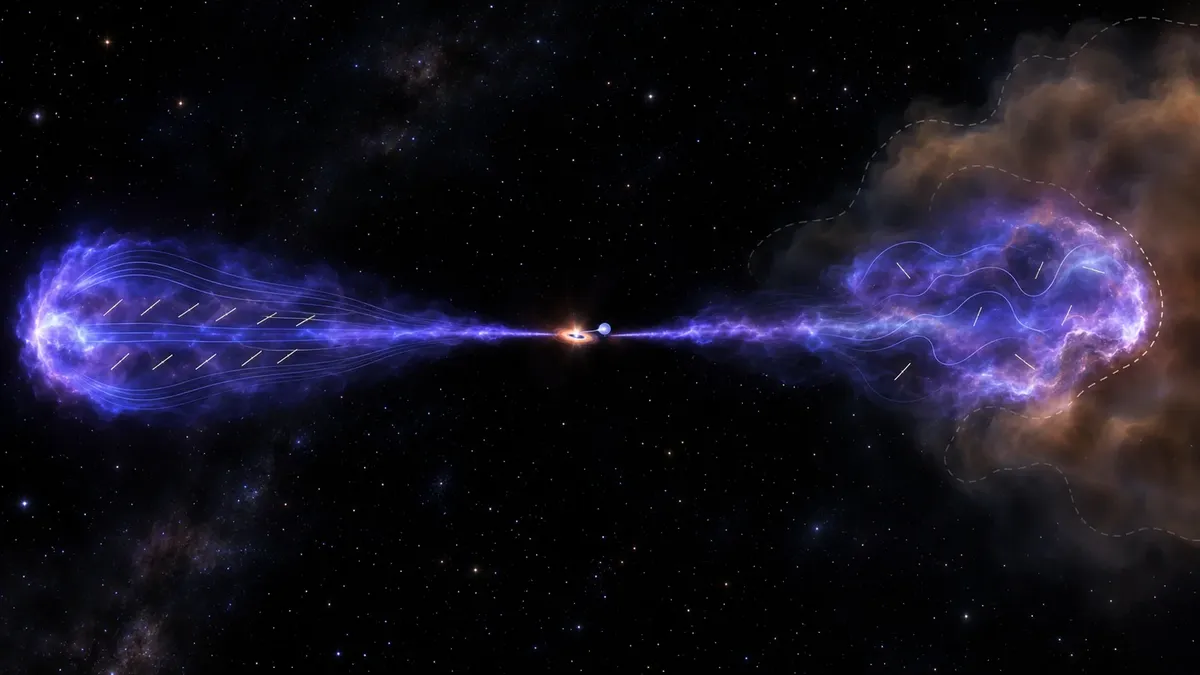
The two distant lobes of the microquasar SS 433 glow in X-rays, but do their magnetic fields look similarly organized? A new analysis of IXPE observations finds no significant X-ray polarization from the western lobe’s bright head—and reports that its polarization is lower than the eastern head’s.
SS 433 is a binary system that launches two opposing jets into the surrounding supernova remnant W50. Far from the binary, each jet brightens in a region called its head. These regions emit hard X-rays thought to come from energetic electrons spiraling through magnetic fields. Measuring the X-rays’ polarization can help astronomers infer whether those fields have a preferred, orderly direction or are more tangled.
Earlier IXPE observations found strong polarization from the eastern head, consistent with an ordered magnetic-field component. The new study asks whether the western head behaves the same way. The authors analyzed observations from April and October–November 2025 with NASA and Italian space agency’s Imaging X-ray Polarimetry Explorer (IXPE), which measures X-ray polarization. They compared the western result with the previously reported eastern measurement.
Making a faint signal easier to measure
The western source is faint against background X-rays and instrumental noise. The team first used a Chandra X-ray image to define candidate source regions, then chose one that gave the best expected sensitivity for IXPE in the 2–5.5 kiloelectronvolt energy band. In that region, the authors estimate that only about 30% of the recorded counts came from the astrophysical source; the rest were background.
They applied three approaches to estimate polarization. A basic analysis found no detection. A spectropolarimetric fit, which models the energy response and background, also found no detection. Their main result comes from a weighted analysis: it uses information about where events occurred and whether their detector tracks look more like photons or charged particles. Rather than simply discarding events classified as likely particles, this method assigns them weights, aiming to reduce loss of real photons and bias from residual background.
The weighted fit estimated polarization at 1.4%, with a formal uncertainty of 12.5%. In practical terms, the data do not establish that the western head is polarized: its measured polarization is consistent with zero. The analysis sets an upper limit of 32% at 99% confidence. That limit is important context: “consistent with zero” does not prove the polarization is exactly zero.
A difference between the two heads
The authors compared probability distributions for the eastern and western polarization estimates. In 99.5% of their paired draws, the western value was lower. They describe this as a 99.5%-confidence difference (2.8 sigma). The eastern head’s reported central polarization is near 50%, whereas the western measurement remains too uncertain to pin down a precise value.
Polarization offers an indirect view of magnetic structure. When emission from many regions has differently oriented polarization, the signals can partly cancel, leaving a low net polarization. The western result could therefore indicate a less ordered magnetic field than in the east—but the measurement does not map the field in detail or identify a unique cause.
The paper discusses environmental explanations. The western lobe is shorter and lies in a region the authors infer to be denser than the eastern side. They suggest that stronger interaction with surrounding material could stir the magnetic field. They also point to observations of molecular gas near both heads: the western gas clump lies upstream of the X-ray-bright region, a geometry they say could fit a more direct jet–cloud interaction and increased turbulence. These are proposed interpretations, not demonstrated mechanisms.
What remains open
The result depends on extracting a weak polarization signal from data dominated by background, and the reported upper limit shows that substantial polarization is not ruled out. The comparison with the eastern head is statistical evidence for a difference, not a direct measurement of why the lobes differ. Further observations and modeling will be needed to test whether environment, jet dynamics, or another factor explains the contrast.
This article describes a preprint: although its acknowledgments mention referee comments, the supplied source does not establish the publication status of this version. The findings should be read as the authors’ reported analysis rather than as settled consensus. The paper is available at arXiv:2611.34592v1.
- SS 433
- X-ray polarization
- IXPE
- astrophysical jets
- magnetic fields
- W50
Reviewed cross-references
These connections were reviewed by a model, not independently fact-checked by a human. Similarity does not imply agreement; consult the original papers and the evidence below.
X-ray polarization hints at turbulence around SS 433’s eastern jet
Shared method: Both studies use IXPE polarization analyses with event weighting: the western-lobe study describes spatial and particle/photon weights, while Fan et al. describe particle and spatial weighting for the eastern jet. The implementations and fitted regions differ, so this is a methodological connection, not a direct comparison of polarization results.
Model review: · openai-codex/gpt-6-luna
Evidence and provenance
Selected excerpts, not complete papers. PDF extraction can omit figures or damage equations, tables and reading order; sources may be preprints.
2611.34592v1 — Original paper
Excerpt reference:
static/papers/2611.34592v1.md:12-55
Basis: Paper text
Source SHA-256:010c567f8e93efadbecc2bd9e2d3d369af175e130b4b4306d7c589cce8ba08a02611.03846v2 — Original paper
Excerpt reference:
static/papers/2611.03846v2.md:75-139
Basis: Paper text
Source SHA-256:b3b5596478e46b3641d7c22028445b60d54d827fbbfc45dca636565bb52e3fb32611.03846v2 — Original paper
Excerpt reference:
static/papers/2611.03846v2.md:575-643
Basis: Paper text
Source SHA-256:b3b5596478e46b3641d7c22028445b60d54d827fbbfc45dca636565bb52e3fb3
Related reading
Automatically matched by shared topic keywords. These links do not imply that the sources agree or establish a consensus.
X-ray polarization hints at turbulence around SS 433’s eastern jet
Source published
Shared keywords: astrophysical jets, ss 433, x ray polarization
A gamma-ray rhythm around SS 433 came and went
Source published
Shared keywords: ss 433
LMC X-1’s X-ray polarization changes with its orbit
Source published
Shared keywords: x ray polarization
X-ray polarization narrows the possible shapes of Cygnus X-1’s corona
Source published
Shared keywords: x ray polarization
Tracing X-ray polarization to probe a black hole’s surroundings
Source published
Shared keywords: x ray polarization