TRANSMISSION // 2611.34577v1
How a laboratory makes and measures interstellar ice
Source published
A study of the COSPINU2 laboratory setup finds that water-ice growth conditions affect signs of porosity and optical properties, while chamber pressure alone can mislead.
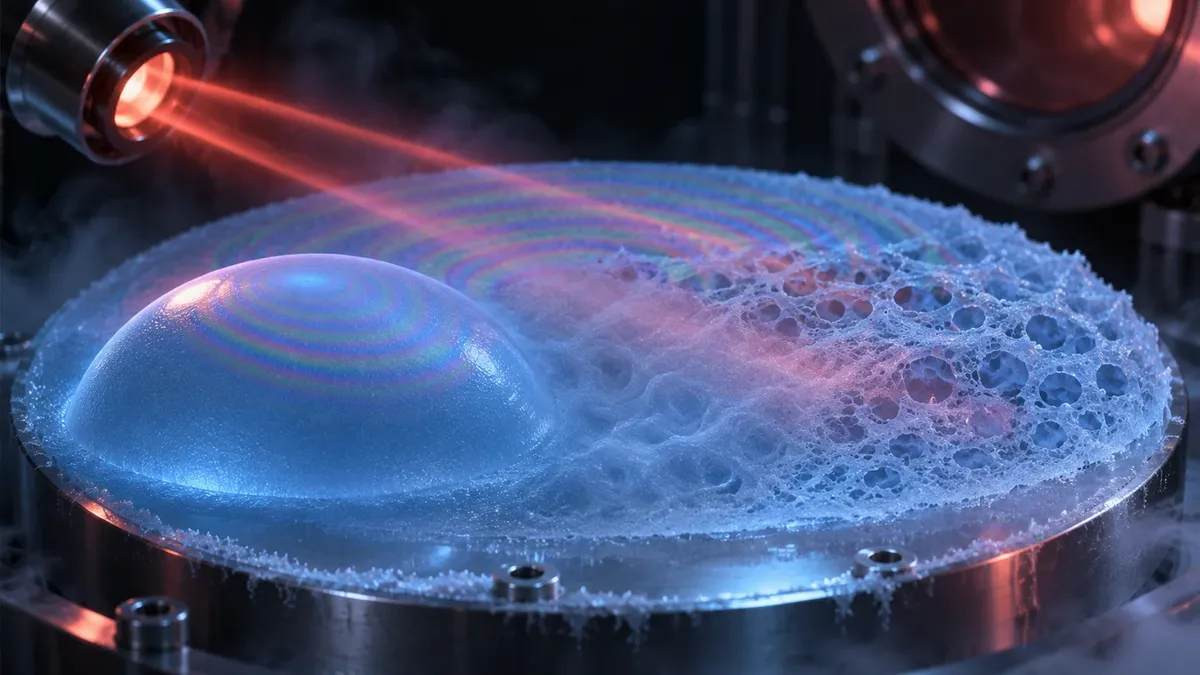
Water ice in space is not always a neat, compact coating. Its structure depends on how it forms, and that structure can affect how other molecules interact with it. In experiments with the COSPINU2 setup, colder and faster-grown films showed signs consistent with greater porosity; some thick, porous films also changed abruptly as they grew.
Amorphous solid water (ASW) is water ice without the ordered crystal structure familiar from snowflakes. In cold space, it makes up much of the ice coating dust grains. Its internal pores and surface area can influence how other molecules stick, move and react. But laboratory ice is shaped by the conditions used to grow it, so measurements from one experimental setup may not automatically describe ice made in another.
Delfina Toulouse and colleagues ask a practical question: what kinds of water ice does the COSPINU2 laboratory apparatus produce under different growth conditions, and how reliably can those films be characterized? They present the work as a benchmark for the setup, which is intended for future experiments on ice and hydrogen molecules and for studies of ice’s optical properties.
Several ways to inspect a growing film
COSPINU2 combines a cryogenic, ultra-high-vacuum chamber with several measurement tools. The team used infrared spectroscopy to probe the ice’s molecular bonds, laser interference to estimate optical properties and film thickness, imaging to map the film’s shape, and a mass spectrometer to monitor gases released during heating. These methods provide different clues: interference depends on film thickness and refractive index, while particular infrared features can indicate under-coordinated water molecules associated with internal surfaces.
The researchers compared two ways of depositing water. In background deposition, vapor enters the chamber and can settle on the substrate and other cold surfaces. In doser deposition, a tube directs vapor toward the substrate. The doser limits growth elsewhere in the chamber, but blocks direct optical monitoring during deposition, so some measurements are made afterward.
For background-grown films, the team compared interference signals at two angles to estimate the refractive index near 633 nanometers. They then used near-infrared interference fringes to determine thickness. Mid-infrared spectra provided additional structural indicators. For doser-grown films, interference patterns in optical images helped reconstruct a dome-shaped thickness profile.
Growth conditions leave measurable clues
In background-grown films, lower deposition temperatures and faster growth generally produced lower refractive indices and stronger “dangling-OH” infrared features. These observations are consistent with more porous ice: rapidly arriving molecules may have less time to settle into denser arrangements, while warmer deposition allows more rearrangement. The dangling-OH features are useful indicators of internal surfaces, but they do not provide a direct numerical measurement of porosity. Optical interference also affects their measured intensity, especially in thick films.
The study identifies an important measurement trap. Converting the chamber’s pressure reading into a density for background-grown ice gave implausibly low estimates. The authors attribute the mismatch to cryopumping: cold parts of the apparatus capture water vapor, so the pressure reading does not directly reflect the molecular flow reaching the substrate. Pressure remains useful for tracking and reproducing deposition conditions, but it cannot, by itself, establish the film’s density in this geometry.
Doser-grown films presented a different challenge. They formed a localized dome rather than a uniform coating, so thickness varied across the substrate. The researchers combined image-based thickness maps with an independent thickness measurement near the dome’s center. Their density estimates also depended on correcting for vapor that escaped beyond the finite substrate. That correction uses an extrapolated volume, not a directly measured one, so the resulting values are effective estimates rather than a simple weighing of ice on the substrate.
Porous ice can change suddenly
In some thick, low-temperature films, the researchers saw abrupt changes during or after deposition: interference contrast dropped, the surface scattered more light, and infrared features shifted toward those associated with a more compact structure. Signals from independent optical paths changed together, supporting the interpretation that the ice itself had restructured rather than the effect being only a detector artifact.
The observations are consistent with partial collapse, cracking or reorganization of a porous network, but they do not establish a single mechanism. Restructuring appeared in faster-growing background films at thicknesses of a few micrometers; slow growth showed no such event within the range examined. In doser-grown ice, changes were concentrated near the thickest, fastest-growing center of the dome. These patterns point to growth rate, local thickness and deposition conditions as relevant factors, without isolating precisely how each contributes.
The authors conclude that COSPINU2 can combine several measurements to build a more complete picture of laboratory ice than any one diagnostic alone. This is groundwork for future experiments, not a direct measurement of interstellar ice: the films are laboratory analogues grown on a specific substrate in a particular apparatus. The findings are reported in an arXiv preprint and may not have undergone peer review. The authors state that supporting data are available from the corresponding author upon reasonable request.
- amorphous solid water
- interstellar ice
- laboratory astrophysics
- ice porosity
- infrared spectroscopy
- COSPINU2
Reviewed cross-references
These connections were reviewed by a model, not independently fact-checked by a human. Similarity does not imply agreement; consult the original papers and the evidence below.
Dust-like surfaces sharply reduce UV-driven ice loss in laboratory tests
Supporting evidence: Toulouse et al. report that deposition conditions alter ASW porosity indicators, including refractive indices and dangling-OH signatures; Parent and Laffon report that particulate substrate morphology is associated with reduced UV photodesorption from thin water ice. Together these results support the bounded point that ice-related measurements can depend on physical structure, but they concern different ice structures, substrates, and outcomes and do not establish a shared mechanism.
Model review: · openai-codex/gpt-6-luna
Evidence and provenance
Selected excerpts, not complete papers. PDF extraction can omit figures or damage equations, tables and reading order; sources may be preprints.
2611.34577v1 — Original paper
Excerpt reference:
static/papers/2611.34577v1.md:819-902
Basis: Paper text
Source SHA-256:a7be233771b58a395e08cb3d2a8a98e9505627450790340d23d3f50467c345062611.09308v1 — Original paper
Excerpt reference:
static/papers/2611.09308v1.md:490-544
Basis: Paper text
Source SHA-256:1a8f2121a8a9d5383d7e813e4a03013e6c294b09d2685a8178728bb7dd8a3e7a
Related reading
Automatically matched by shared topic keywords. These links do not imply that the sources agree or establish a consensus.
Dust-like surfaces sharply reduce UV-driven ice loss in laboratory tests
Source published
Shared keywords: laboratory astrophysics
Can Electron Radiation Help Glycine Form Peptide Bonds in Space?
Source published
Shared keywords: interstellar ice
A lab test of UV-driven release from CO₂ ice
Source published
Shared keywords: interstellar ice
A giant planet’s heavy hydrogen points to unusually cold building blocks
Source published
Shared keywords: interstellar ice
Infrared spectra reveal contrasting gas regions in nova V5668 Sgr
Source published
Shared keywords: infrared spectroscopy