TRANSMISSION // 2611.34554v1
Why single photons can build interference fringes
Source published
Lecture notes distinguish the phase fixed by an optical mode from the phase of a photon’s quantum state to explain single-photon interference fringes.
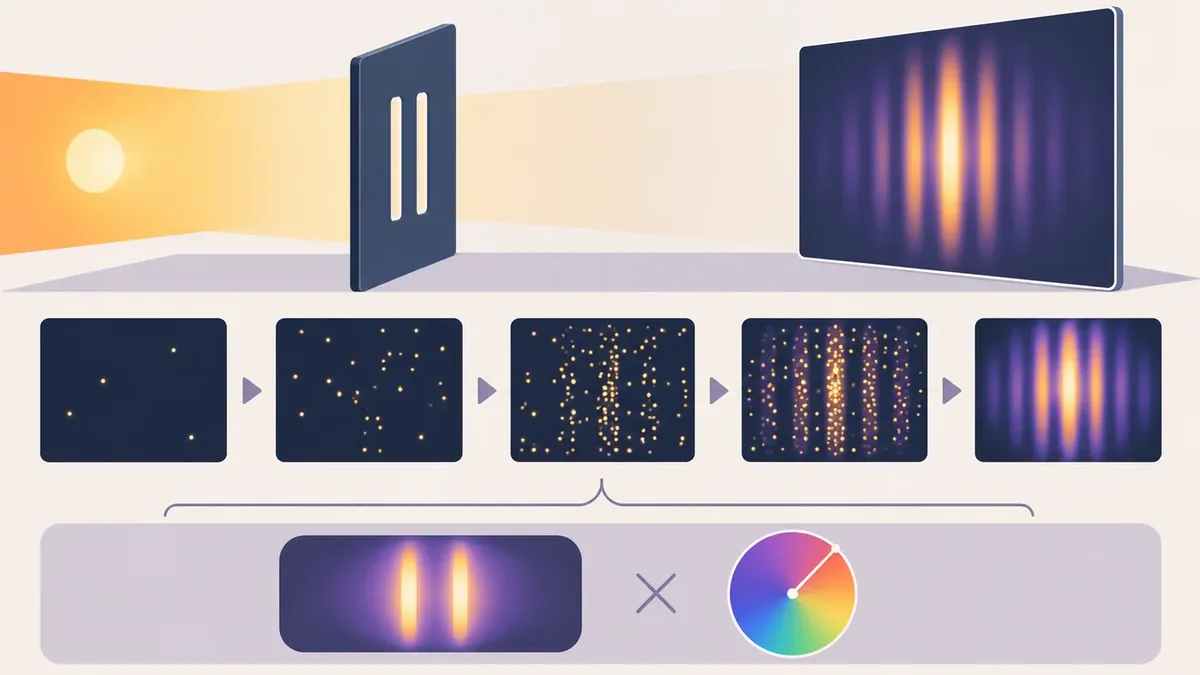
If a photon-number state has no definite phase, why can photons sent one at a time through two slits still build an interference pattern? Andrea Aiello’s lecture notes address the puzzle by distinguishing two meanings of “phase.”
The familiar two-slit pattern raises a question: a photon-number state—a state with a definite number of photons—has no completely determined phase. Yet photons sent through a two-slit apparatus one at a time can produce detection events that build up into fringes. How can this happen without a definite phase belonging to each photon-number state?
Andrea Aiello’s lecture notes, Why do single photons produce interference fringes? The phase of a mode and the phase of a state, offer an explanation based on separating two meanings of “phase.” One is the phase of a mode, which the abstract says is fixed by the optical setup. The other is the phase of the quantum state that excites that mode. The notes’ central claim is that the mode’s phase—not a definite phase of the photon-number state—determines the fringes.
The notes build the explanation from first principles. As described in the abstract, they start with Maxwell’s equations, expand the electromagnetic field in vector modes, quantize the field, and introduce the quantity measured by a photodetector. They then distinguish mode phase from state phase and show how this distinction answers the question about interference. The author says the calculations are given in full and that the notes include problems with solutions.
This is a theoretical explanation, not a report of a new two-slit experiment. Its focus is conceptual: the presence of fringes does not, in the author’s account, require photon-number states to have a definite quantum phase. Instead, the optical setup fixes the phase associated with the mode, and that is the phase identified as determining the interference pattern.
The evidence available for this article is the paper’s abstract, rather than its full text. It does not provide the detailed derivation or enough information to assess the detector treatment, so those details cannot be evaluated here. The source record identifies the work with arXiv, but the supplied material does not establish its publication or peer-review status. The explanation should therefore be understood as the author’s account in lecture notes, not as an independently assessed experimental result.
- single-photon interference
- quantum optics
- photon-number states
- optical modes
- phase
Reviewed cross-references
These connections were reviewed by a model, not independently fact-checked by a human. Similarity does not imply agreement; consult the original papers and the evidence below.
A crystal that makes its own quantum-interference state
Supporting evidence: Aiello’s lecture notes state that a single-mode excitation can produce fringes with visibility set by the geometry. Bajo et al. report highly indistinguishable photon pairs, a single-mode approximation, and two-photon interference fringes in their 3R-MoS₂ experiment. This is compatible evidence that mode coherence matters for interference, but the experiment concerns polarization-entangled photon pairs, not single-photon two-slit fringes.
Model review: · openai-codex/gpt-6-luna
Evidence and provenance
Selected excerpts, not complete papers. PDF extraction can omit figures or damage equations, tables and reading order; sources may be preprints.
2611.34554v1 — Original paper
Excerpt reference:
static/papers/2611.34554v1.md:198-267
Basis: Paper text
Source SHA-256:29460a787b292b7b62290f9eead866b12cf5e81e7ddcad8f63cef8c07224241f2611.34701v1 — Original paper
Excerpt reference:
static/papers/2611.34701v1.md:639-703
Basis: Paper text
Source SHA-256:a7cd8c64d902e9788d95e9c173d27a31a3d2667deaa501c2b1971dac7e390531
Related reading
Automatically matched by shared topic keywords. These links do not imply that the sources agree or establish a consensus.
A crystal that makes its own quantum-interference state
Source published
Shared keywords: quantum optics
How excited atoms could squeeze light during harmonic generation
Source published
Shared keywords: quantum optics
How Chiral Transmons Reshape Light in a Waveguide
Source published
Shared keywords: quantum optics
How quantum-light fluctuations reshape harmonic generation
Source published
Shared keywords: quantum optics
Can one photon make a better quantum sensor?
Source published
Shared keywords: quantum optics