TRANSMISSION // 2611.34548v1
When a star’s disk behaves like a tilting frisbee
Source published
Some rapidly rotating stars are surrounded by disks of gas. A study of archival spectra and brightness records examines signs that these disks can tilt or warp, while emphasizing that the evidence is uneven and the mechanism remains uncertain.
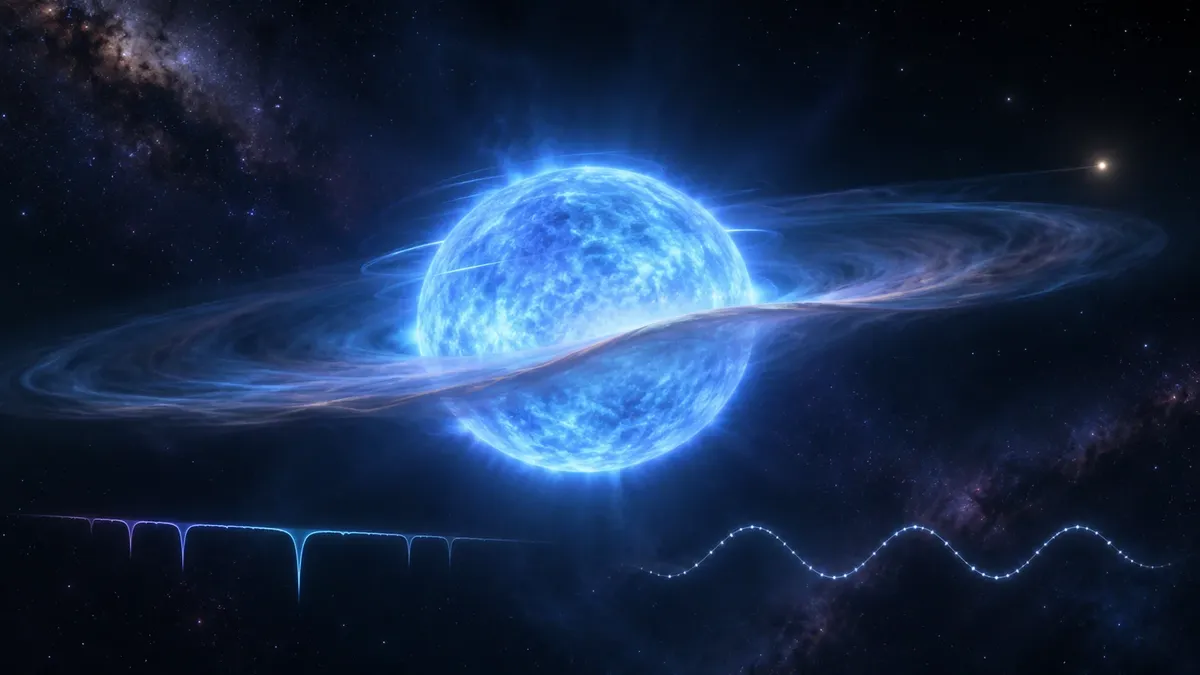
Be stars are fast-spinning stars ringed by gas. Their disks are usually treated as aligned with the star’s equator—but some observations suggest that a disk can temporarily tip or bend. Astronomers Dietrich Baade, Jonathan Labadie-Bartz and Thomas Rivinius examine possible examples, and ask what the evidence can—and cannot—show.
A Be star is a rapidly rotating star surrounded by a disk of gas shed by the star. The disk can leave fingerprints in a star’s spectrum and brightness. If the disk’s orientation changes, those fingerprints may change too—rather like seeing a frisbee from a different angle. But a changing signal does not automatically mean the whole disk has tilted: a thicker disk or a burst of mass loss could produce some similar effects.
In this study, Dietrich Baade, Jonathan Labadie-Bartz and Thomas Rivinius gather published observations and public records, including spectra from the Be Star Spectra database and long-term photometry. They look for two proposed clues: temporary “shell” absorption features in a spectrum, which can arise when gas crosses the line of sight, and heartbeat-like changes in brightness. The authors compare these clues across several stars, rather than reporting a new observing campaign or a single uniform measurement of disk tilt.
Two clues, with caveats
The clearest cases in the authors’ argument are HD 120678 and Pleione. Both have shown heartbeat-like brightness changes as well as temporary shell features during longer periods when their spectra show emission from surrounding gas. The authors interpret this combination as evidence that a disk can change orientation and, at times, pass across our line of sight. In HD 120678, the brightness dip coincided closely with a shell-like episode. Pleione’s behavior has also been modeled as a long-term cycle involving a companion and a misaligned disk.
Other stars offer less conclusive evidence. PZ Gem had a brief shell episode during a long stretch of emission, but the paper says its disk’s behavior around that event remains unresolved. In V1294 Aql, the authors find possible evidence of a changing orientation in the outer, Hα-emitting region. They distinguish this from the inner disk, whose spectral features appear more stable. A warped disk could therefore produce different-looking signals in different parts of the system.
The authors also discuss heartbeat-like brightness changes in other stars, including AzV 493. Such a light curve may be consistent with a changing disk orientation, but by itself it does not establish that explanation. The term “heartbeat” can be misleading: the better-known heartbeat stars brighten and dim mainly because a star is distorted in an eccentric binary orbit. Here, the proposed explanation is instead a changing view of the circumstellar disk.
That distinction matters because shell absorption is not a unique signature of tilting. In some stars, enhanced mass loss might temporarily puff up a disk enough for it to cross the line of sight, without the entire disk plane moving. The paper specifically urges caution about treating shell episodes alone as proof of a three-dimensional tilt. It also notes that the inner disk contributes much of the visible-light signal, while Hα can trace gas farther out; different regions need not respond in the same way.
A possible trigger, not a demonstrated cause
The authors suggest that a third star, on a strongly inclined orbit or passing close to the Be star, could provide a gravitational nudge. That is a proposed explanation, not a mechanism established by these observations. None of the candidate systems discussed is known to be a triple system, and the authors say further information about stellar companions is needed. They also point out that the candidate list is small, so large disk tilts or warps do not appear common in the cases currently identified.
Most of the named candidates are very hot, early-type stars, with Pleione a notable exception. The authors offer possible reasons for that pattern, including observational bias, but caution that it could be a statistical fluke. It should not be read as evidence that tilting is exclusive to hot stars.
The paper’s value is mainly in assembling and interpreting scattered observations, not in providing a definitive census or directly measuring the cause of each event. Several interpretations remain open, and the authors note that more spectroscopic examples are still being prepared for a separate paper. This article is based on the arXiv version identified as v1; a preprint is a public research manuscript and is not, by itself, a guarantee of peer review or independent confirmation. The authors’ central message is therefore best read as a case for taking disk tilts seriously—and testing them carefully—rather than as proof that every unusual Be-star variation comes from a tilting frisbee.
- Be stars
- circumstellar disks
- stellar variability
- spectroscopy
- binary stars
- astrophysics
Related reading
Automatically matched by shared topic keywords. These links do not imply that the sources agree or establish a consensus.
TESS finds pulsations common in young B-type stars
Source published
Shared keywords: binary stars
How two young stars may draw gas from a shared reservoir
Source published
Shared keywords: binary stars
Weighing a magnetic white dwarf through hot gas and a companion’s motion
Source published
Shared keywords: binary stars
Timing J1912-4410’s slowing white dwarf
Source published
Shared keywords: binary stars
How binaries lose orbital energy to sound
Source published
Shared keywords: binary stars