TRANSMISSION // 2611.34545v1
Can video AI remember what happened before?
Source published
StreamRecall tests whether video models can answer questions using evidence scattered across a live stream. Its authors also propose EviStream, a memory method that keeps selected visual details under a fixed budget.
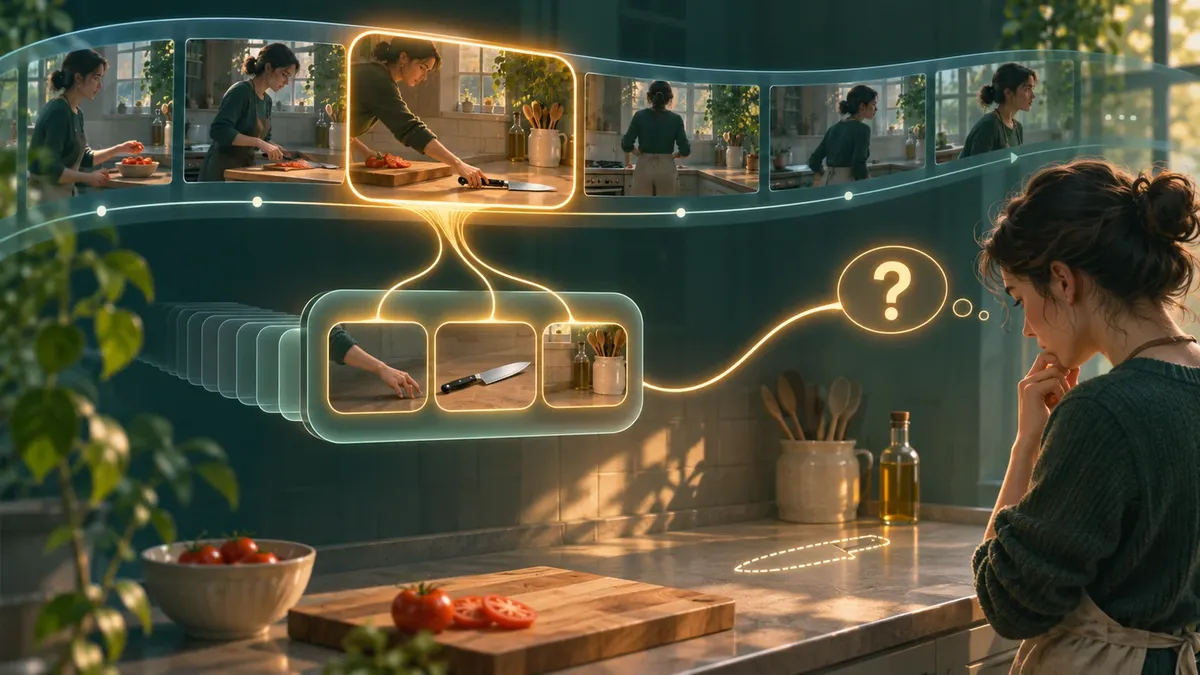
A streaming assistant may need to answer a question now using something it saw minutes ago. A new benchmark and memory method examine whether video AI can preserve, retrieve and connect those earlier clues.
The challenge of answering in the moment
Many video question-answering tests give a model the whole recording before asking a question. But a live assistant cannot rewind freely or inspect future footage. It must respond using what has arrived so far—and may need to connect several events that happened at different times.
Consider someone reaching for a knife while preparing food. To answer a question about where the knife was placed, a system might need to recall an earlier moment, identify the same object and relate that past event to what is happening now. The challenge is not simply recognizing a frame: it is retaining useful history and assembling a chain of evidence without relying on anything that has not yet happened.
The authors introduce StreamRecall, a benchmark designed to test this kind of context-aware reasoning, and EviStream, a method for compressing the visual information a model keeps while a video unfolds. Their paper is a preprint, so its claims should be treated as research results awaiting further scrutiny rather than settled conclusions.
A benchmark built around past evidence
StreamRecall contains 4,983 questions drawn from 462 videos, totaling 136 hours, from EPIC-KITCHENS-100, Assembly101 and Ego4D. The researchers set each question at a point in the video when an information need could plausibly arise. The answer may depend on evidence from earlier moments, rather than only the most recent segment.
Questions cover tasks such as tracking an object, ordering events, comparing durations and following changes in an object's state. The paper describes eight broad reasoning patterns and annotations for the relevant evidence intervals. Human reviewers checked whether questions fit their video context, whether answers were supported, and whether the cited evidence was sufficient. The authors report 14,968 evidence items across the benchmark.
To look beyond whether a model gets an answer right, the authors propose the Evidence Utilization Cascade. It checks a sequence of steps: locating relevant evidence, citing it, assigning it the right role, completing the evidence chain and deriving a supported answer. This distinction matters because a correct answer can result from a guess, while a model may also find some relevant moments but fail to connect them properly.
Compressing visual memory
EviStream aims to preserve useful visual details without keeping every visual token—the model's internal representation of parts of a frame—in its long-term key-value (KV) cache. It processes frames in sequence, detects changes in scene or content, and selects a small set of tokens intended to represent both the current frame and information not already covered by recent visual memory. It also merges some similar, unselected tokens into retained ones. The method is training-free: it does not change the model's learned parameters.
In the reported setup, each frame produces 196 visual tokens, and EviStream retains seven for the KV cache. The authors evaluate it on the benchmark against offline models and other streaming systems, using several answer formats. They report 43.5% overall accuracy for EviStream with Qwen3-VL-8B, compared with 38.1% for the strongest streaming baseline in their table. The larger offline Qwen3-VL-235B model scored 52.1%. The paper also reports lower peak GPU memory and faster time to first token for EviStream than the other streaming methods tested in that comparison.
The results are not uniform across tasks: EviStream ranked first among the streaming systems on five of eight reasoning patterns, while the authors say state-chain and temporal-reasoning questions remained difficult across models. In a component test, removing temporal coverage produced the largest reported accuracy drop. This supports the authors' view that retaining information not represented in recent context matters, but it does not establish that the method will perform similarly on other videos or systems.
What remains uncertain
StreamRecall uses existing activity datasets, and its questions and evidence were created through a mixture of automated tools and human review. That process may leave biases or errors, and familiar, annotated activities may not capture the variety of real-world streams. The paper also notes that EviStream does not reduce the work of the visual encoder: it still produces all 196 tokens before selection. And because discarded visual tokens cannot be recovered, a missed detail may be unavailable to answer a later question.
There is an internal discrepancy in the paper's descriptions of evidence depth: the abstract says questions span 1–11 evidence hops, while the main text and benchmark description say 1–8. The reported results should therefore be read with that inconsistency in mind. More broadly, the findings come from a single preprint and particular benchmark, models and evaluation setup. They suggest a way to study streaming memory and reasoning, not proof that video assistants are ready for dependable use in everyday or high-stakes settings.
- streaming video AI
- video question answering
- StreamRecall
- EviStream
- vision-language models
- AI memory
- temporal reasoning
Reviewed cross-references
These connections were reviewed by a model, not independently fact-checked by a human. Similarity does not imply agreement; consult the original papers and the evidence below.
V-STORM tests whether video AI can connect the evidence it finds
Shared method: Both papers use staged evaluation to separate evidence grounding from later reasoning: StreamRecall’s Evidence Utilization Cascade assesses locating, citing, grounding, completing, and deriving, while V-STORM separately evaluates perception, evidence localization, and compositional reasoning. The stages and tasks are not identical, so this is a methodological parallel, not a direct comparison of results.
Model review: · openai-codex/gpt-6-luna
Evidence and provenance
Selected excerpts, not complete papers. PDF extraction can omit figures or damage equations, tables and reading order; sources may be preprints.
2611.34545v1 — Original paper
Excerpt reference:
static/papers/2611.34545v1.md:318-427
Basis: Paper text
Source SHA-256:13b4a99b065457ea979089d7baac24317c1c732c1450c850bfb46a3d63a33fce2611.09511v1 — Original paper
Excerpt reference:
static/papers/2611.09511v1.md:271-333
Basis: Paper text
Source SHA-256:9059e75b6a44b78ca504416f09c9afb17329cb7f7716429d3e827e2490b3d2c4
Related reading
Automatically matched by shared topic keywords. These links do not imply that the sources agree or establish a consensus.
Can a video be stored in a model’s weights?
Source published
Shared keywords: ai memory, video question answering, vision language models
How VMSA Helps AI Search Hours of Video
Source published
Shared keywords: temporal reasoning, video question answering
Teaching AI What to Remember From Video
Source published
Shared keywords: ai memory, video question answering
When disaster AI may miss the value of earlier images
Source published
Shared keywords: temporal reasoning, vision language models
How VTree builds a reusable memory of long videos
Source published
Shared keywords: video question answering, vision language models